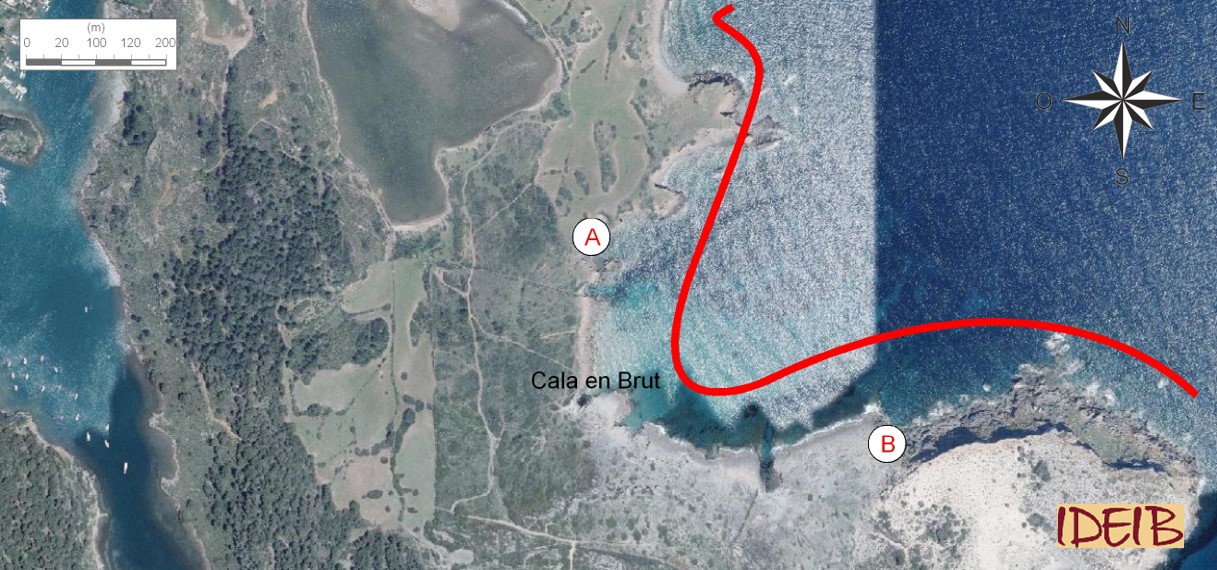
Proposed route to the stopping point.
On the north side of Cala en Brut cove, you can see radiolarites, black lloselles and conglomerates interleaved in the geological series of the Paleozoic made up primarily of sandstones and lloselles. From the sea, the folded levels of radiolarites are particularly striking. They are a rather unique type of rock formed by the accumulation of planktonic organisms called radiolaria, characterised by a silicate skeleton. Radiolaria float in the sea, and when they die, their skeletons are deposited very slowly on the bed. They live in the open sea, far from the talus and are common in warm seas with volcanic activity, which entails the presence of abundant silica in the sea needed for these organisms to survive. The minuscule size of the components that form these rocks means that they are characterised by an extremely slow speed of sedimentation; we can reckon that a thousand years are needed to form a level of just 0.5 cm of radiolarites.
These silicate rocks formed by the accumulation of skeletons of radiolaria are interleaved between fine layers of sedimentary rock which tends to exfoliate in small flakes, similar to sedimentary rock formed by clay.</p></div>">pelite. </p></div>">llosella. They display very well modelled folds as a consequence of the plasticity given to them by these layers of sedimentary rock which tends to exfoliate in small flakes, similar to sedimentary rock formed by clay.</p></div>">pelite. </p></div>">llosella. When the sea cools down, the radiolaria die en masse and a new, solely detrital sedimentary cycle starts, which will end up giving rise to the sedimentary rock which tends to exfoliate in small flakes, similar to sedimentary rock formed by clay.</p></div>">pelite. </p></div>">llosella.
Along with the radiolaria, you can see black masses, which are conglomerates formed from mud outflows, which slid in an underwater environment to become deposited in the great abyssal depths. They gave rise to rather chaotic materials in a fine, black and very abundant matrix, with fossils and cobbles of different compositions, without any type of internal order. All these materials have also been identified at Binimel·là massif and, just like in this area, it is thought that they sedimented on more than one occasion.
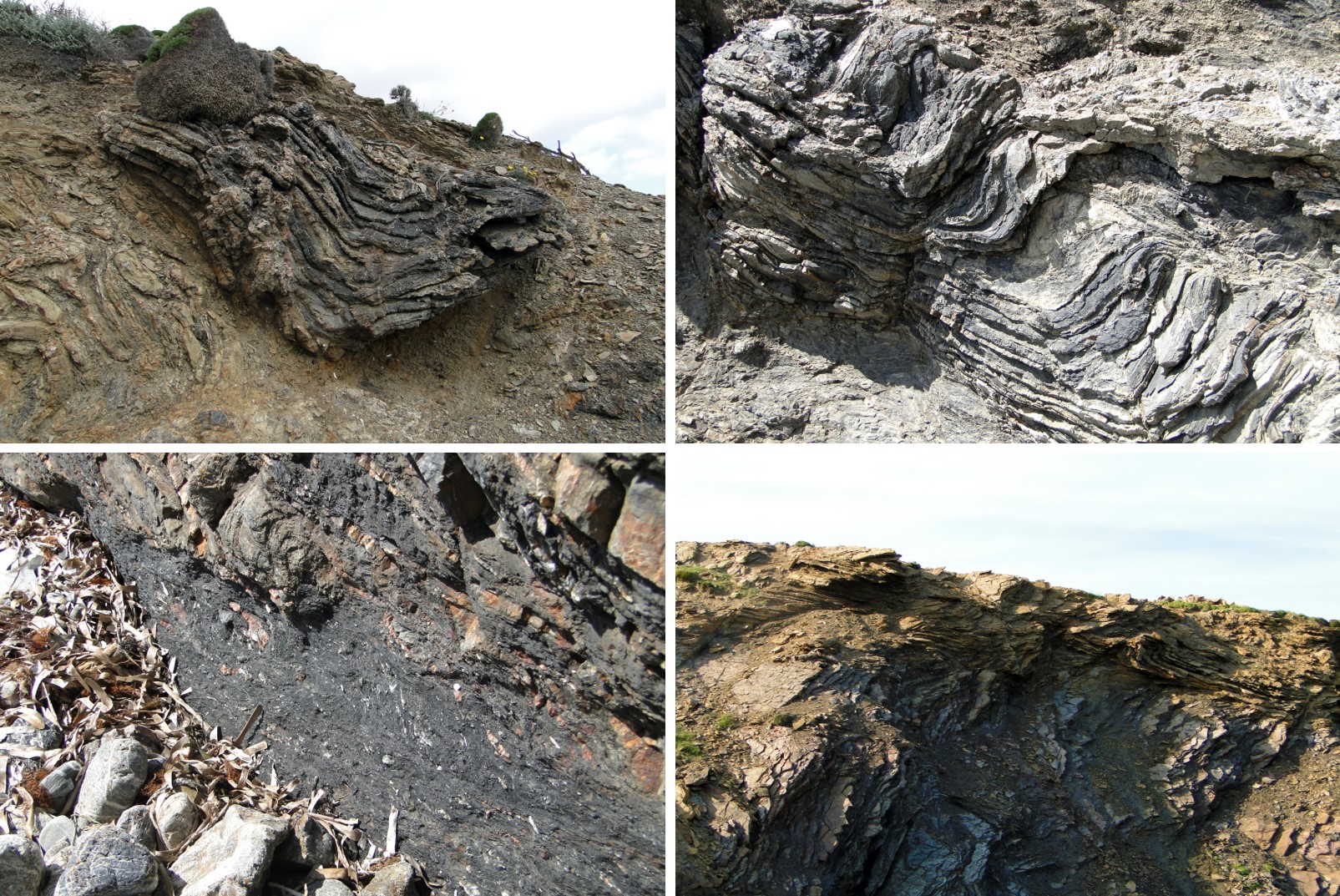
Disorganised levels of folded radiolarites, black lloselles and mud outflows at Cala en Brut cove (point A).
The south of the cove is covered by levels of sand dragged from the seabed at times when the sea level was lower, creating dunes that fossilised over time to create marès. These fossil dunes from the Quaternary were sedimented at various times, as shown by the different position compared with the sea level where they are situated, much higher and older at the Punta de s’Enclusa headland compared with the ones that cover a large part of the lower part and interior of the cove. Around Punta de s’Enclusa, there are abundant blocks fallen from the dune. As they are “modern” rocks, they are not very hard as they have not had enough time to turn into a rock with enough consolidation to prevent the constant falling of blocks that come away from the cliff.

Different levels of fossil dunes in the south of Cala en Brut. At the top of the cliff, the dune (with its lower limit shown in red) is older than the one covering the lower part of the cove and that has darker colourations (with its upper limit marked in yellow). You can see the numerous blocks that have fallen away from the dune situated at the top (point B).
If your boat and the state of the sea allow, we recommend heading for the next stopping point hugging the coastline as much as you can between narrow straits opened up between large fallen blocks and the shore.
