The oldest materials of Mallorca correspond to the Paleozoic era, and more specifically to the Carboniferous period, from over 300 million years ago. These can only be observed in a small sector of the Tramuntana coast, so discreet and remote that it was not documented until the 1980s. This peculiar place is near S’Hort de sa Cova, on the Valldemossa coast, and its blackish cliffs are formed by a type of rock that is unique the island called sedimentary rock formed by clay.</p></div>">Pelite affected by a low degree of metamorphism.</p></div>">metapelite, which consists in clays that have been slightly altered by the heat and pressure of the geological processes. The environment they represent is marine, although with a strong continental influence, as is testified by the plant remains that are sometimes found fossilised.
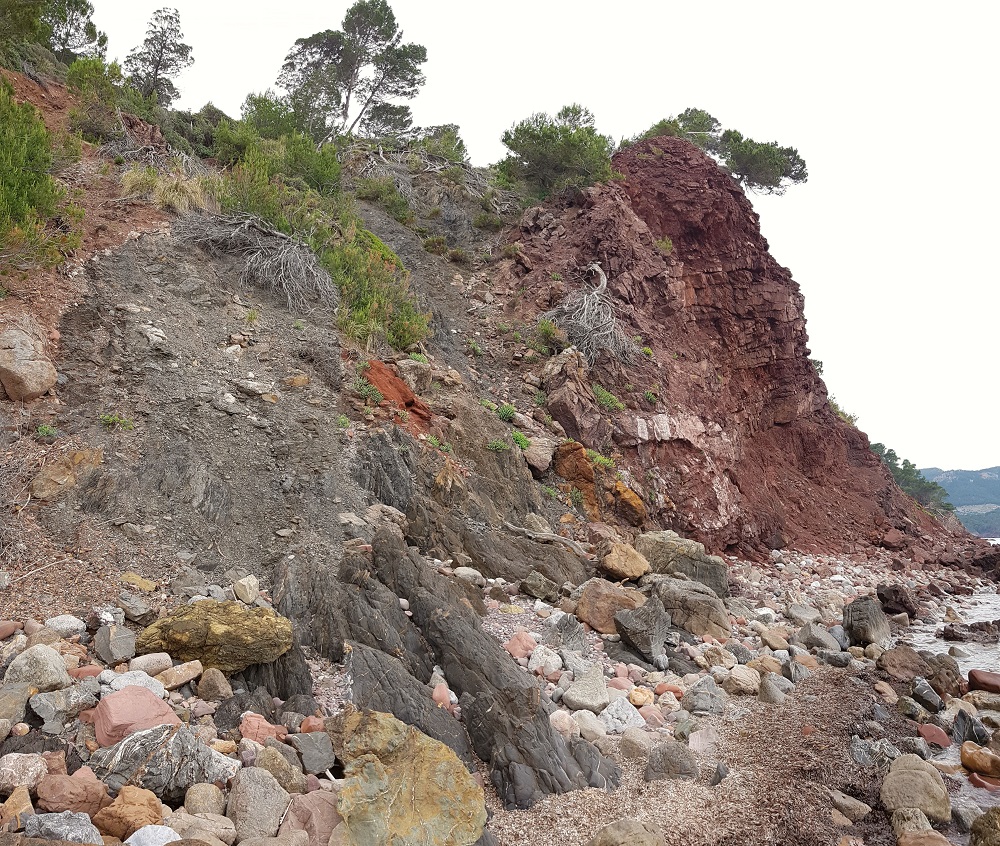
Outcrop of S’Hort de Sa Cova.
The Carboniferous period was followed by the Permian, a period geological which developed between 299 and 251 million years ago. Mallorca has few vestiges of it, but they are rather more extensive than those of the Carboniferous. Where they are best observed is at the Port des Canonge, a coastal village built entirely over the Permian. The materials are mostly sandstones with purple and reddish tones. Locally called pedres d’esmolar because they are used as sharpening stones, they endow a peculiar beauty on the landscape. In spite of being almost sterile in fossils, the few that have been found are of great importance, such as the recently published finding of a part of the upper jaw of a reptile. In addition to the fossil record, special mention must be made of the occasional abundance of copper minerals impregnating the sandstones which were probably exploited to obtain this metal since prehistoric times.

Sandstones of the coast of Cala Estellencs.
The period that followed the Permian, the Triassic, is the first which does have an extensive representation in Mallorca, being present in both the Serra de Tramuntana, the Serres de Llevant and in the Serres Centrals of the island. It begins in the Mesozoic era, which also includes the Jurassic and the Cretaceous. The oldest rocks that appear in this period are similar to those of the Permian and are called Buntsandstein stratigraphic unit and reflect the specific environmental conditions in which they were formed.</p><p><br></p></div>">facies. In the municipality of Estellencs, where they are best observed, there is one of the most important vestiges in Europe of flora and fauna from this epoch.
Continuing with the Triassic, following the deposition of the materials described above there is a sequence of limestones and dolomites of a marine origin called Muschelkalk stratigraphic unit and reflect the specific environmental conditions in which they were formed.</p><p><br></p></div>">facies. In Esporles, one of the representative localities of this type of materials, there are occasional strata that contain millions of molluscs, which form a type of rock called lumaquela.
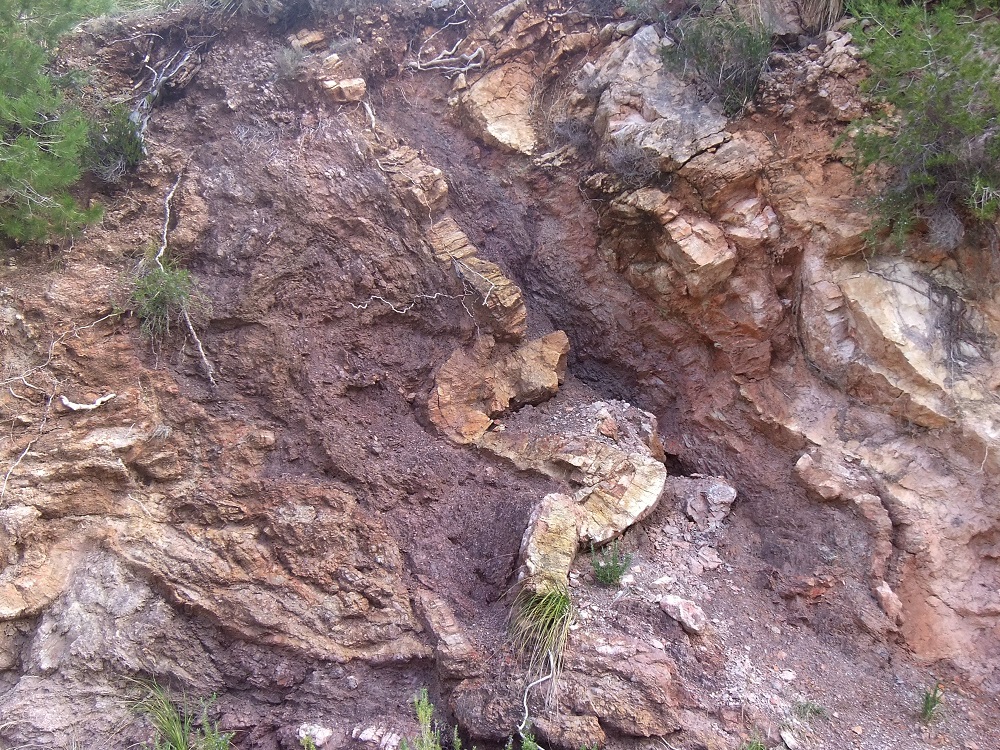
Volcanic rocks in Cala Tuent.
The most modern part of the Triassic is formed by another type of very different rocks, generically included in what is called the Keuper stratigraphic unit and reflect the specific environmental conditions in which they were formed.</p><p><br></p></div>">facies, like those which appear in Cala Tuent. The most characteristic materials are the multicoloured clays, which frequently contain large quantities of gypsum which has been exploited historically in localities like Sóller. The outcrops of this epoch frequently contain basalts and lavas, which testify to the intense volcanic activity which affected the zone. This type of deposits are a source of various minerals like lead, copper or silver.
The next period, the Jurassic, is one of the best represented in the island: so much so that its materials form a large part of Mallorca’s reliefs. In Mallorca, its materials are fundamentally marine, generically divided into three parts: Lower (Lias), Middle (Dogger) and Upper (Malm).
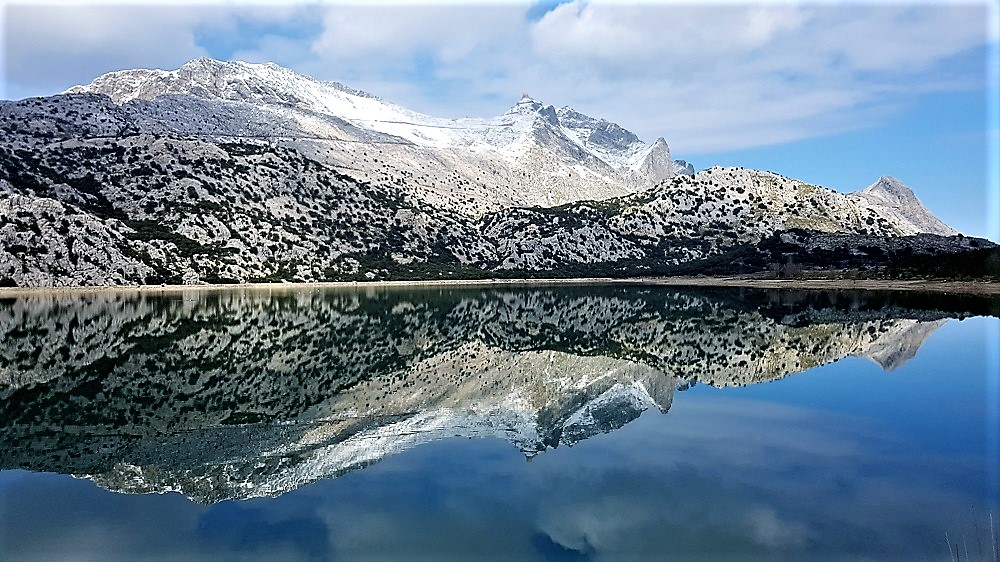
Puig Major, a massif mostly formed by Lower Jurassic massive limestones.
As we advance through the Jurassic, there predominate softer materials called marls and margo-limestones, which, although they already appeared in the Lias, are more characteristics of the Dogger and the Malm. These represent seabeds of greater or lesser depths. Fossils tend to be abundant in the outcrops of this epoch, notably the ammonites. One of the greatest for observing them is Cala Fornells, although the island of Cabrera also has very relevant outcrops.
The last period of the Mesozoic is the Cretaceous, which began some 145 million years ago and continues to be of marine origin. Its Lower part is the best developed, and corresponds largely to an alternation of limestones, marls and margo-limestones of blue-grey colour, generically called maiolica stratigraphic unit and reflect the specific environmental conditions in which they were formed.</p><p><br></p></div>">facies. The most characteristic fossils are, as in the Jurassic, the ammonites. The places where this type of materials are best observed are Cala Mesquida and Cala Torta.
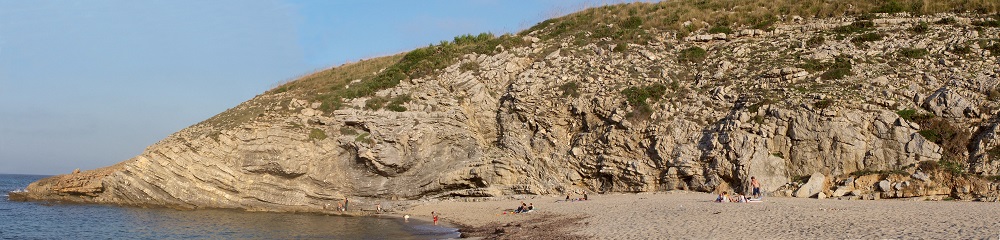
Slumps in the limestones and marls of Cala Torta.
From the Upper Cretaceous there are few outcrops, probably due to later erosive processes which stripped away a large part of the original deposits. Most of these are found in the area of Andratx. In the present day they are very little known.
The oldest outcrops after the Cretaceous correspond to the Paleogene and include the Eocene and Oligocene, from between 45 and 25 million years ago. These epochs have left a very diverse fossil record which represents marine and continental environments. Of the former, Cabrera has many of the best outcrops. During these epochs there existed a series of tropical lacustrine basins similar to the present-day swamplands of America or Asia. These basins have provided, among other items, mammal fossils. The large quantity of plant matter which deposited in the lakes is the origin of the deposits of coal that were much exploited during the 19th and 20th centuries in the Es Raiguer district. The Paleogene has very extensive outcrops in the Peguera zone.

Limestones of the Upper Eocene of Peguera.
The epoch which follows the Oligocene, the Miocene, is without doubt one of the most important in the geological history of Mallorca, and it marks the beginning of the Neogene period.
From the Lower Miocene, some 20 Ma ago, and until the Middle Miocene, some 15 Ma ago, is when the island began to acquire its present-day morphology, with elevated zones (horst) and depressions (graben), a consequence of the Alpine Orogeny. Examples of the folds of this epoch can be observed at Cala Sant Vicent.
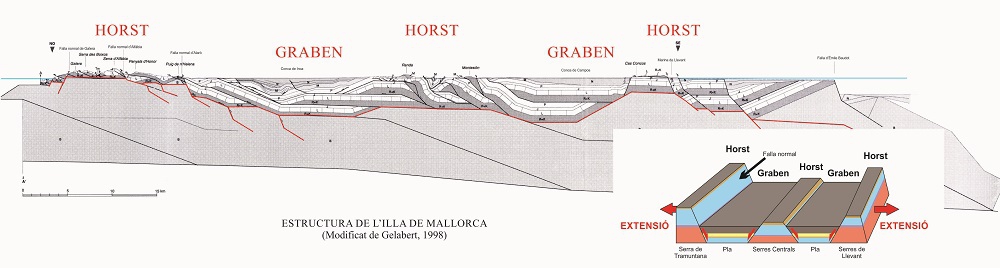
This ground elevation generated underwater landslides which gave rise to very characteristic sediments named turbidites, which can be observed in both Cala Banyalbufar and Cala Bóquer.
In the Upper Miocene (from 13 to 5.3 Ma) there existed two main islands coinciding with Tramuntana and Llevant, separated by a shallow sea flanked by coral reefs, which today mainly form the cliffs of the coast of Migjorn and Llevant.

Reef of the Cap Blanc.
Just before the end of the Miocene there occurred a catastrophic event, the desiccation of the Mediterranean, also known as the Messinian Salinity Crisis.
The following epoch, the Pliocene, began with the re-entry of waters of the Atlantic into the Mediterranean. This caused some immigrant terrestrial species to become isolated and to evolve into endemisms such as the famous ‘rat-goat’, the Myotragus.
During the Pliocene (from 5.3 Ma ago) the shallow sea situated between Tramuntana and Llevant gradually receded, leaving some fossil beaches. Mallorca began to be recognisable in its present-day form.
The Pleistocene, which began 2.5 million years ago, marks the start of the geological period in which we are in the present day, the Quaternary, and it is amply represented in the island by deposits of diverse origins, some of which continue today: alluvial fans, such as those observed in the Betlem area; eolianites; and beaches like that of Es Carnatge.

Fossil beach in Es Carnatge.
In addition, it was during this epoch that most of the caves we know today developed due to eustatic changes caused by the glaciations, such as the Cova des Pas de Vallgornera (see photo).
Finally, the geological processes which are taking place in the Holocene, from 10,000 years ago until today, are the causal factors of the island’s present-day appearance.
These processes which took place in the past continue to occur in the present and will continue in the future.
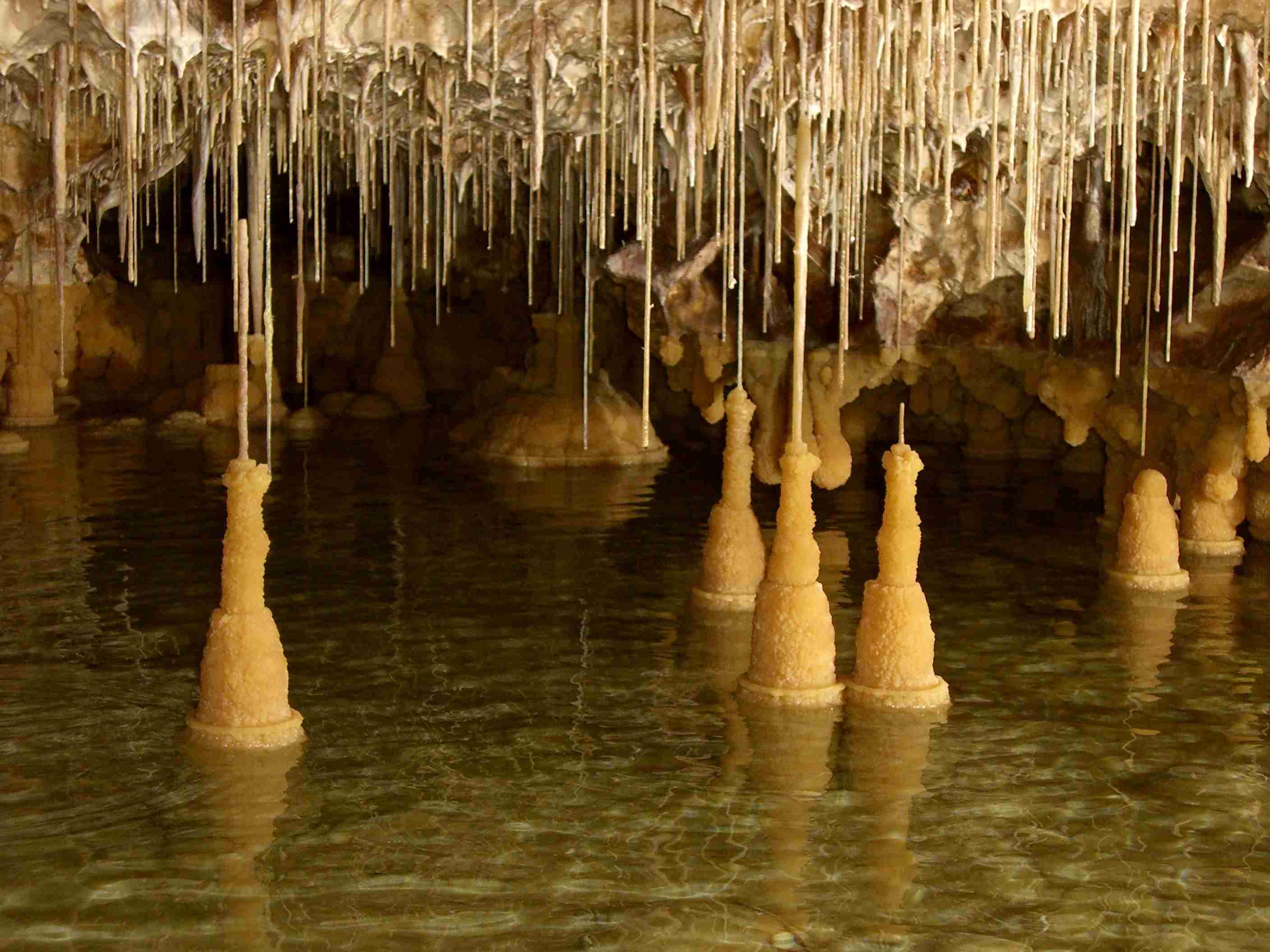
Cave of the Pas de Vallgornera.

.jpg)
.jpg)
