The Balearic Islands constitute the eastern end of the Baetic mountain range, in other words, its prolongation to the sea, and it forms the Balearic promontory. Possibly because it occupies the most marginal position of this promontory, Menorca displays geological features that differentiate it from the rest of the islands and the Baetic mountains themselves.
Menorca is made up of two very different parts (the Tramuntana region in the north and the Migjorn region in the south), separated by an imaginary line that runs from the Port of Maó, more or less following the main road that connects the towns of Maó and Ciutadella, but that turns north towards Cala Morell cove when it reaches Ciutadella.
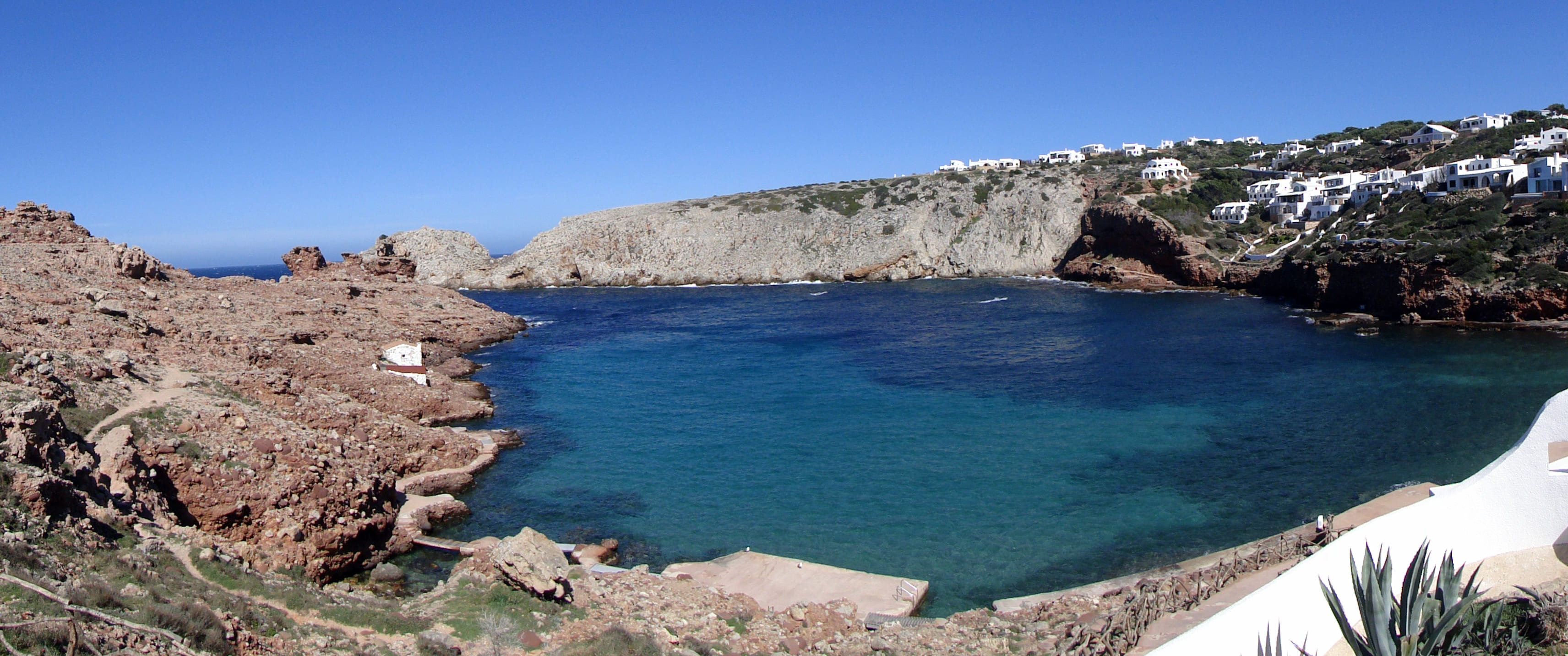
Cala Morell is the best place on the island to see the contact between the northern Tramuntana and the southern Migjorn of Menorca.
Geologically very varied, but with a predominance of siliciclastic rocks (such as sandstones), the Tramuntana region is characterised by featuring the oldest materials on the island. The rocks are fractured and folded and create a network of heterogeneous lands from the Paleozoic and Mesozoic, and occasionally the Paleogene.
On the other side, the southern Migjorn region is much more uniform, with an almost horizontal layout slightly inclined towards the sea, cut through by numerous ravines, which have opened up a path between the rocks and developed a river network that flows into the sea in the southern coves. Here we find what is probably Menorca's most characteristic rock, marès from the Miocene, although other rocks from the same period can also be identified.
If we describe the materials that make up Menorca’s subsoil from the oldest to the most modern, we have to start our route at Tirant. It is here where we find the rocks considered to be the oldest in the Balearic Islands. The presence of fossils of graptolites (colonial marine invertebrates) among its rocks allow us to determine that they were sedimented around 400 million years ago (late Silurian – early Devonian) on the seabed. These are sandstones and very dark lloselles where levels of even limestones are interleaved.
However, the majority of the rocks from the Paleozoic in Menorca are formed especially of an alternation of sandstones and conglomerates interleaved between lloselles sedimented in the Carboniferous (between around 350 and 300 million years ago). It is estimated that as a whole they are in excess of 4,000 metres and were formed from avalanches of sediments that came from the continental shelf and reached the great sea depths in the form of turbulent currents. Fossils here are scarce, although we can make some out, including trilobites and corals dragged by the turbulent currents, and especially traces of bioturbation in the lloselles. Interleaved in this series are rather disorganised levels of volcanic rocks, radiolarites, limestones, conglomerates, etc., with especially spectacular outcrops at Binimel·là beach.
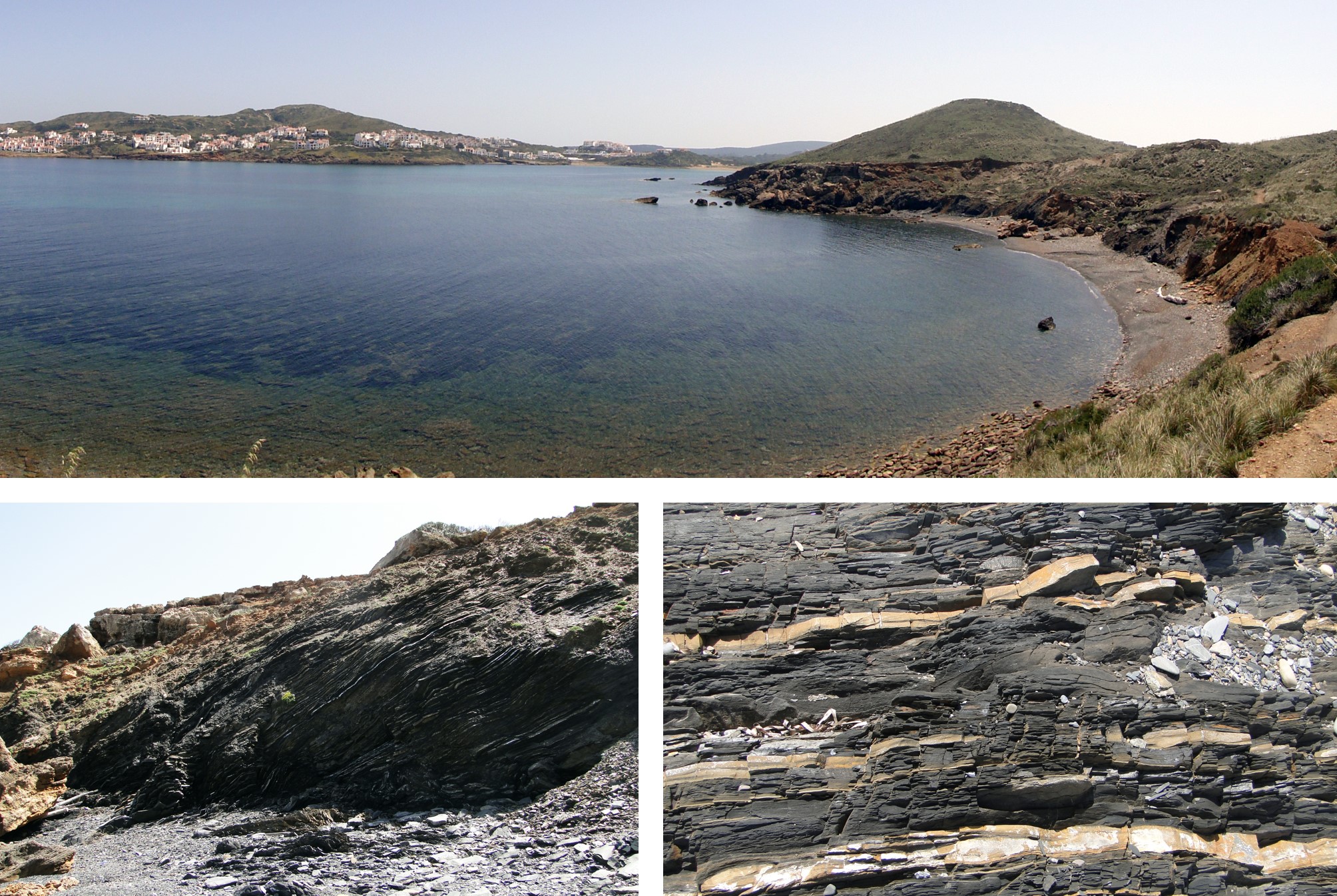
Alternations of sandstones and lloselles at Tirant and radiolarite folds at Binimel•là.
These rocks would have been brought up from the great sea depths to create mountain ranges during the Hercynian orogeny. Orogenies correspond to the series of geological processes that acted over millions of years to lead to the creation of the Earth’s mountain ranges originating the relief.
The rising of these mountain ranges, under a rather dry climate, allowed the development of a large river network that would cause the sedimentation of the red rocks formed after those of the Carboniferous. They are conglomerates, sandstones and clays sedimented during the Permian and the lower Triassic (around 250 million years ago) that are characteristic of El Pilar beach, Punta Roja d’Algairens headland and La Penya de s’Indi tectonic, eustatic or antropical processes</span></p></div>">outcrop, as well as other sites. Here, fossil remains of plants, vertebrates and, occasionally, ichnites have been identified; and we should highlight that their rocks are criss-crossed by dikes of volcanic rocks.
The fluvial sedimentation of the red rocks would be interrupted in the middle Triassic (some 240 million years ago) by a rise in sea level. This phenomenon would cause the formation of a shallow sea and, consequently, a change in sedimentation that would lead especially to limestones and dolomites. The conditions for observing these rocks are especially good at El Toro mountain and at S’Arenal d’en Castell beach. The formation of Triassic rocks in Menorca ends with a coastal sedimentation under a dry climate, with the appearance of lagoons with a marine influence that would give rise to marls, between which gypsums and dolomites are interleaved.
After this, in the Jurassic and lower Cretaceous (between 200 and 110 million years ago), the sedimentation would continue in a shallow sea, although we should stress with various sedimentary interruptions. Dominant among the Jurassic rocks are the dolomites with laminations associated with stromatolites and fossils, especially of brachiopods, foraminifera and crinoids. In the ones from the Cretaceous, we should highlight the abundance of fossils, with the presence of ammonites, echinoderms, gastropods and bivalves. These rocks that tectonic, eustatic or antropical processes</span></p></div>">outcrop, for example, at Cavalleria and at Fornells areas are also identified in the Migjorn region under the rocks from the Miocene at Punta Nati headland and Pont d’en Gil area.
The period between the upper Cretaceous and the Paleogene (between 100 and 23 million years ago) are an unknown in the geological evolution of Menorca, as no rocks from these periods have been identified on the island, with the exception of the conglomerates at Macar de sa Llosa shingle, which have been associated with the late Oligocene (around 23 million years ago). Perhaps the sediments from these eras were deposited in an area that is now beneath the sea, or maybe erosion rubbed them away.
We should stress that this “dark age” in Menorca’s sedimentary records corresponds to a phase where the main activity of Alpine orogeny occurred. These intense orogenic movements moved Africa and Europe closer together, as they had been separated until that time by a much wider sea than the present Mediterranean. So, as these continents came closer to each other, the sediments that had been formed over millions of years and accumulated in the Mesozoic sea basins basins steadily transformed into rocks and compressed.
As though it were a crash in slow motion, the immense force that these two continents drove caused the deformation of the sediments of the Mesozoic and oldest Cenozoic, which covered very many kilometres and, as has been explained, the breaking of the oldest and most rigid rocks that formed the base or plinth of the sedimentary basin, and in turn, the piling of some on top of the others, essentially forming three overlapping laminae that superimposed old rocks on other more modern ones in the Tramuntana region. This process culminated in the emergence of huge rocky masses from the seabed, creating large mountain ranges, such as the Baetic mountains.
This way, the great movements caused the rising of Menorca’s Tramuntana, and later the sinking of the southern part (the Migjorn region), which meant that the sea surrounding the island invaded areas that had been emerged until then. So, at the start of the Miocene (23 million years ago), the emerged area of Menorca was limited to the Tramuntana region in the north (much more extensive than it is today), while the southern Migjorn was being flooded by the sea. A huge amount of organisms lived in this sea (such as algae, molluscs, echinoderms, corals and fishes). Waves, erosion caused by living organisms (bioerosion) and other phenomena gradually transformed the shells and skeletons of these organisms into sand, which was finally deposited on the seabed. This sand was mixed with sediments from the erosion of the rocks making up the mountains of the Tramuntana region. Over time, this mix of sands became consolidated, forming the rock that we know in the Balearic Islands as ‘marès’.
Despite the apparent homogeneity of Menorca’s Migjorn region, it is possible to distinguish three geological units. The oldest is made up primarily of conglomerates and sandstones, was probably sedimented in the lower Miocene (around 20 to 15 million years ago) and can be easily identified at Cala Morell area. The middle was deposited later, around 11 million years ago, and dominates most of this region of the island. It is made up primarily of marès, although we do see other rocks, and it was sedimented in a ramp area (a marine platform with a constant gentle slope), where numerous and varied life forms proliferated. At the top, the most recent unit was deposited around 7 million years ago in a reef environment. It is made up of marès and limestones (hard rock), especially with coral and levels of Sedimentary rock whose main component is calcium carbonate (CaCO3). Its origin can be chemical, organic or detritic.</p><p><br></p></div>">limestone algae (rhodoliths), that, when calcium carbonate enters their tissue, can fossilise.
Finally, we need to point out the presence on the island of rocks from the Quaternary, the latest of the geological periods, which are considered to be of little importance in Menorca owing to their extent. Their distribution is quite uneven and developed especially near the coast. They correspond to levels of sand dragged by the wind from the seabed and deposited on the coast at times when the sea level was lower than it is now, creating dunes and beaches that fossilised over time to create marès. Fossil remains have been identified in these rocks, most notably those of the endemic genus on the Balearic Islands of Myotragus, a mammal from the Caprinae subfamily. It is believed to have arrived in the Balearics at the end of the Miocene (around 5 million years ago) when a large part of the Mediterranean dried up. Isolated from the outside world and free from predators, its evolution resulted in the rather curious-looking species known as Myotragus balearicus, small in stature, with very short robust legs, very centrally positioned eyes and just one incisor.
