Eivissa.
The oldest outcropping materials in Eivissa are from the Triassic, present mainly in the northern part of the island. The oldest levels are found at the Punta d'en Valls, corresponding to a sequence of dolomites of the Middle Triassic, from some 240 Ma. Although nothing more than a few microfossils and bioturbation have been found in them, it has been possible to characterise them within the so-called Muschelkalk facies. However, in Eivissa, this type of rocks display the particularity of light-dark striping due to the presence of veins of calcite and dolomite, named 'zebra' facies (see photo), representing the sea bottom within a shallow water environment. In contrast, the upper part of the Middle Triassic contains limestones which can preserve macrofossils such as bivalves or ammonites.
Leaving behind the Middle Triassic, the Upper Triassic on the island is very similar to that of Mallorca, formed by the so-called Keuper facies, charaterized by multicoloured clays with plasters and occasionally quartz crystals, named Compostela hyacinths. The Triassic also contains the magmatic rocks with which deposits of minerals are sometimes associated.
The Jurassic is much better represented than the Triassic, an important part of it is located in the north of the island. The rock that characterises its lower part is again the dolomite, which occurs in massive form and with an appearance very similar to the dolomites of the Middle Triassic, although with a little less than 200 Ma. As usual in the Upper Triassic, indications of volcanic activity have been detected.
The alteration of the rock is the reason why many of the fossils which could contain this rock have disappeared, although some can be found at a microscopic level, helping to date the sediments. A stratigraphic gap means that some important parts of the Middle Jurassic are not represented in the island. Cala Llonga (see photo) is where this period can be best studied in Eivissa.
The Upper Jurassic, in contrast with all the earlier materials, can be very rich in fossils, with outcrops having a great abundance of ammonites in limestones usually of reddish colours, called ammonitico rosso facies, some 160 Ma old here. Although this type of rock is the most striking of the Upper Jurassic, it is generally composed of well-stratified grey and yellowish limestones. During the first phases of the Cretaceous, which began 145 Ma ago, the tectonic activity caused the increase in depth of the sea-bottom, and deep sedimentary basins were formed. It was in this type of environment that levels of limestones, marls and margo-limestones developed, fossilising countless foraminifera and an abundance of molluscs, primarily ammonites.
Around the Middle Cretaceous, the depth of the sea floor rose again, favouring the growth of important communities of organisms proper to shallow waters, notably a group of bivalves which, similar to the present-day corals, formed reefs: the rudists. The Penyal de S'Àguila (see photo above) is an excellent place for observing this type of old ecosystems from approximately 110 Ma, which are classified among the so-called Urgonian facies. After this episode, the group of materials from the Upper Cretaceous were deposited, and Eivissa has the most complete record from this period in the Balearic Islands (although it is distributed into small outcrops). Although some aspects of this chapter of the island's geology are still unresolved, it appears that throughout the Upper Cretaceous the seabed remained stable due to the reduction of tectonic activity.
A new and more substantial stratigraphic hiatus means that from the late Cretaceous (65 Ma ago) to the Lower Miocene (20 Ma) there is no geological record in Eivissa. It was in the latter period when the present-day reliefs were raised up by intense folds and thrusts in the previous formations, grouped into the various tectonic units. All of this occurred as part of an important global geological process called the Alpine Orogeny, which was accompanied by volcanic activity which left outcrops like those close to S'Aigua Blanca. This same locality contains olistostromes, large chaotic masses of rock formed by submarine landslides (see previous page) Apart from these, marls are what primarily characterise this ancient Miocene, with an abundance of fossils, particularly those of microscopic size, which are very useful for dating the strata. Among the marls, but especially on top of them, there are conglomerates which denote the continental influence of the deposits, basically marine. These can be seen in places like the Serra de Beniferri. In the Upper Miocene, some 10 Ma ago, coral barriers developed in tropical marine environments which, in essence, are the same as those present in the rest of the islands. Testimonies of this interval are only present in the north of Eivissa. The Pliocene, which began some 5.3 Ma ago, is present but very poorly represented.
The Quaternary, the last geological era, began 2.5 Ma years ago and has a diverse representation here in Eivissa, as in Mallorca and Menorca. During a large part of this period, coastal dune landscapes developed, creating 'marés' sandstone, which was exploited in quarries. At Sa Pedrera it is easy to observe these materials (see photo).
Occasionally, associated with these ancient dunes are beach deposits, which can contain abundant mollusc fossils. In zones with a certain relief, fluvial erosion during the Quaternary has given rise to the deposition of sediments on the hillsides, called glacis deposits, very continuous and visible around the Labritja torrent.
In parallel, and thanks to the abundance of carbonatic rocks, all types of karstic formations formed, such as dolines or caves. From the Holocene, which began around 10,000 years ago, there are also notable deposits which tell about the island’s geologic dynamics. Es Codolar, a coastal barrier of pebbles associated with dunes, constitutes one of the best examples of this type of formations in the Balearics.
Formentera.
the smaller of the Pitiüses, has a much more recent geological history than in Eivissa. The oldest outcropping materials here date from the Upper Miocene, shortly after the Alpine Orogeny. In this stage (from 11 to 7 Ma, approximately), large tropical coral reefs dominated the shallow seas of the Balearic Promontory, leaving large limestone zones which now form a considerable part of the island. The cliffs of La Mola and the Cap de Barbaria are the largest and most representative outcrops of this type. Associated with these deposits, there are others of continental origin, formed by fossil dunes and paleosols. These represent the coastal zones on solid ground close to the coral barriers. They can best be observed in the islet of S’Espalmador.
From the late Miocene and Pliocene (from 7 to 5.3 Ma, approximately) there is no known geological record in the island. However, from the Pleistocene there are many outcrops representing different environments from that period. In this respect, we can single out fossil beaches like that of Es Copinyar or fossil dunes like those of Cala En Baster.
From the current geological period, the Holocene, there are also interesting places, such as the Estany des Peix and the Estany Pudent, two neighbouring salt lagoons formed possibly in karstic depressions which have been cut off from the open sea by cordons of sand.
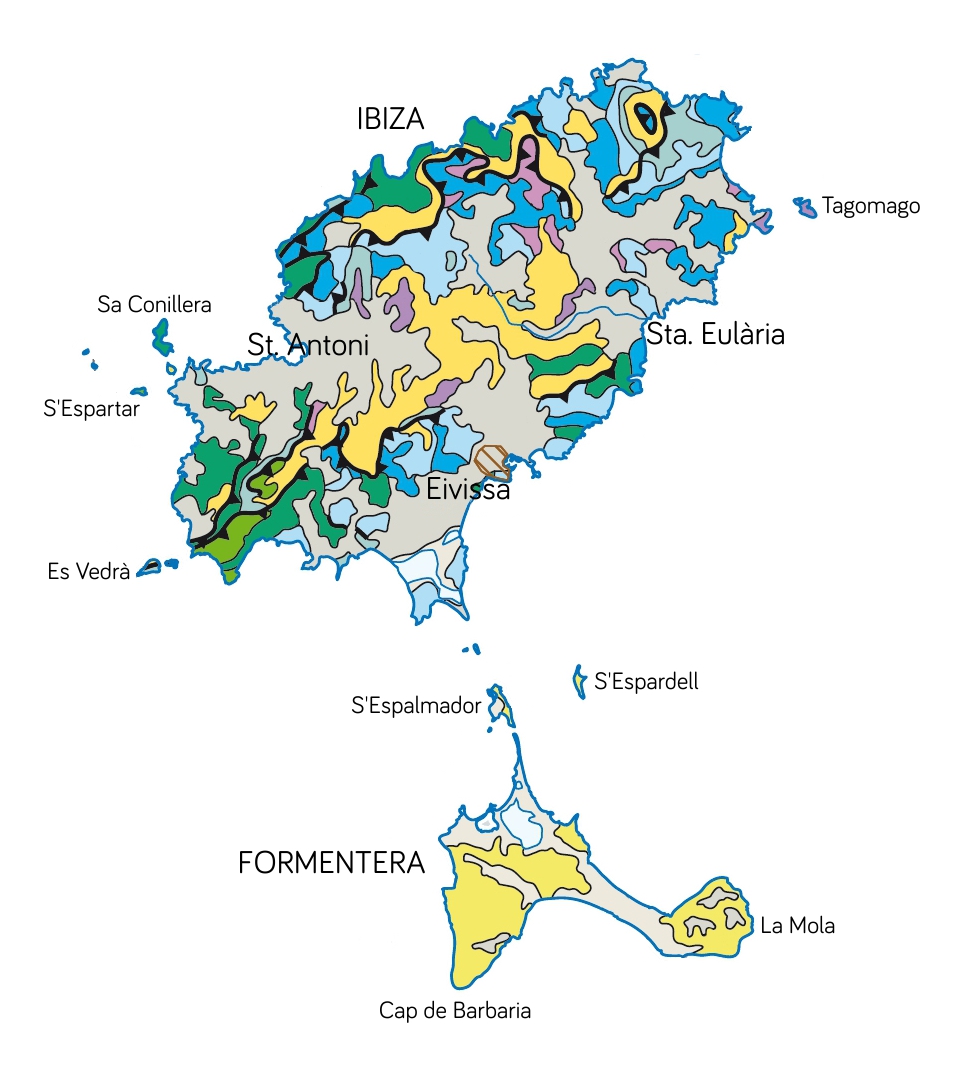
Geological map of Eivissa and Formentera: purple represents Triassic materials, blue are Jurassic, green colour are Cretaceus, yellow Neogene and grey are Quaternary deposits.
