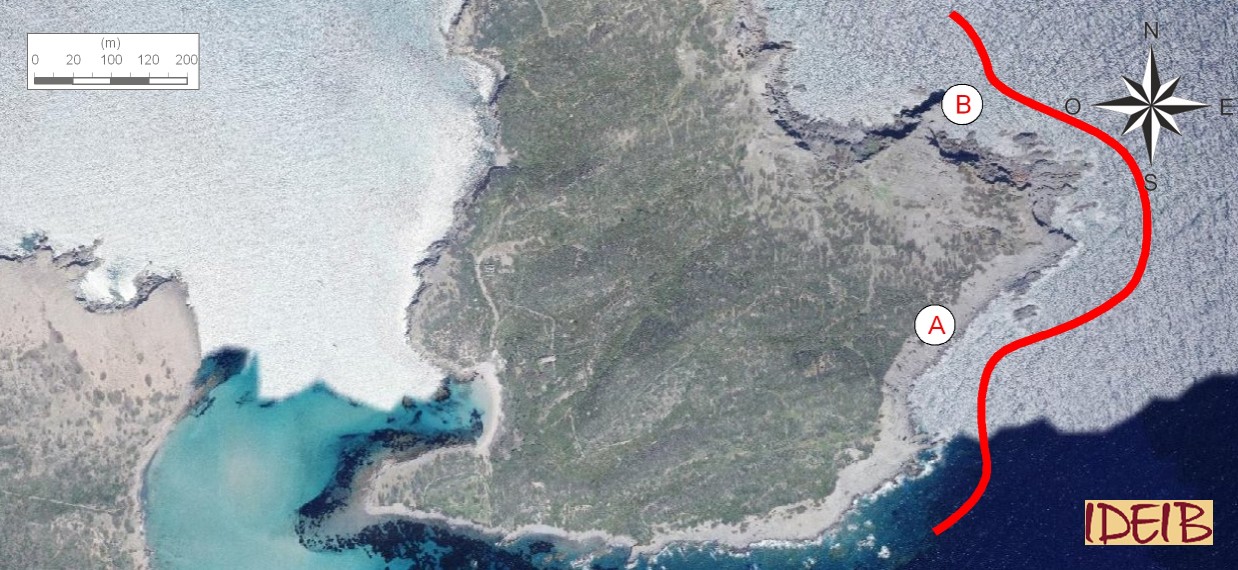
Suggested route from the stopping point.
The route starts in front of one of the entrances to the mine on the Es Bou i Sa Vaca cliff. Menorca is an island with relatively little mineralogical interest, although between the second half of the nineteenth century and the first half of the twentieth century around a hundred mining applications were filed, including to extract gold. Most of these mines never prospered and a large part of the ones that did proved to be little more than prospecting.
On the island, most of the mines aimed to dig for copper minerals (such as the Nueva Adela mine (at Pla de Mar near El Pilar) and the Rubia mine (in the El Toro mountain)) and they did so in red rocks from the Permian-Triassic (sedimented by large rivers between 240 and 260 million years ago). However, there are exceptions, such as the mines at Illa d’en Colom, which mined in the dark rocks of the Paleozoic (deposited at the great sea depths over 300 million years ago).
Illa d’en Colom islet is home to two mining sites, one in its centre on its eastern edge, at the tiny inlet called Sa Mitja Lluna, where copper mineralisations were extracted. The other, in front of you, is on the Es Bou i Sa Vaca cliff, where zinc minerals were extracted.
In the rubble at the Sa Mitja Luna copper mine, ceramic fragments dating from the Bronze Age were discovered together with remains of prehistoric stone tools. This copper mine is the only one from prehistoric times to be documented so far in the Balearics, although there must very probably be others, but traces of it have been lost due to subsequent mining activity conducted. This copper mine would have been particularly active in the first quarter of the twentieth century, just like the zinc mine, which was registered in 1902, shortly after work started here, but where mining would have continued after copper extraction had ceased.
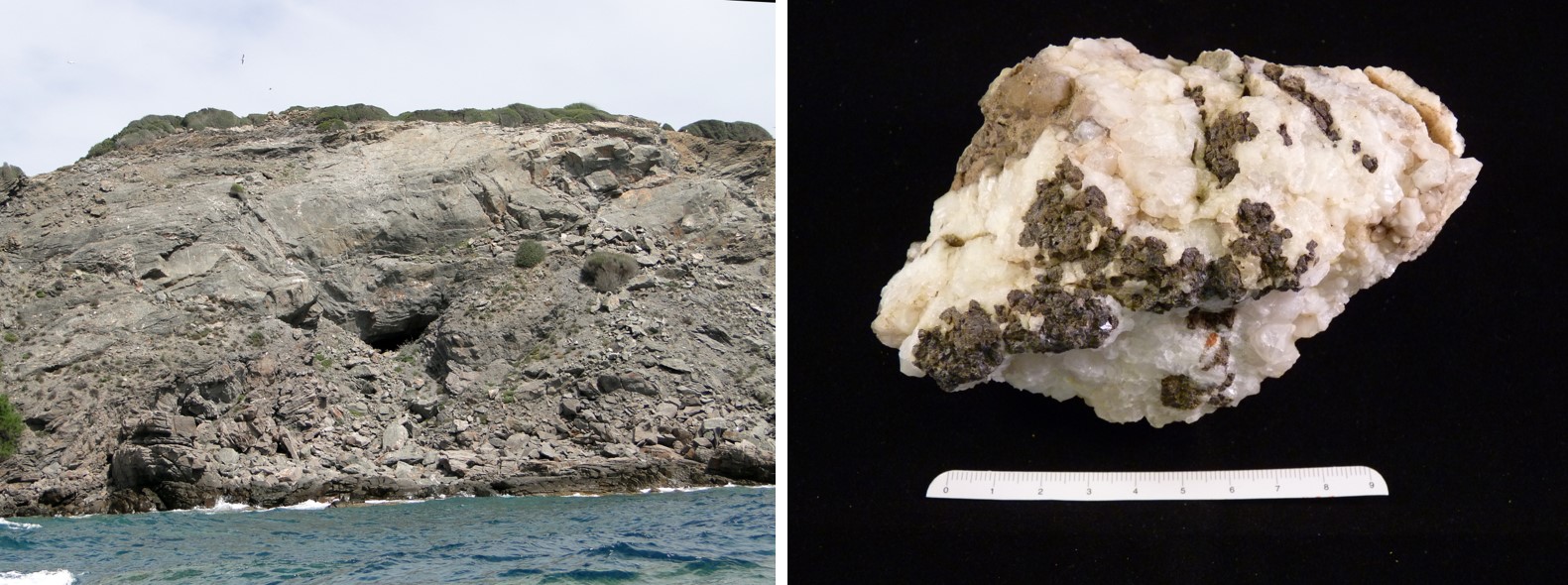
Lower entrance to the blende mine on the Es Bou i Sa Vaca cliff, somewhat hidden by rockfalls (point A). On the right, quartz mineralisations (white) with blende (grey) found in this mine (Menorca Geology Centre).
If you carry on around the island from the east, you will see the severe fracture in the dark rocks. You can stop at the Cap de Llevant point of the islet, where you will see the overhang intensely fractured in various directions. In it, you can see white “blemishes” in the rock, which are quartz mineralisations.
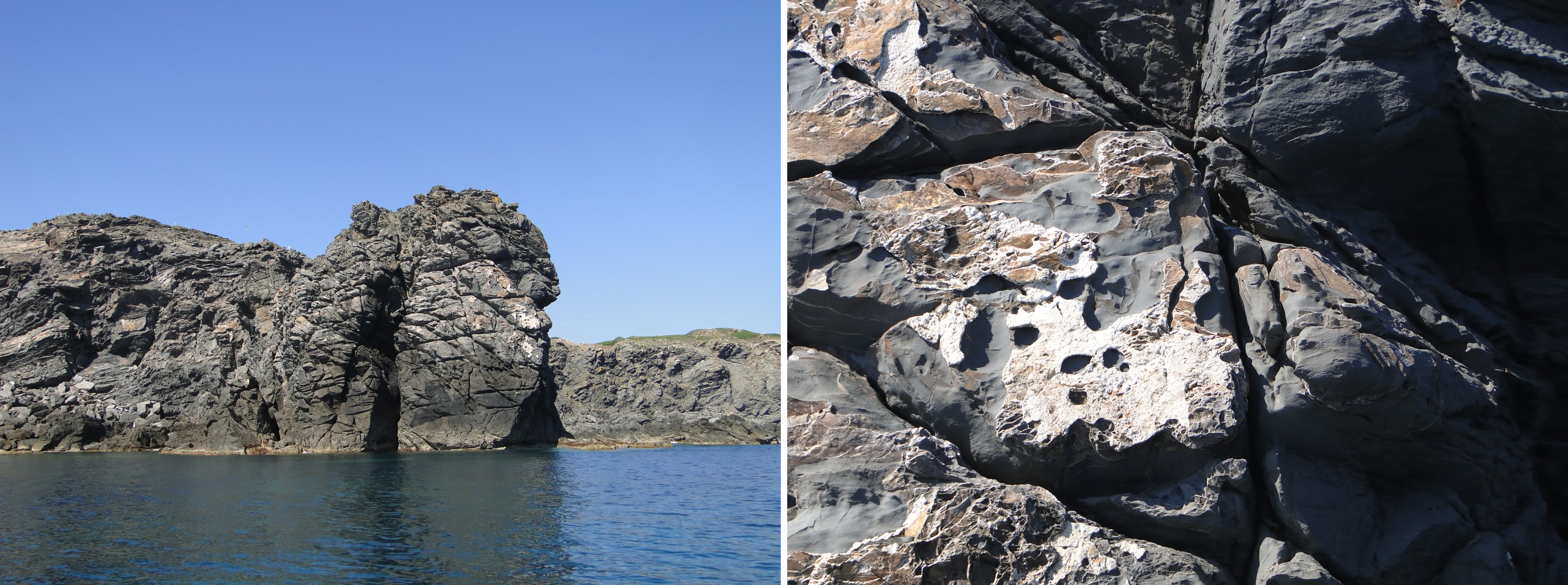
Cap de Llevant point of the Illa d’en Colom island (point B), intensely fractured and with the presence of quartz mineralisations embedded in the surface of the rock (close-up on the right).
Evidently, the mines are not located in the east and southeast of the islet purely by chance. The rocks in this part of Illa d’en Colom are rather deformed. As a result of this deformation, the rocks have broken into numerous fractures through which hydrothermal fluids flowed which, laden with silica, would eventually precipitate as different minerals. In other words, the mineral masses (called ‘ledges’) that were of interest for mining refilled old fractures.
Quartz was the most abundant of these mineralisations to be extracted. However, there were also small precipitations in the form of iron sulphides, (creating chalcopyrite) and copper sulphides, which through contact with the outside world are found in a highly-altered state in minerals such as azurite (strident blue) and particularly malachite (a no less striking green) which were mined at the Sa Mitja Lluna mine. The mineral that was mined on the Es Bou i Sa Vaca cliff was a blende, a zinc sulphide that is usually accompanied by a small amount of silver. Brown-red iron oxides, such as haematite, have also been identified. The blende is embedded in lodes of white quartz (which are small, giving a sense of the low yield of the mine) that refilled the fractures that had opened up in the rock.
At the tectonic, eustatic or antropical processes</span></p></div>">outcrop in front of you, you have to imagine that the quartz mineralisations that you can see refilled an old fracture and that, therefore, hugging this flat wall there was another rock. So, between the rock you can see and the one no longer there, there was a fracture through which fluids laden with minerals flowed. Over time, this rock that you cannot see broke away and fell to the bottom of the sea, leaving in view the fracture surface that separated them.
On the way to the next stopping point, note the different colours that stain the cliffs due, in part, to these diverse mineralisations.
