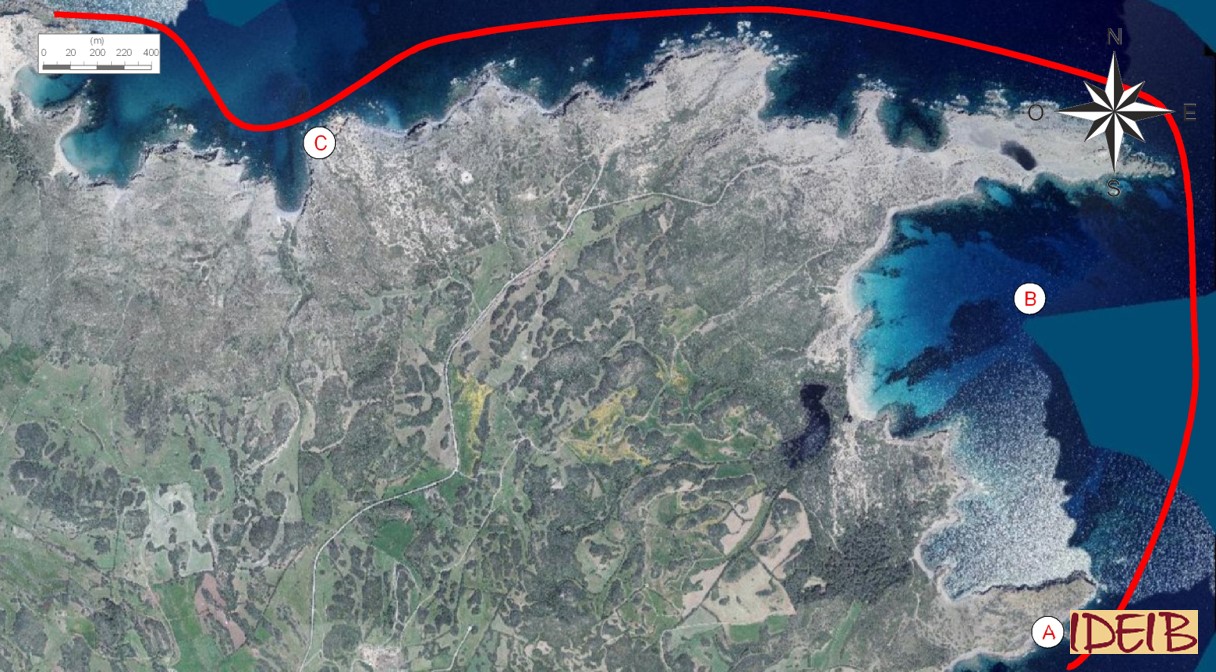
Suggested route to the stopping point.
The first observation at the stopping point can be made on the Cap de Mossènyer Vives headland, especially on its south side, this promontory is characterised by the presence of abundant faults. The sedimentary rocks are characterised by their stratified rocks, in other words, by being formed of strata or layers that are piled horizontally on top of each other and that show a clear continuity. Very often, this continuity is broken, for example, due to the effect of faults. A fault is formed by the action of tectonic forces (very often associated with large earthquakes), which fracture the Earth’s surface rocks and cause them to move. At this point, you can see how the horizontal continuity of the layers of sandstones is cut by the action of various faults. Faults are one of the most frequent and spectacular geological processes on Earth and are fundamental in the formation of mountains and ranges
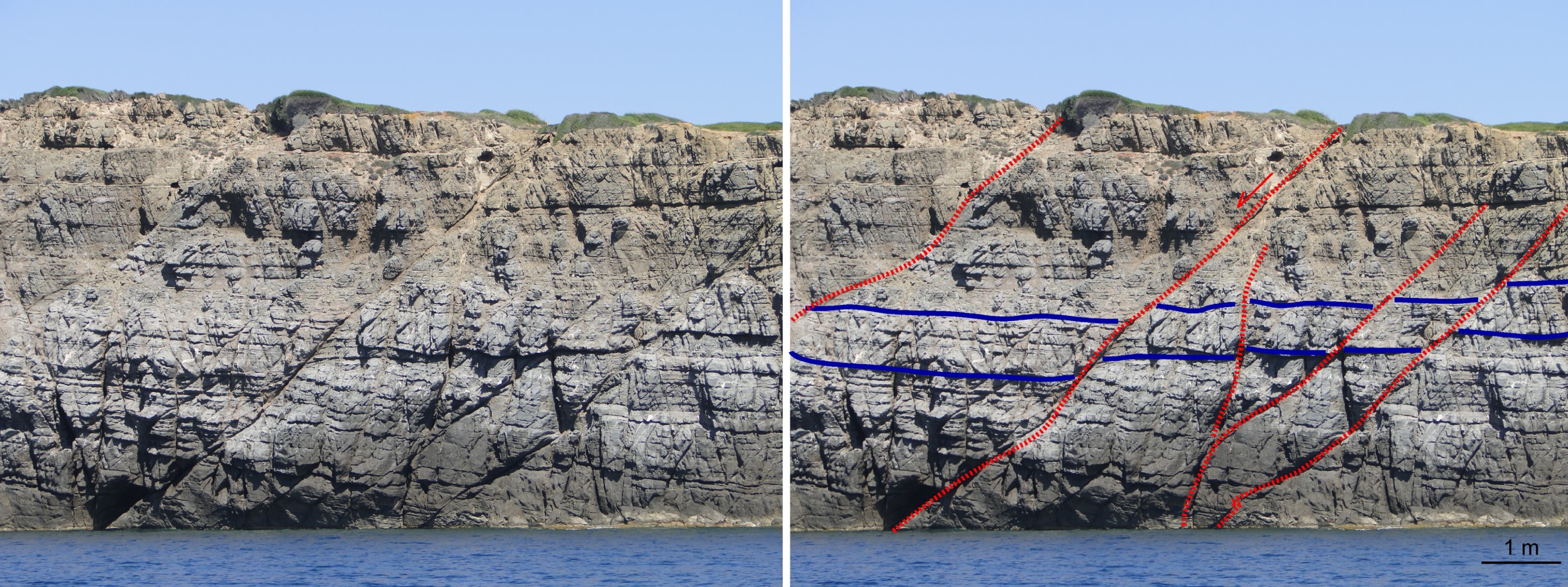
Strata affected by faults (in red) at Cap de Mossènyer Vives. In blue, you can see a guide layer displaced by the faults (point A).
Heading for Addaia, you will see numerous inlets and promontories on this stretch of the Menorcan coast. Soft rocks are more easily eroded by erosive agents such as waves, especially conditioned by the severe northern storms, rainwater, salt and wind, so over thousands of years, coves have formed. By contrast, where more resistant rocks, such as sandstones or conglomerates predominate, we find promontories as well as islets and reefs. This way, at the beaches at Morella, Cala en Caldes and Mongofra, the predominant rock is sedimentary rock which tends to exfoliate in small flakes, similar to sedimentary rock formed by clay.</p></div>">pelite. </p></div>">llosella, where the storms from the east, together with the action of streams at times of great storms, have steadily carved out these coves. By contrast, at Cap de Mossènyer Vives and Cap Favàritx headlands, we especially find rocks made up of coarse particles that are much more resistant to erosion. When you reach Cap de Favàritx, we recommend stopping to take a look at these rocks, massive, coarse-grained sandstones that imbue the rock with an appearance of resistance to sea storms, which is why the lighthouse could be built here.
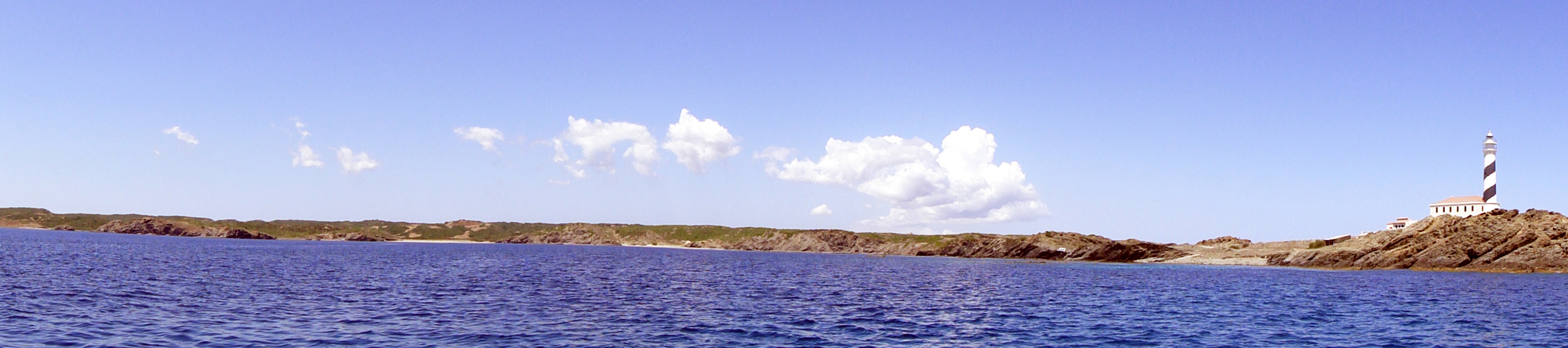
At Cala Tortuga and Cala Presili (left) coves, soft rocks predominate unlike the powerful sandstones and micro-conglomerates that make up Cap de Favàritx headland and on which the lighthouse was constructed (point B).
On reaching Cala en Caldes, note the numerous blocks of rock that have fallen away from the cliffs. In fact, a large part of Menorca’s north coast is subjected to a constant and natural process of cliff erosion due to the more or less continuous fall of blocks of rock. Right on the eastern side of this cove, you can see an example of rockfall that is quite different from the sort we are used to seeing. In this case, the movement of geological materials has occurred in a series of interleaved layers of sandstones and sedimentary rock which tends to exfoliate in small flakes, similar to sedimentary rock formed by clay.</p></div>">pelite. </p></div>">llosella from the Paleozoic that are very different from each other. You can see that in this case, the movement was massive, a slide that left a huge surface in a concave half-moon shape. We cannot see the materials that broke off as the slide carried them to the seabed. This type of movement is reminiscent of the effect that would be left by a giant spoon scooping out the materials that broke off. Passing through the cove by boat, you can see interesting examples of alternations of layers of sandstones and sedimentary rock which tends to exfoliate in small flakes, similar to sedimentary rock formed by clay.</p></div>">pelite. </p></div>">llosella with various undulations and inclinations resulting from the deformation caused by tectonic movements.
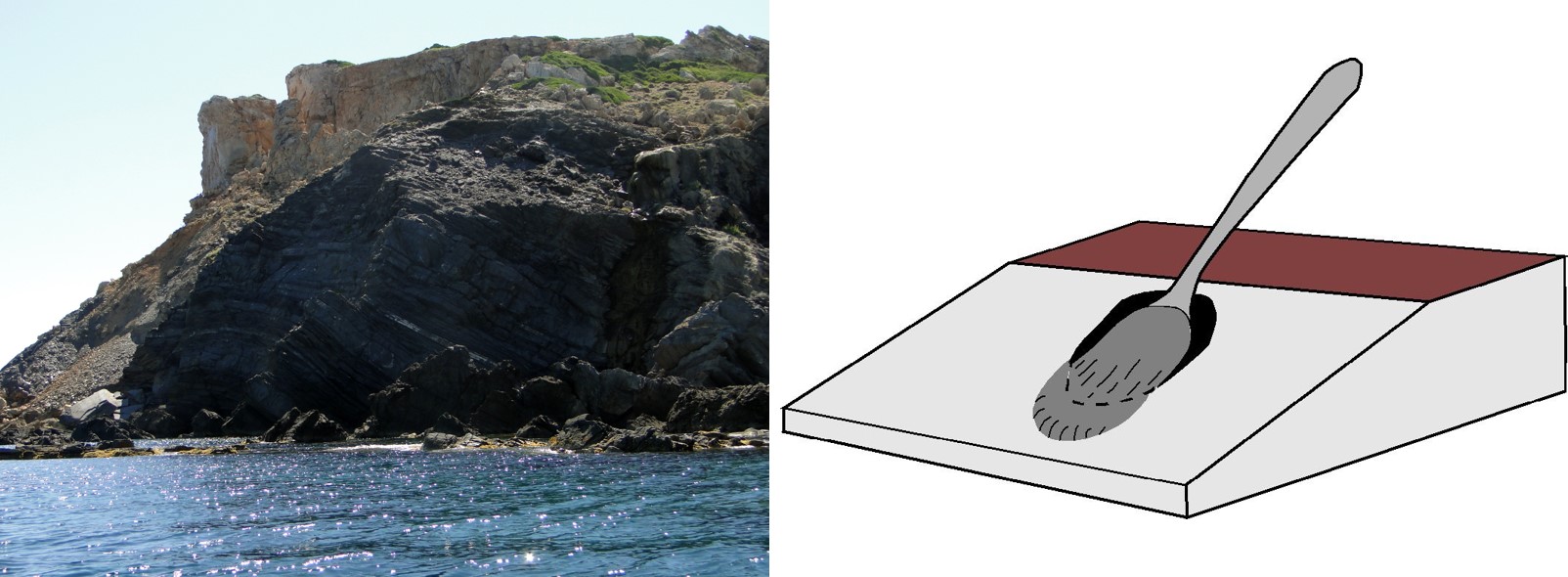
Scar resulting from a huge rockfall on the eastern side Cala en Caldes: the gap is reminiscent of the area that would be left by a giant spoon scooping out the materials that broke off (point C).
