| UTM-X | UTM-Y | ||
|---|---|---|---|
| STOP 1: EN VERMELL | |||
| STOP 2: LLOSA DE RAFALET | |||
| STOP 3: PUNTA DES FALCONS | |||
| STOP 4: ILLOT DES TORN AND CALÓ ROIG | |||
| STOP 5: TORRE D’ALCALFAR |

Access route to the stopping point.
The route ends at Morro d’Alcalfar point, near the tower of Spanish origin dating from the late eighteenth century and built at the same time as the tower at Son Ganxo. From this lofty point, you get a good panoramic view of the coastline and the Illa del Aire island. You can see the parallel layers that dominate practically the whole of the area and that, as has been explained in the previous stopping point, are the reef taluses or slopes.
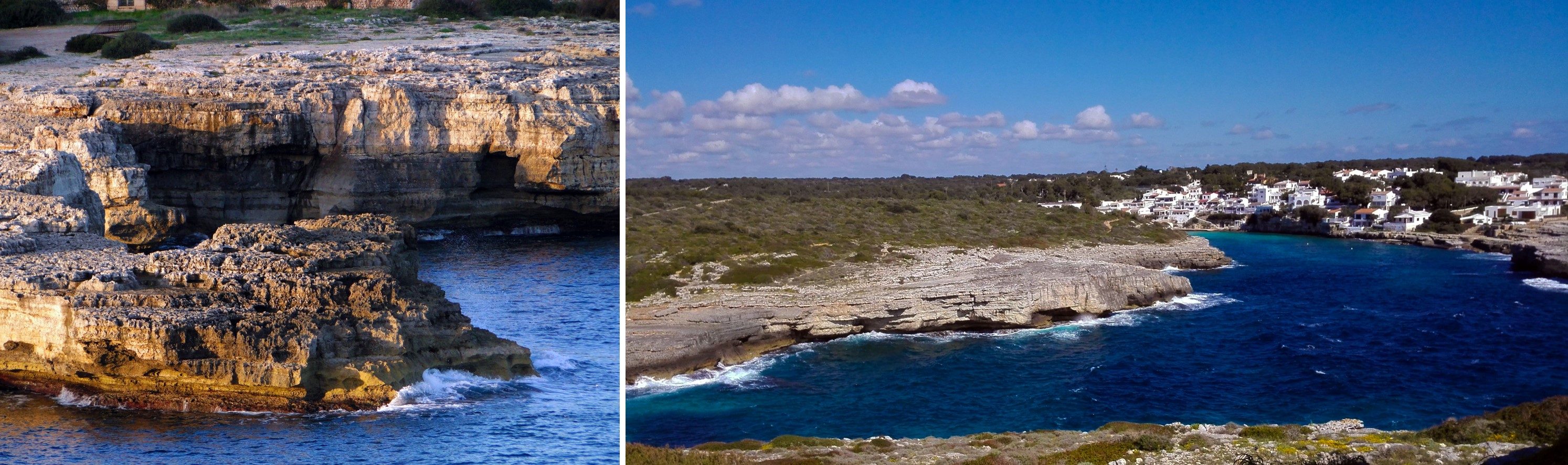
From the Torre d’Alcalfar defence tower, you get superb views of the area, dominated by layers of flat and parallel strata typical of reef taluses (point A).
By looking at the rocks that make up the defence tower, you can make out some blocks that can be associated with bioconstructions, which are a mineralised structure caused by the action of living beings that lived in the reef, such as corals. It should be considered that to save on work, the stone that was used to build the towers was probably from the same environment where it was built, which also allowed the integration of these elements in the landscape. As a result, it is possible that these rocks came from the same area. However, it should be considered that the restoration that took place in 1994 introduced marès rocks of other origins.
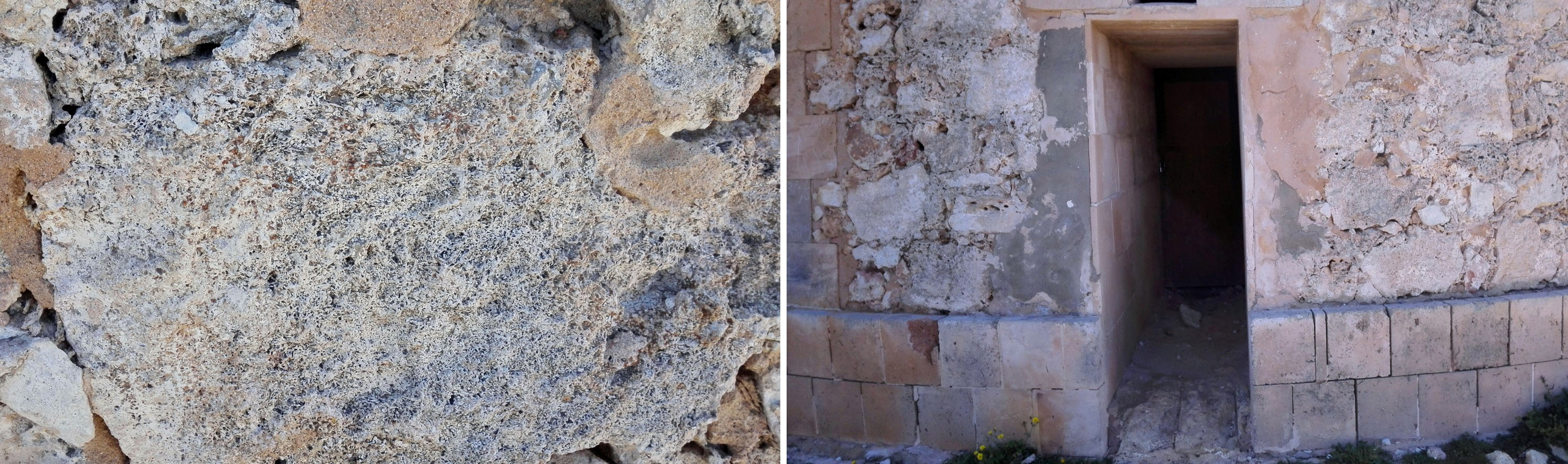
Bioconstructed block at the Torre d’Alcalfar and entrance to it. The uneven blocks with lighter tones are probably of an origin related to the area around the tower; by contrast, the more brownish blocks can be associated with blocks extracted at other sites and used during the restoration (point A).
From here, you get good views of the Illa de l’Aire island. Not too long ago in terms of geological history, the island was probably part of the island of Menorca, forming its southeast coastal limit. This way, it should initially be expected that the rocks that we find on the coast are the same as on Illa de l’Aire. These rocks are there, but they are covered by others, so the island displays geological differences compared with the nearest stretch of coast. The explanation is that at a time when the sea level was lower than it is now, the sand that surrounded the islet was dragged and accumulated on its surface, creating a series of dunes that consolidated over time, creating a new rock. These fossil dunes display a slight elevation on the south of the island, where the lighthouse was built, which indicates that the sand dragged here by the wind came especially from the north.
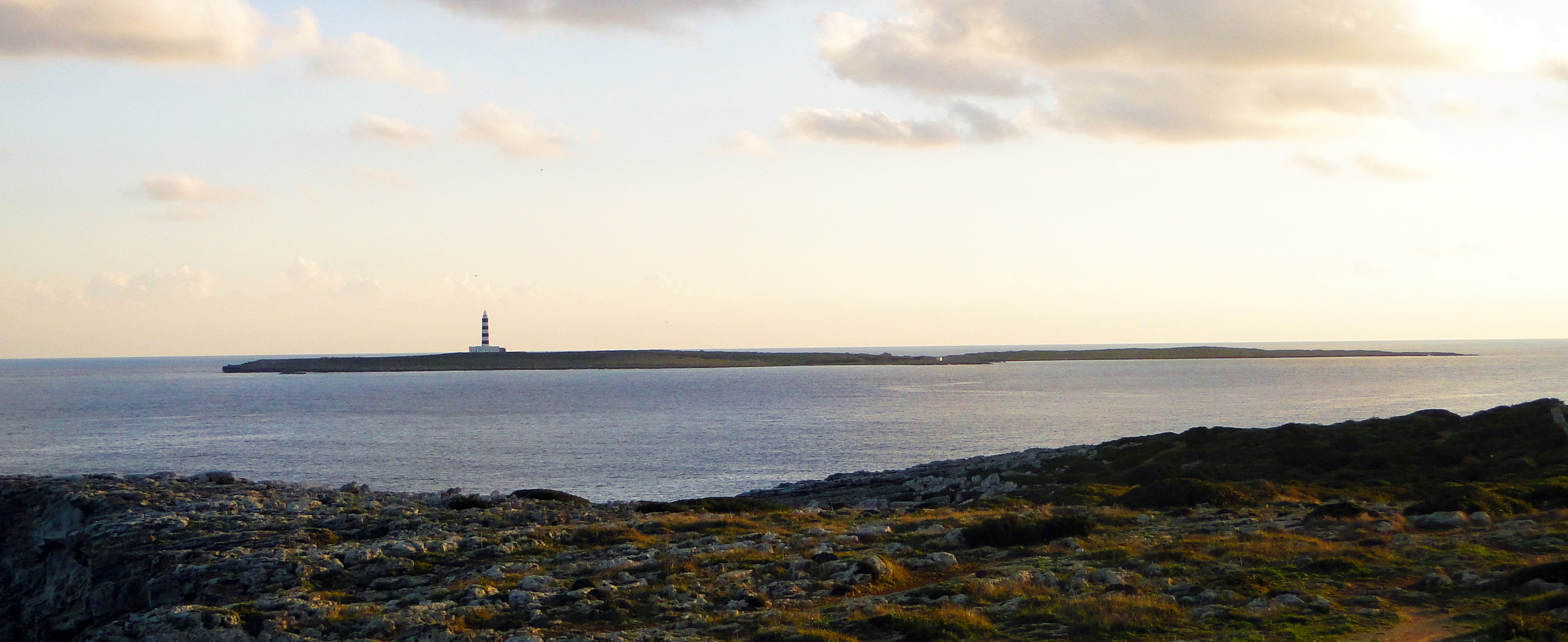
Illa de l’Aire from Torre d’Alcalfar (point B).
