| UTM-X | UTM-Y | ||
|---|---|---|---|
| STOP 1: EN VERMELL | |||
| STOP 2: LLOSA DE RAFALET | |||
| STOP 3: PUNTA DES FALCONS | |||
| STOP 4: ILLOT DES TORN AND CALÓ ROIG | |||
| STOP 5: TORRE D’ALCALFAR |

Access to the stopping point and continuation towards the next one.
The colour acquired by the rocks at En Vermell allows the geological tectonic, eustatic or antropical processes</span></p></div>">outcrop at the first stopping point on the route to be easily identified among the cliffs that demarcate the S’Algar residential area to the east.
The red or brownish tones that the materials acquire here are due to the intense erosion that affected the Sedimentary rock whose main component is calcium carbonate (CaCO3). Its origin can be chemical, organic or detritic.</p><p><br></p></div>">limestone rocks, which predominantly make up the cliffs. These rocks are extremely permeable to water which, if when it is filtered through the rock it is heavy with CO2, acquiring a slightly acid pH, it can slowly dissolve it. This process is called ‘karstification’, and a waste product of the dissolving of the rock is a red clay, rich in iron oxides and other insoluble compounds.
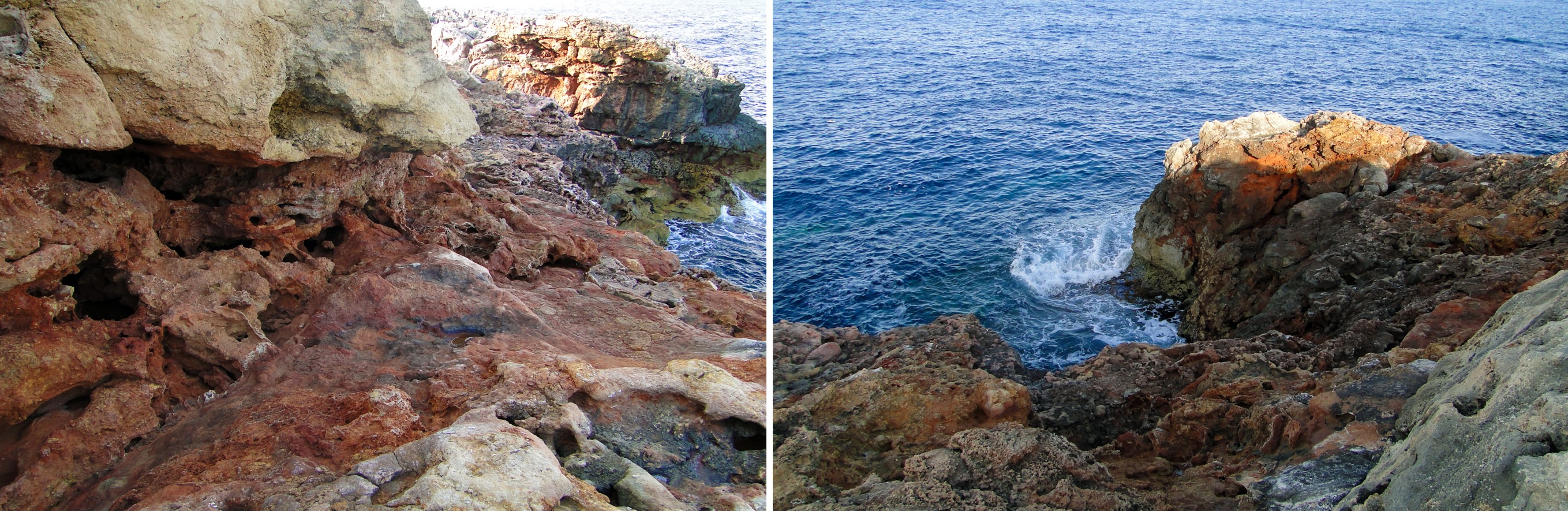
General view of the En Vermell outcrop, characterised by its intense reddish colour (point A).
If you look closely, you’ll see that among the reddish sediments you can see small cobbles and/or thick grains of sand. The cobbles display colours between greenish and yellowish and are from the erosion of the dark rocks of the Paleozoic by streams. The grains of sand are predominantly white and are both quartz from the erosion of the paleozoic materials, and small broken fragments of shells of organisms, such as clams and snails. Consequently, these cobbles and grains of sand were eroded and carried by the streams and then reworked by the waves, as can be seen from the presence of marine sediment, mixed with the sediment transported by the streams.
The sediments were deposited at En Vermell on a very uneven surface highly affected by erosion, which would have left the ground filled with holes. Consequently, the sediments would have refilled all the irregularities of the ground in an attempt to make it uniform.
The components of the red clay caused by the dissolving of the Sedimentary rock whose main component is calcium carbonate (CaCO3). Its origin can be chemical, organic or detritic.</p><p><br></p></div>">limestone rock would have acted as agglutinants, in other words, as cement joining these particles. So, once the natural cement had had its effect and the sediment was consolidated, this led to a rock, a sedimentary rock of detritic origin (clasts larger than 2 mm).</p></div>">conglomerate (if the cobbles have a diameter of more than 2 mm) or a sand-sized clasts.</p><p><br></p></div>">sandstone (if its components are smaller than this size). This way, at the tectonic, eustatic or antropical processes</span></p></div>">outcrop you can see conglomerates and sand-sized clasts.</p><p><br></p></div>">sandstone from the Migjorn region of Menorca, therefore, two rocks that are different from the predominant, but not only, one: marès.
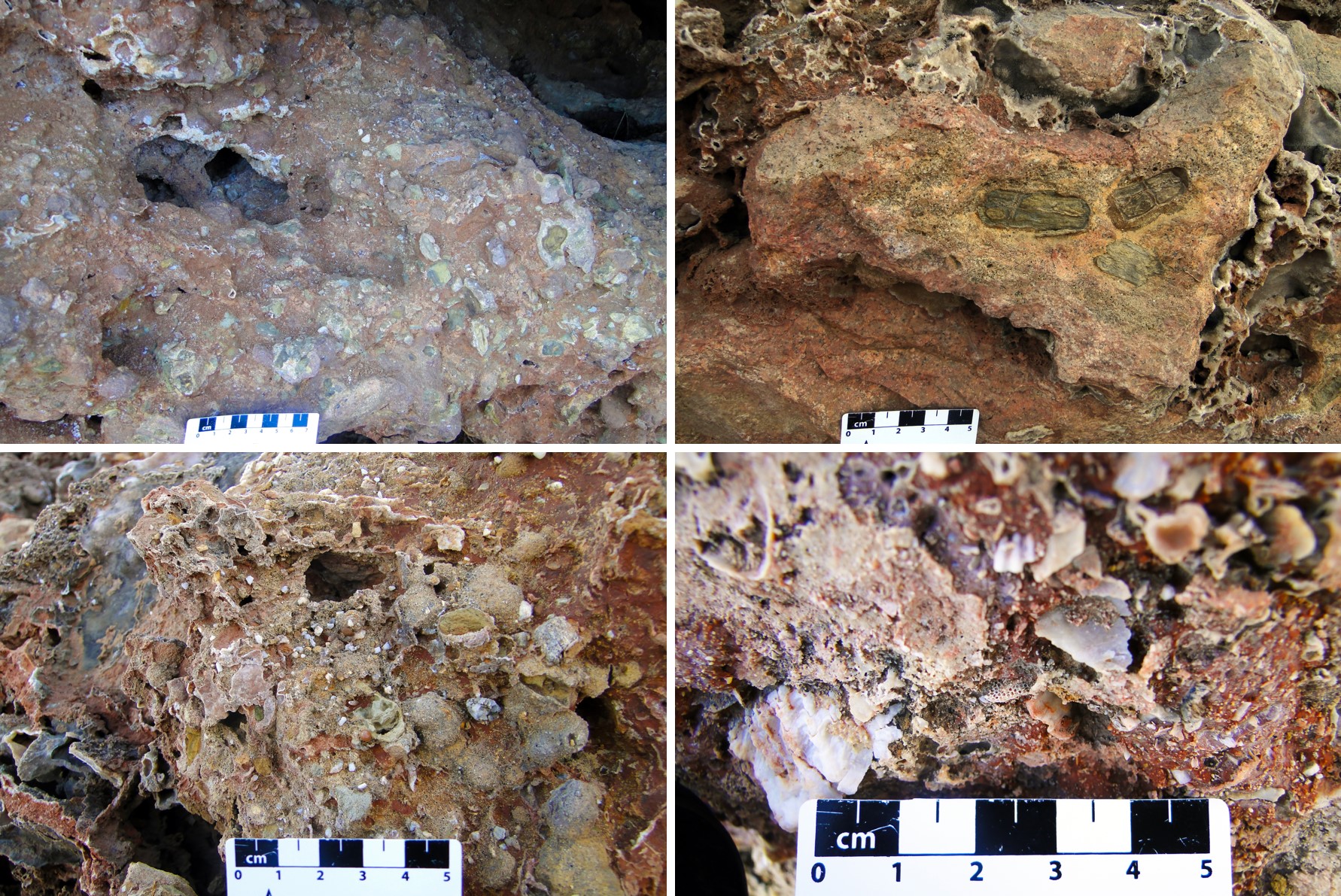
General view of the conglomerates and close-up of the cobbles derived from the erosion of sandstones and llosella (top). Grains of quartz and numerous fragments of shells of marine organisms (white) that make up the sandstones and conglomerates at En Vermell (bottom) (point A).
It is possible that the origin of the streams that carried these cobbles and grains was not very far away. In fact, if you look to the north, you can see the cliffs at La Mola that protect the entrance to the port of Maó. La Mola is made up of a flat surface of Sedimentary rock whose main component is calcium carbonate (CaCO3). Its origin can be chemical, organic or detritic.</p><p><br></p></div>">limestone rocks from the Miocene (sedimented around 5 million years ago), but that are on top of other inclined rocks that are dark in colour. These are sandstones and lloselles from the Paleozoic (deposited over 300 million years ago), the same types of rock that the cobbles and part of the grains of sand that you can see at En Vermell come from.
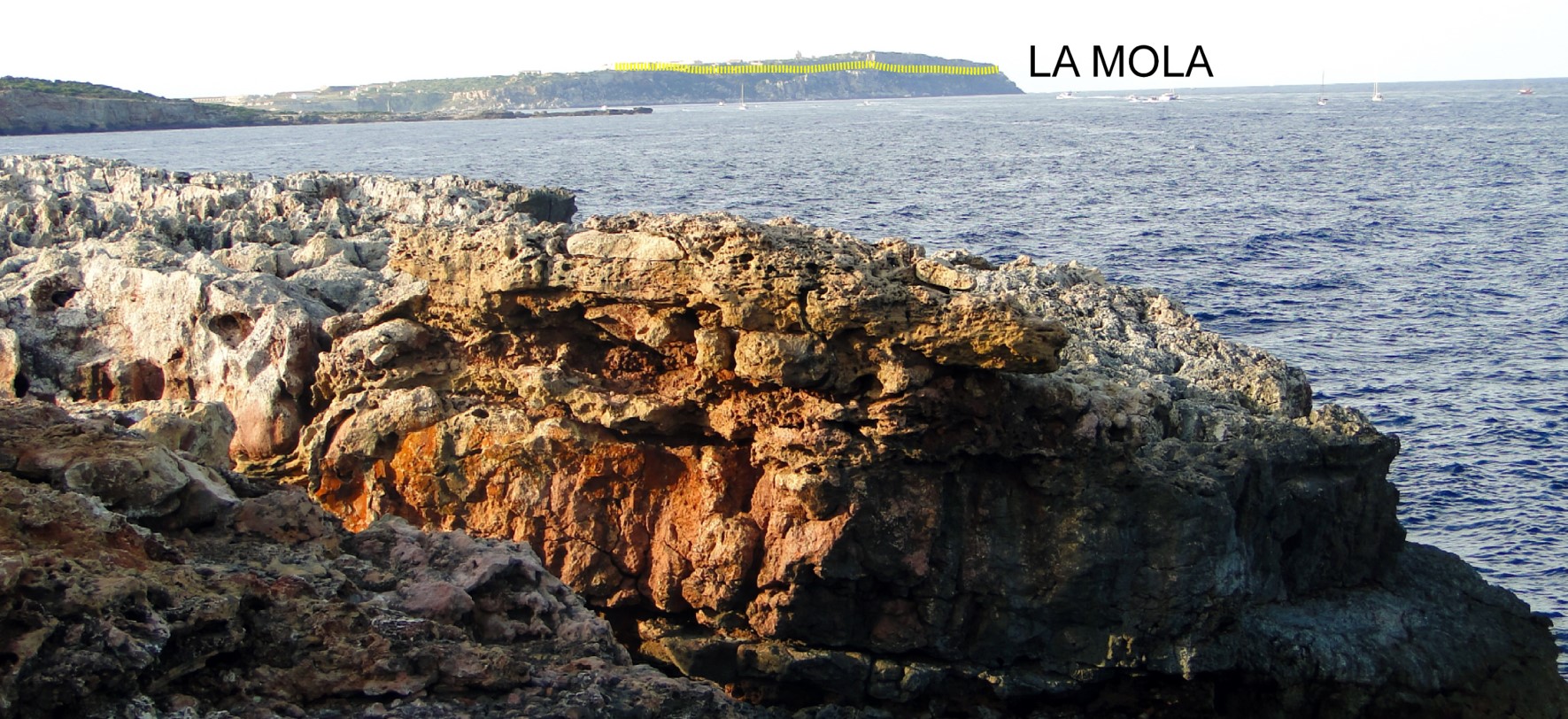
La Mola de Maó mesa from En Vermell cliff. The yellow line indicates the separation between the sandstones and lloselles of the Paleozoic and the limestone of the Miocene on top. The materials of the Paleozoic were intensely eroded, leaving a flat surface on which the rocks of the Miocene were sedimented (point A).
As we have just seen, part of the sediment that makes up these rocks is marine in origin, the remains of shells completely or partially broken by the waves and biological activity. In other words, the steams emptied the sediments that they carried into the sea, where they mixed with marine sediment. Occasionally, this sediment did not break and so the hard remains of the organisms were able to fossilise. Consequently, the presence of fossils at En Vermell is, or rather was, very frequently of clams, brachiopods, sea urchins and, especially, fish teeth.
Unfortunately, these last ones are those that have been most affected by the most voracious fossil hunting and it is hard to find specimens now. Sporadically, we find rounded, orange molars of Sparus cinctus, an ancestor fish to today’s sea bream. It is now practically impossible to find the once abundant large, triangular teeth ending in serrations of Carcharocles megalodon (Agassiz, 1837), known in Menorca as ‘llengües de Sant Pau’ (Saint Paul’s Tongue), to which magical properties are attributed. It is thought that this shark was the biggest carnivorous fish in history, reaching lengths of up to 12 metres and weighing some 14 tons.
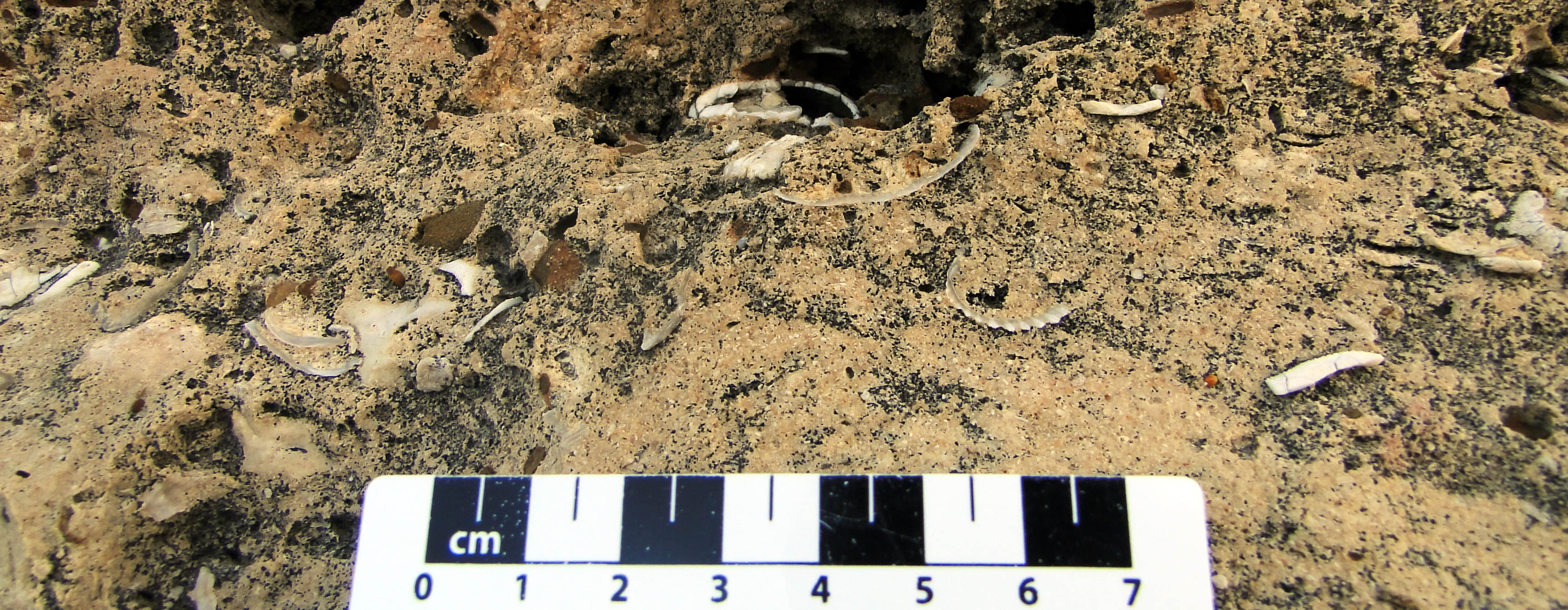
Fragments of fossils of clams and sea urchins, among grey cobbles of sandstones from the Paleozoic, at En Vermell (point A).
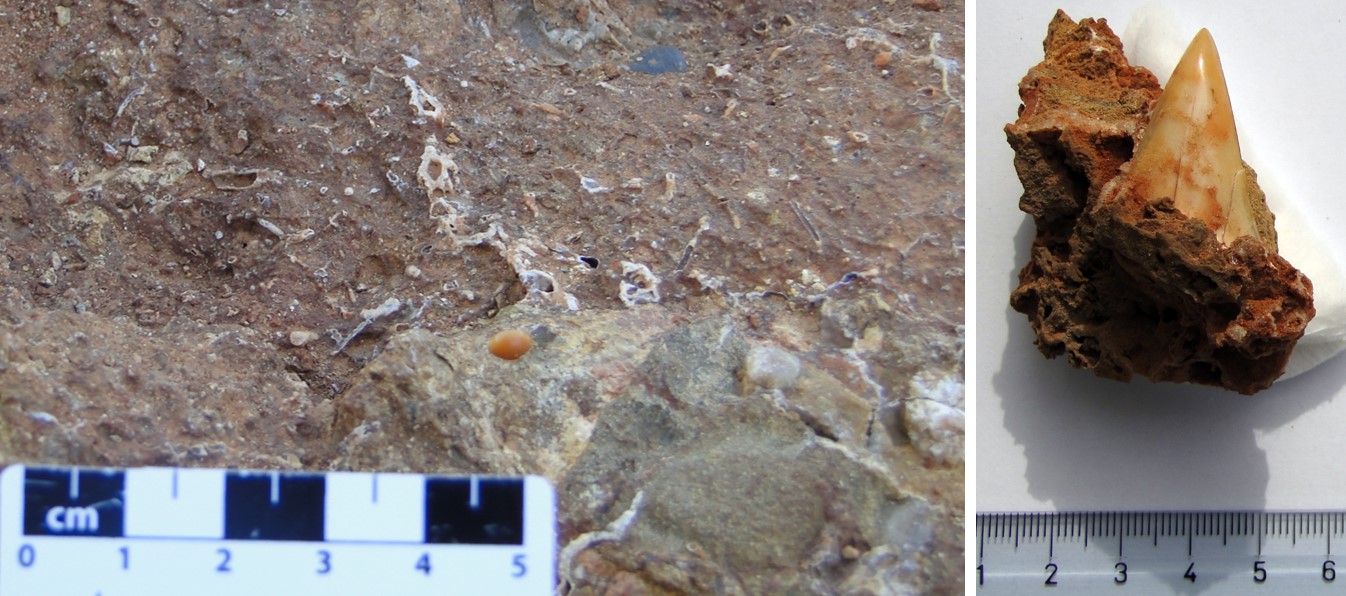
Tooth of a Sparus cinctus, (left, point A) and of a Carcharocles megalodon (right) (specimen found at En Vermell and donated to the Menorca Geology Centre).
Leaving En Vermell, you will see to the south how the rocks are impregnated on the surface with golden patches, which are the subject of the next stopping point.
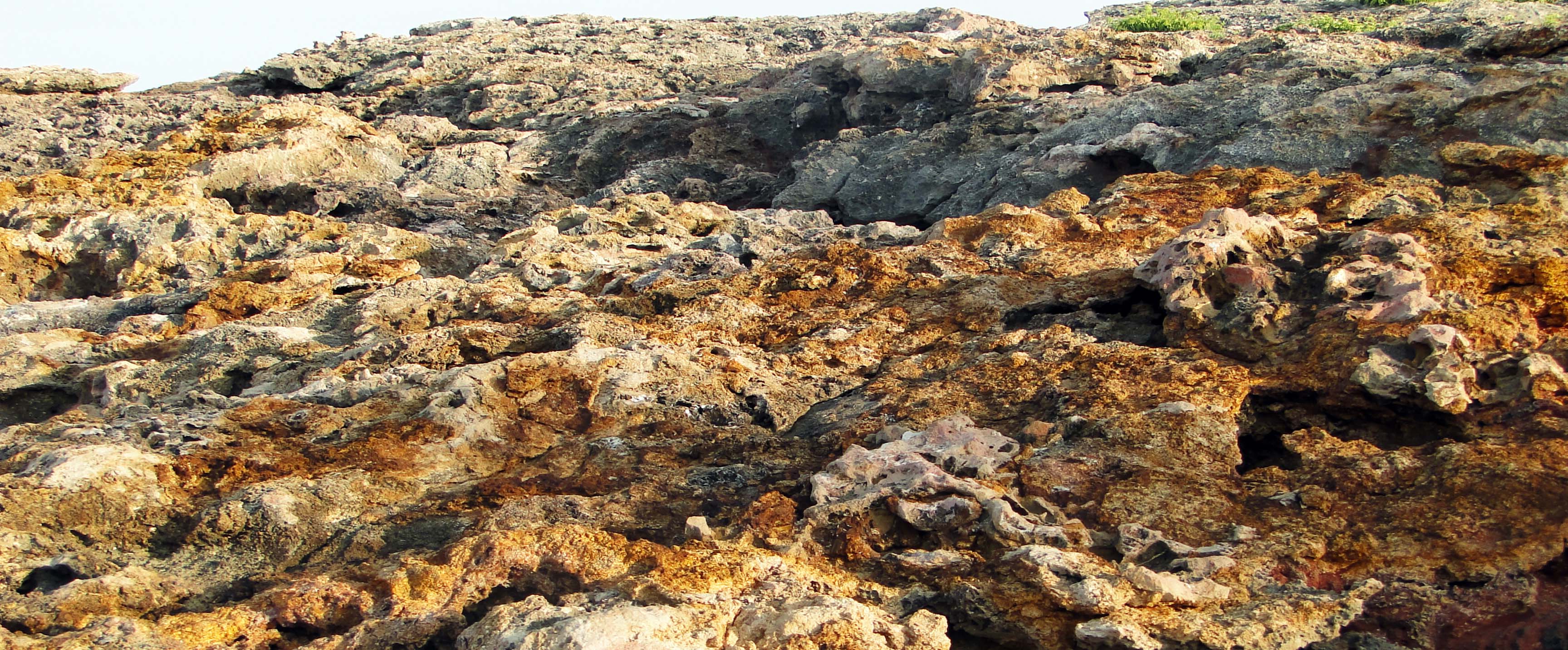
To the south of En Vermell, the rocks take on a rusty aspect that basically carpet a stratum (point B).
