| UTM-X | UTM-Y | ||
|---|---|---|---|
| STOP 1: EN VERMELL | |||
| STOP 2: LLOSA DE RAFALET | |||
| STOP 3: PUNTA DES FALCONS | |||
| STOP 4: ILLOT DES TORN AND CALÓ ROIG | |||
| STOP 5: TORRE D’ALCALFAR |
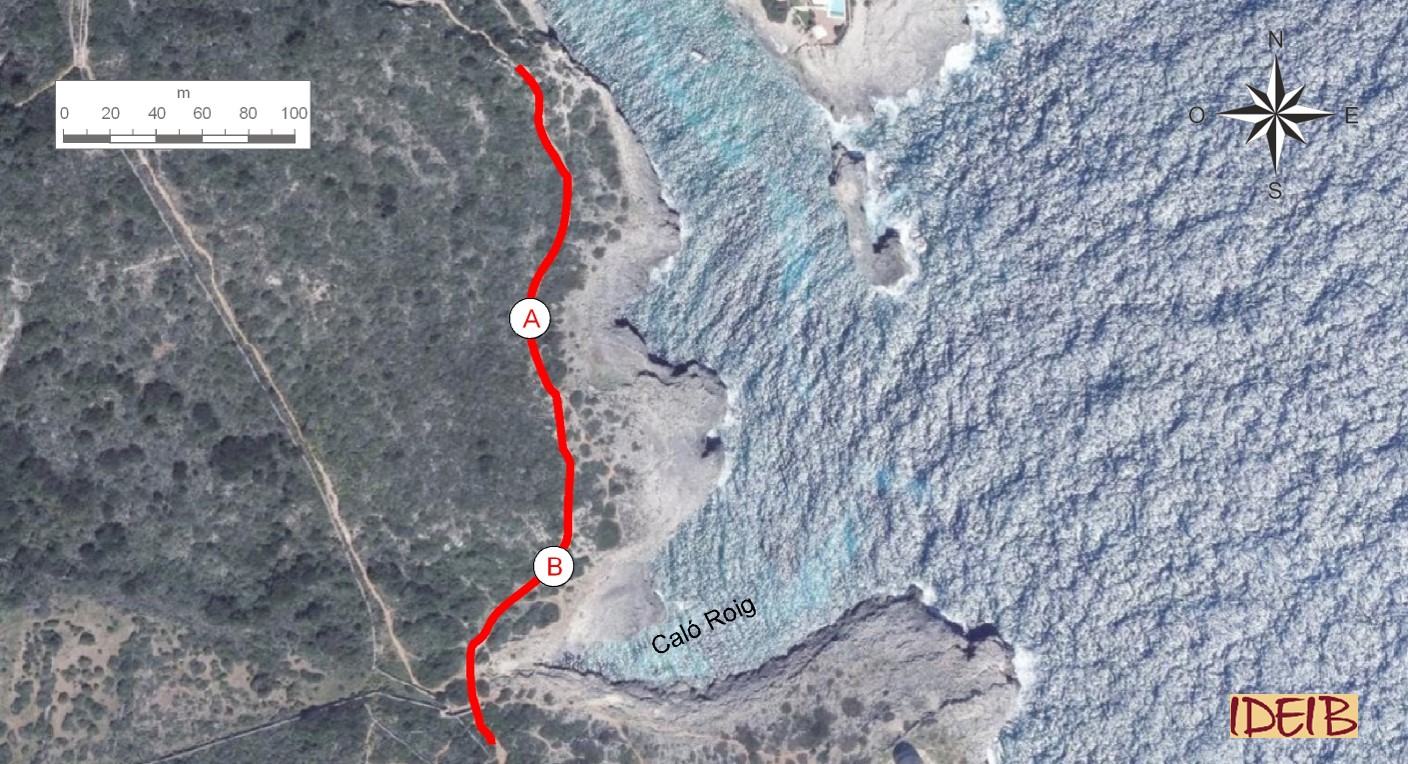
Access, proposed route and continuation to the next stopping point.
The observation point at this stopping point will be on the southern side of Cala Alcalfar cove, which you get to by going around the cove along the beach, where a small stream empties into the sea. In some past time, when the stream was much more energetic, it must have been instrumental in forming the cove.
You are now opposite the Illot des Torn islet. When you look at the islet, probably the first thing that will attract your attention is the arch that stands at its centre like a bridge. This opening occurs at points in the rock that are weaker, normally because they have cracks; these are weak points where the battering of the waves has opened up a small hole that steadily gets bigger. As we explained in the previous stopping point, as the hole increases in size, so the instability grows to the point where the rock collapses. In fact, it is highly probable that the islet was originally connected to the shore by another arch that collapsed. Behind the islet, you can also see the same process in an old cave where the roof has fallen in.
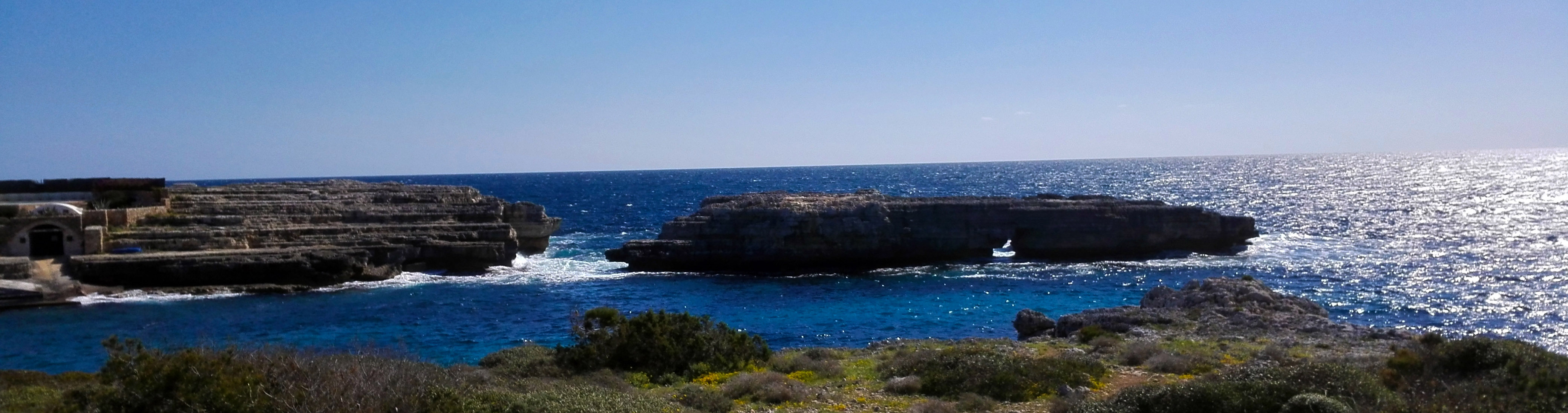
Illot d’es Torn towards the north at Cala Alcalfar (point A).
Take a look at the flat and parallel layers (strata) that make up the islet and that can also be seen in the cove and under the Torre d’Alcalfar defence tower. They are the stratification in parallel plains typical of reef taluses. Reefs are marine ecosystems of calm tropical, and therefore warm, waters made up of a community of living marine beings such as corals and Sedimentary rock whose main component is calcium carbonate (CaCO3). Its origin can be chemical, organic or detritic.</p><p><br></p></div>">limestone algae that, when calcium carbonate enter its tissues, can fossilise. These organisms with a calcareous skeleton grow on top of other dead ones, creating a very resistant Sedimentary rock whose main component is calcium carbonate (CaCO3). Its origin can be chemical, organic or detritic.</p><p><br></p></div>">limestone rock, which is known in Menorca as ‘pedra viva’, literally ‘hard rock” (we should point out that pedra viva can also be formed in other ways). The layout created by the reefs, with organisms growing on top of older ones, ends up with a morphology of uneven rocky mounds, often without a well-defined sedimentary structure.
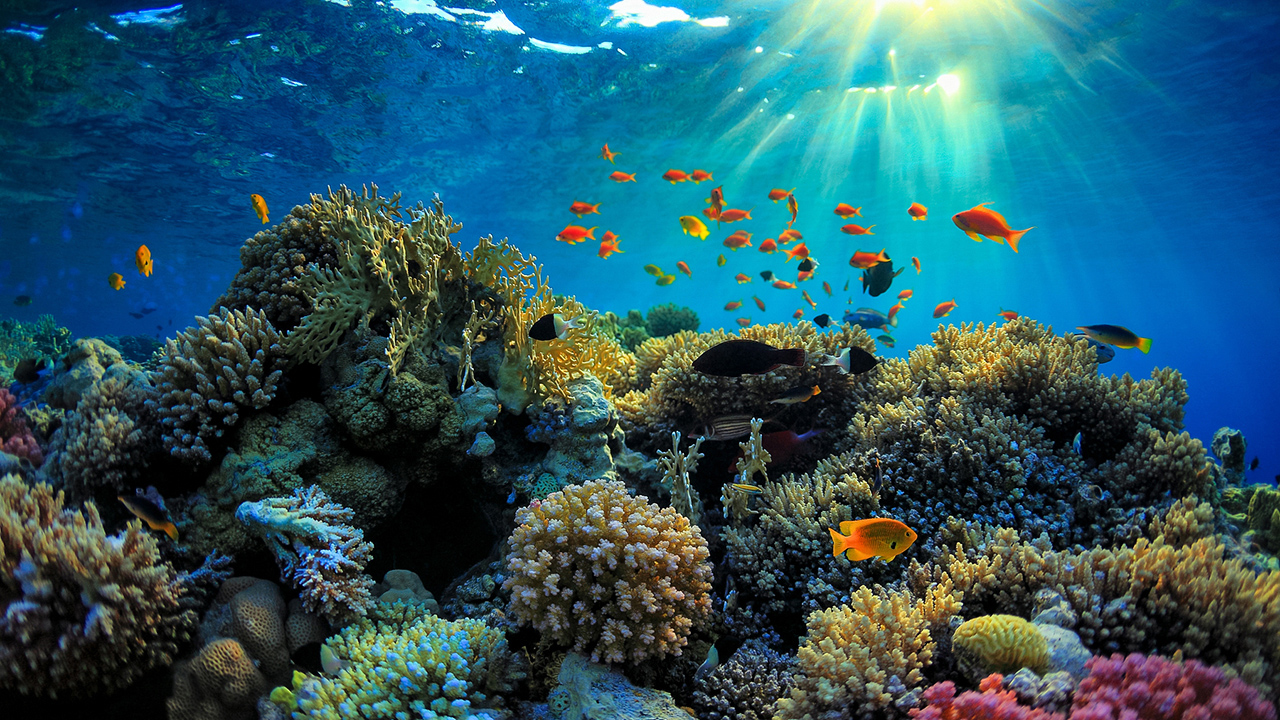
In reefs, each individual is joined to the constructions of its neighbours. Through their growth, they segregate calcium carbonate, which acts as cement to anchor them to the constructions of underlying dead individuals. This way, the reef extends vertically and horizontally. Most of the reefs are made up of skeletons of corals, organisms that live in colonies of numerous individuals. Despite this, other living beings are identified, such as Sedimentary rock whose main component is calcium carbonate (CaCO3). Its origin can be chemical, organic or detritic.</p><p><br></p></div>">limestone algae and clams (www.financialtribune.com).
Consequently, the reefs build a solid construction that stands proud of the surrounding marine formations, and although it is rigid enough to resist the waves, the continuous action of the waves, together with the erosive activity of living organisms, can break off fragments, frequently the size of sand, which are deposited extensively at its base. This way, it should be considered that the reef structure is not limited solely to a mound crammed with calcareous skeleton organisms, but that the sediments derived from its destruction, which are deposited around it, making up its flanks or taluses, are also part of the structure.
The parallel layers that dominate the landscape surrounding you are the front parts or taluses of reefs where the well-stratified sediments that broke off the reef due to the effect of erosion accumulated, together with the new ones that formed at these points. In other words, it should be pointed out that other life forms also proliferate in this sediment, which is deposited at the bottom of the reefs, and that the breakdown of their skeletons will become part of the sediment. Over time, this sandy sediment will consolidate, constituting the most frequent and popular rock in Menorca: marès.
At the top of the promontory, where the Alcalfar defence tower stands, this stratification disappears. Some scientists explain that just below the tower, there is a rock mass that could be associated with the uneven mounds that are formed in the hearts of the reefs. In other words, they believe that under the tower is the living rock made up of the accumulation crammed with organisms that lived in the reef, and underneath this, the marès, well-stratified and derived mainly from the destruction of the skeletons of the living beings that lived in the heart of the reef.
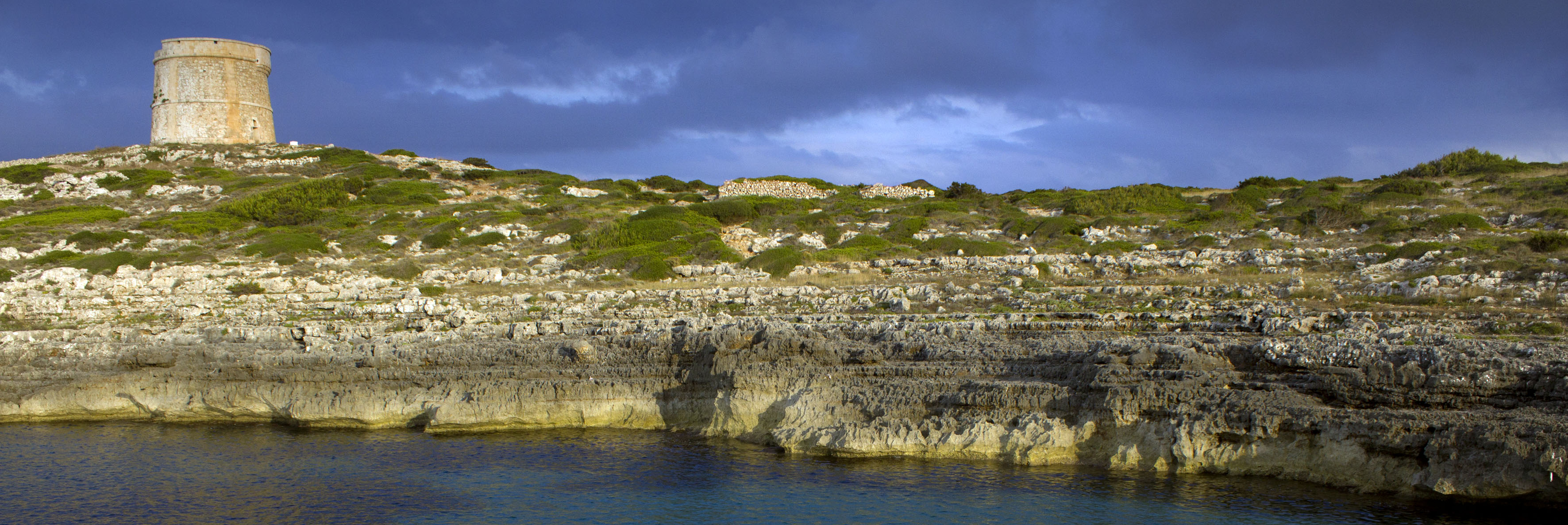
Well-stratified layers at Caló Roig corresponding to reef taluses. The parallel nature between the layers becomes lost as you climb the tower (point B).
