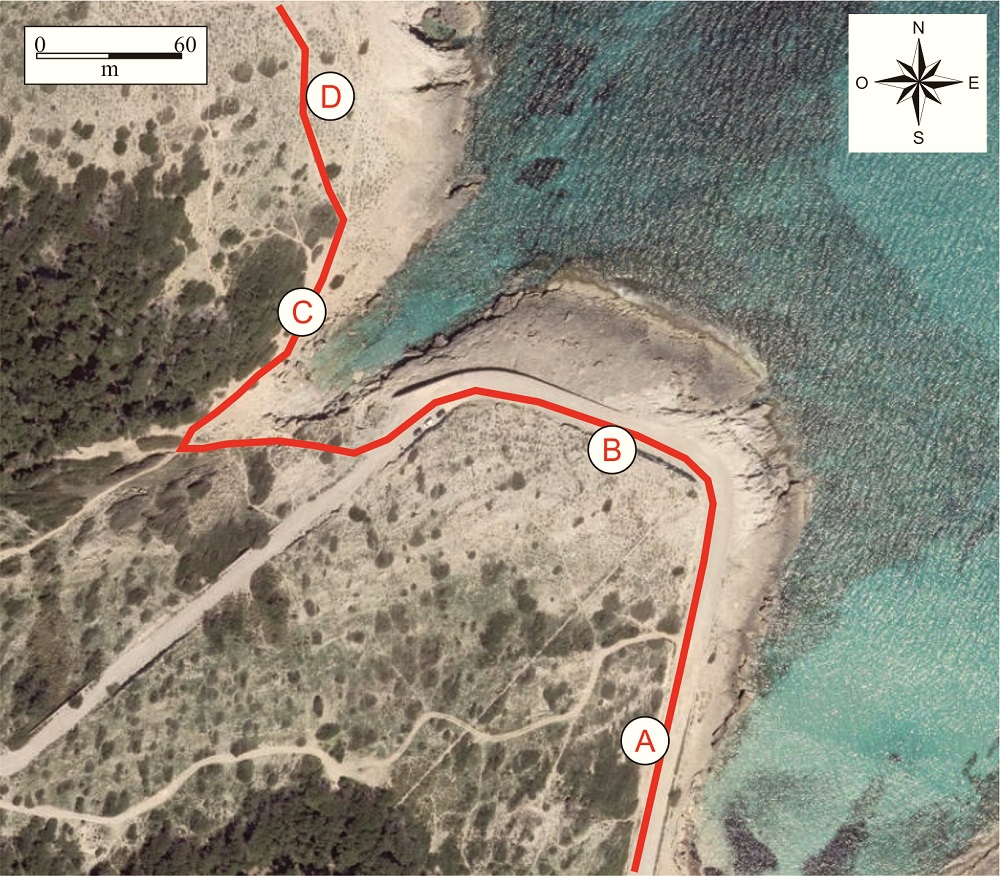
Recommended route.
On the route between Cala Mitjana and Cala Estreta we can see the main characteristics of the Cretaceous rock materials and their relationship with other more modern rocks.
On the slope that leads to Cala Mitjana (point A), covering the Cretaceous rocks, we see other light Brown sand rocks. These are calcarenites and correspond to fossil remontas dunes. These dunes were formed by the action of the wind against the coastal cliffs and are from Pleistocene. They will accompany us during the rest of the itinerary in the way of rocky patches attached to the Cretaceous and Jurassic materials, locally covering fossil beaches of the same Pleistocene.
The fossil dunes and Cretaceous materials form a discordant contact (red line in the bottom image), because the stratification plane.</p><p><br></p></div>">dip between the two lithological units is different, that is, their strata are not parallel to each other.
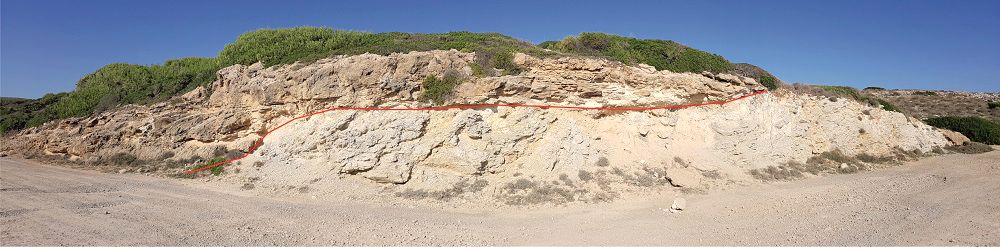
Contact between the Cretaceous rocks, at the base, and the Pleistocene calcarenites (point A).
A Little further on the slope (point B) we can see that the blue-gray limestones of the Cretaceous are very tectonized (very fractured), with abundant folds, fault planes and calcite veins. Some of the planes have developed fault mirrors (flat and polished surfaces due to friction) that have a characteristic flute, indicating the direction in which the fault acted. These faults often converge with each other; give rise to lenticular forms called boudinage.
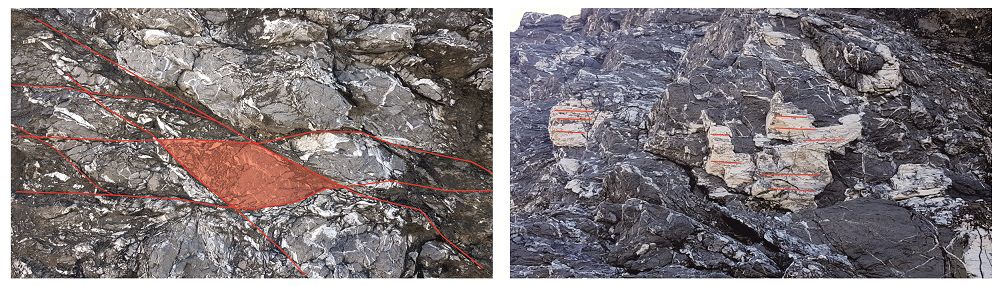
Boudinaged form on the Cretaceous limestones (left) and detail of the fault mirrors (right)
Upwards, on the ascent from Cala Estreta, the stratification of the fossil dunes can easily be seen (point C). Later, at mid-slope, we meet again the Cretaceous limestones, which in this zone eventually contain aragonite, normally in spiral from and with ornamentation. Its <span style="color: black;">abundance and diversity during the Mesozoic makes it a basic fossil for the relative dating of rocks of marine origin. </span></p></div>">ammonite fossils (point D).
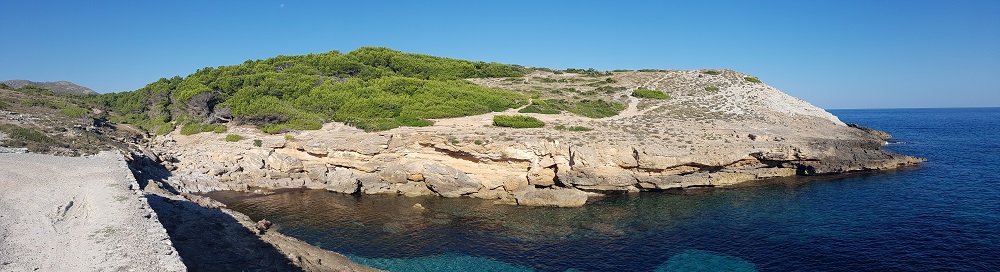
Western slope of Cala Estreta: on the left you can see typical laminations of the Pleistocene dunes, on the right, in the Cretaceous limestones, we can find ammonite fossils.
Ammonites are a type of extinct cephalopod molluscs with an external segmented shell that allowed them to float in the water. They are one of the most characteristic fossils of marine environments. Its abundance and variability gives them great scientific importance. Many of their species are considered guide fossils, that is, fossils that help to date the levels where they are found.
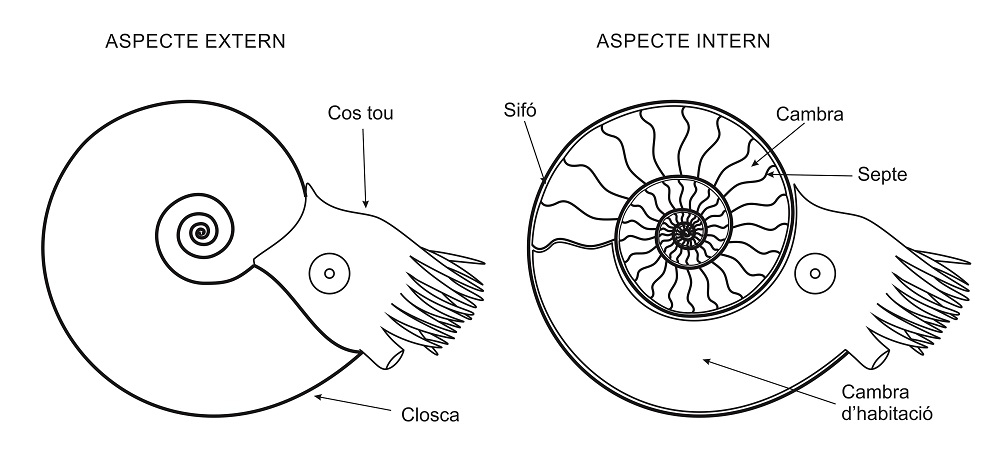
Diagram of the exterior and interior of an ammonite.

Fossil of an ammonite on the Cretaceous rocks.
