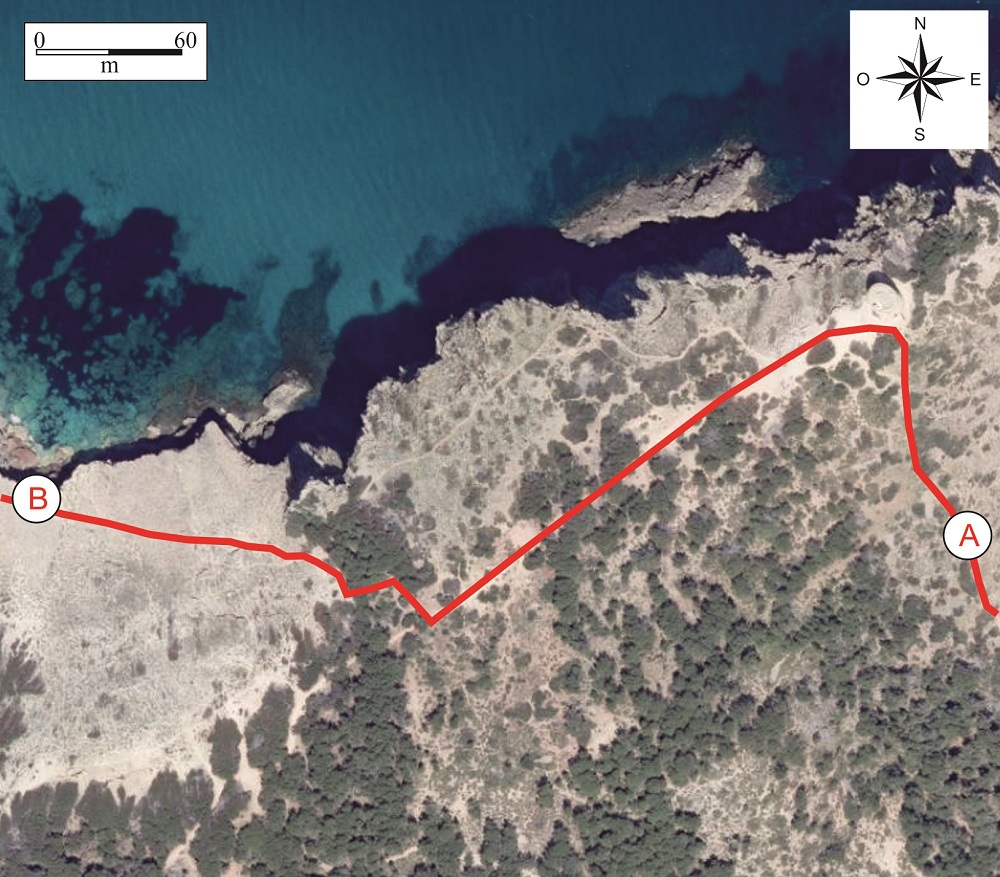
Recommended route.
In the climb up to Sa Torre d’Albarca (point A), the Cretaceous limestones and marls that have accompanied us throughout the route give way to pink rocks with white veins, fractured into centimetric blocks. These are dolomites and dolomitic breccias.
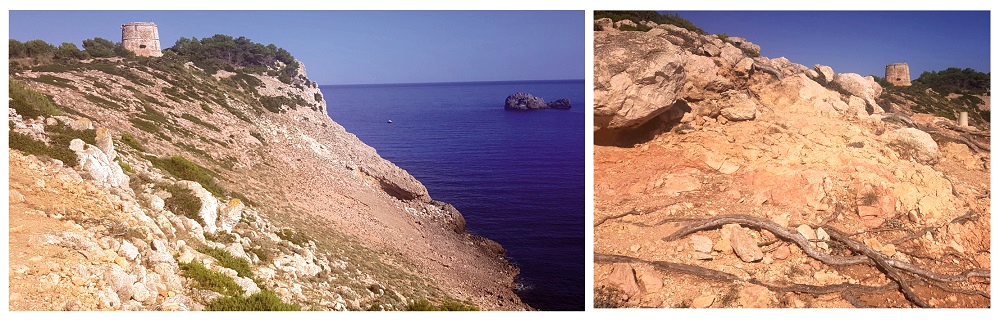
Outcrop of breccias in the climb up to the tower.
AS we will see later (point D of the next stop), these rocks were sedimented in the Upper Jurassic (165-145 Ma) and correspond to marine sediments. They have undergone an intense process of dolomitisation (chemical alteration) and breccification (breakage and fragmentation).
These breccias reappear in the descent from the Torre d’Albarca to s’Arenalet, where, in addition, we will walk on fossil dunes of 15 m in height (point B). It is essentially the same remontary dunes that we have seen along the route. However, at this point, they stand out for their great top of a stratigraphical unit or stratigraphical sequence. </p></div>">thickness and, above all, for the presence of large blocks of Jurassic rocks interspersed (blocks of pink colour). This indicates that when the dunes were forming, they were affected by landslides of the cliff on which they were attached.
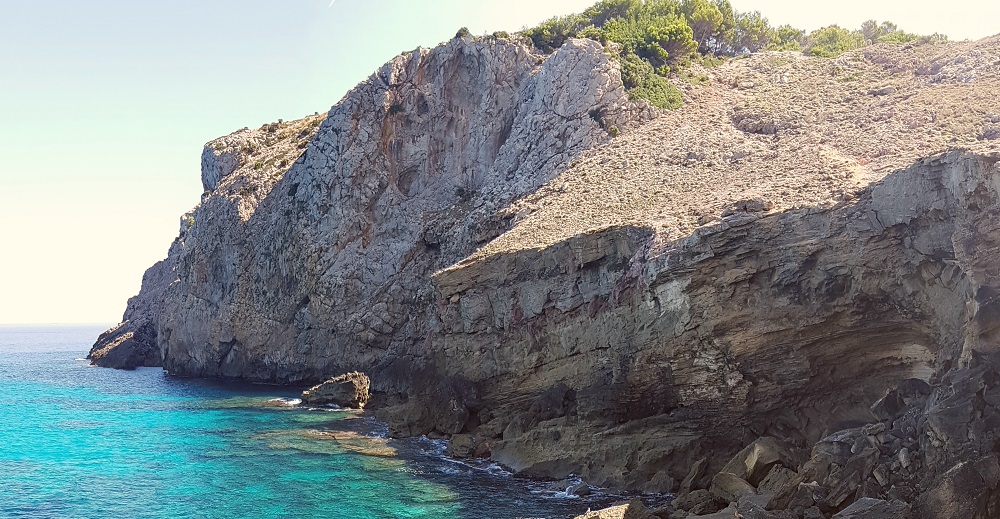
Cliff of dolomitic breccias with an enormous fossil dune in the foreground.
