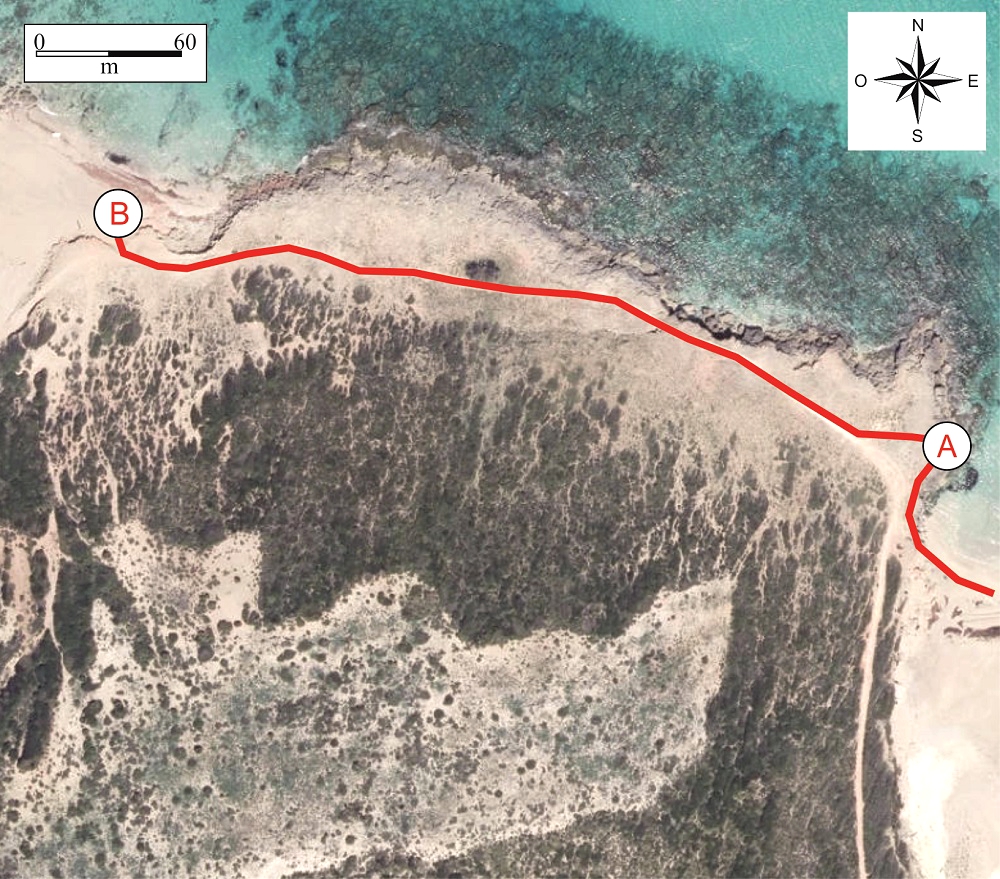
Recommended route.
In the section of coastline between Sa Font Celada and s’Arenalet, below the fossil dunes, there are several small discontinuous outcrops that represent fossil beaches of Pleistocene.
Its paleontological content, basically Mollusc equipped with a fleshy foot and with the body generally protected by a single-piece shell, normally in a spiral shape. The gastropods include snails and limpets, among others.<strong> </strong></p><p><br></p></div>">gastropod molluscs and bivalves indicate a type of coast similar to today’s. However, the presence of species which nowadays live mainly in tropical and subtropical environments of the Atlantic denotes that the climate was clearly warmer
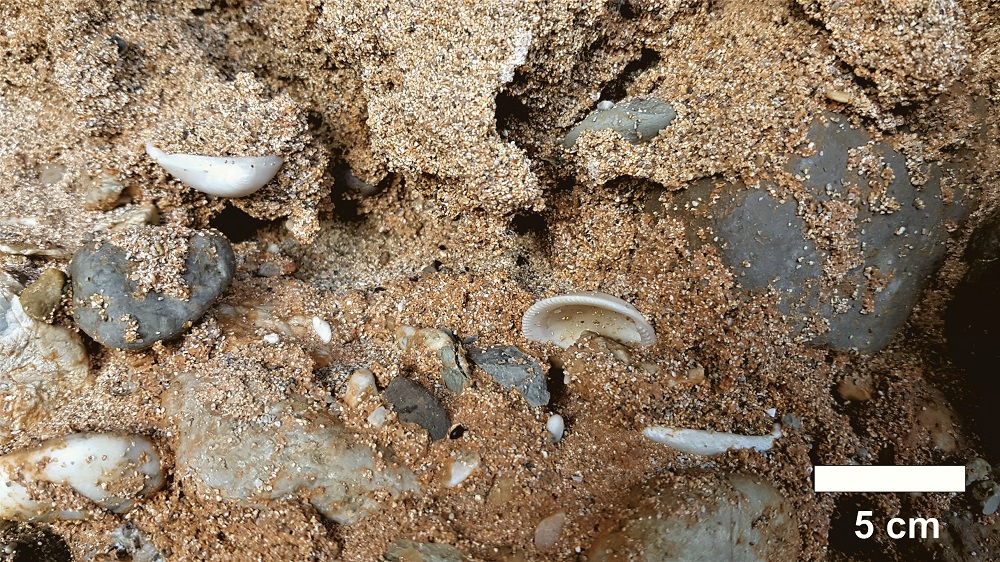
Detail of the beach deposit with Pleistocene mollusc fossils in Sa Font Celada (point A).
On the other hand, at the beginning of s’Arenalet beach (point B), we can observe that the Pleistocene fossil dunes were eroded laterally by a water course, leaving a deposit formed by gravels of different sizes and a reddish brown matrix.
The disposition of the stones is not homogeneous: they are ordered in layers, separated by interspersions of silts, and display a certain degree of imbrication. All of these factors indicate that this is an alluvial deposit, where the gravel layers correspond to moments of storm floods while the silts are from periods in which the stream had a lesser flow.
The gravels are quite angular, which indicates that the source area from which they originated is quite close by, and in addition the lithology is very homogeneous, because there is an abundance of Cretaceous limestones.
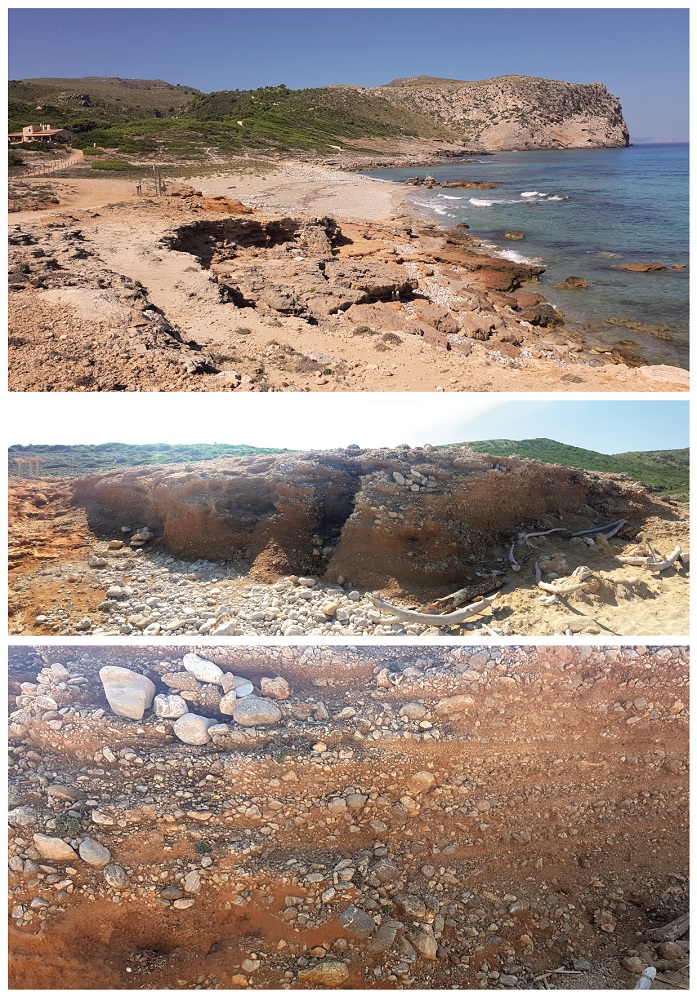
General view of the beach of s’Arenalet and detail of the Quaternary alluvial deposit.
