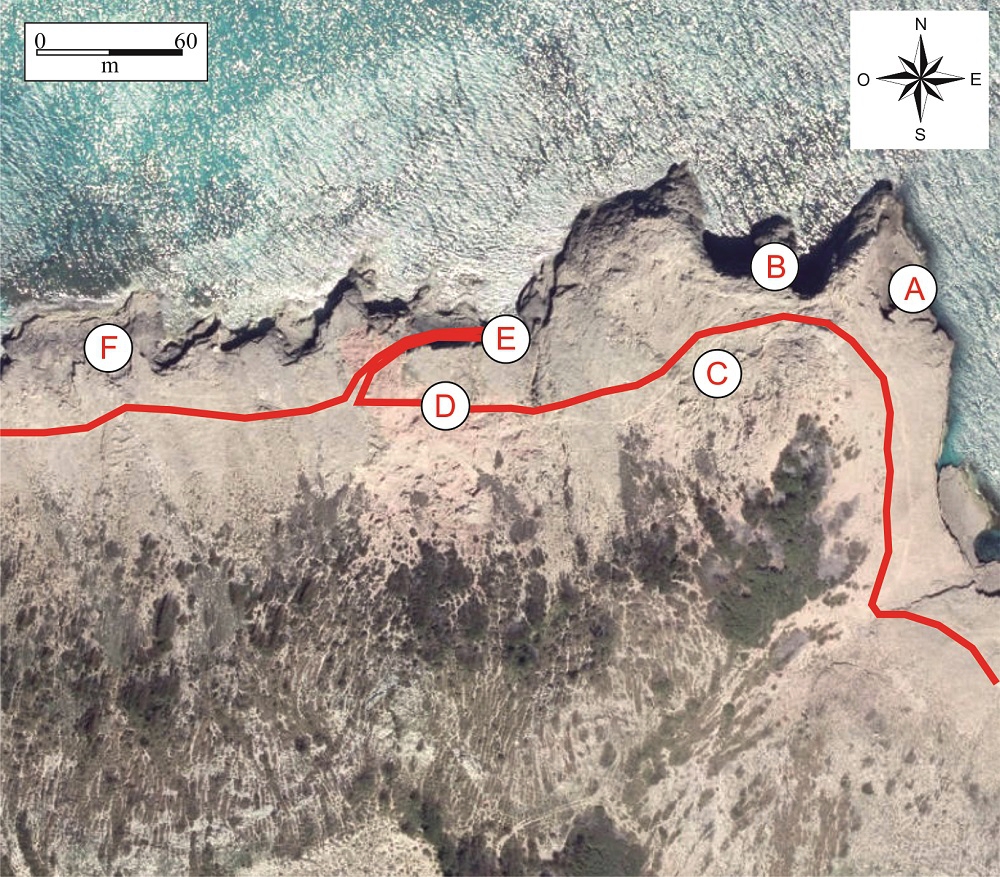
Recommended route.
Continuing our route, in the coastal zone, we see a littoral erosion arch, developed on the fossil dunes of Pleistocene (point A) and, in opposite direction, a littoral erosion bridge, developed on the Jurassic breccias (point B).
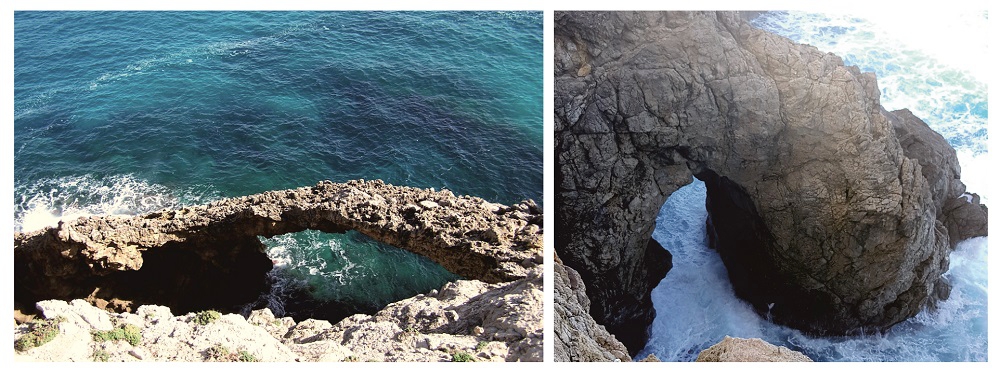
Littoral arch developed on calcarenites (left), and littoral bridge, developed on dolomitic breccias (right).
This type of structures are product of the degradation and retreat of the coastal cliff, due to marine processes (waves, tides, ...).
In this area the slope is constituted by pink and gray dolomitic breccias and interspersed with lenticular limestones of the Cretaceous. At point C, we can appreciate that the contact between both materials is discordant, is a contact
<div class="ql-editor"><p class="ql-align-justify">This occurs when the contact between two stratigraphic series is due to a fault.</p><p><br></p></div>">mechanical contact (fault).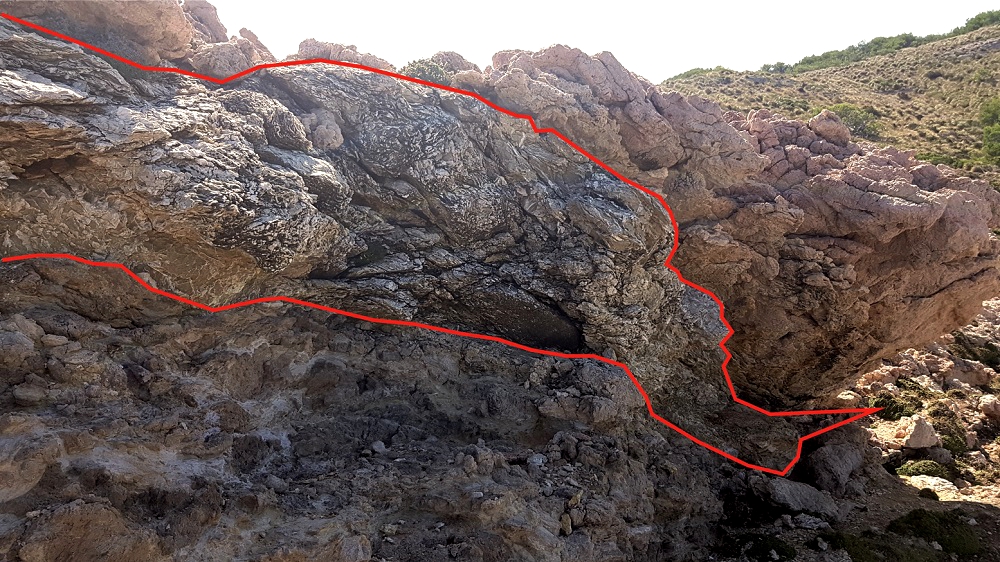
Mechanical contact between the Cretaceous limestones and the Jurassic breccias.
Further on, at point D, the fossil dunes, which cover the coastal slope, have been eroded, revealing a spectacular tectonic, eustatic or antropical processes</span></p></div>">outcrop of limestones and dolomitic breccias.
The kidney-shaped forms and the pink colour of the rock contrast with the rest of the landscape, making this place unique in Mallorca.
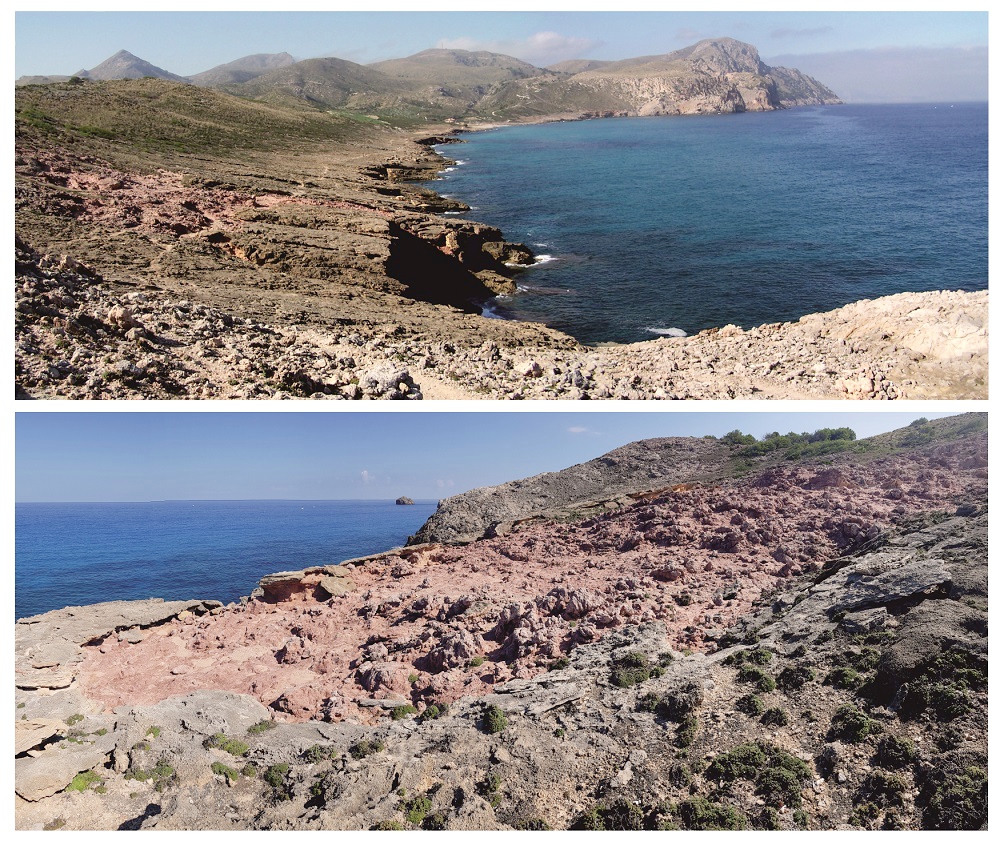
Jurassic outcrop, in the fossil dunes.
Although in the first impression it looks like a mass of chaotic rock, if we loo, closely at some points, we can see that, in fact, it is well stratified. The presence of countless faults has blurred much of its original disposition.
This rocky formation is apparently sterile in fossils that allow its dating, however the punctual presence of Aptychus (operculum of ammonites) and levels with flint suggest that its age corresponds to the Upper Jurassic (165-145 Ma), since these elements are very characteristic of this interval time in Mallorca island.
The intense breccification of the materials, the presence of abundant faults and the existence of lenticular outcrops of Cretaceous limestones interspersed in the Jurassic rocks, denote that this area has suffered an intense deformation and crushing.
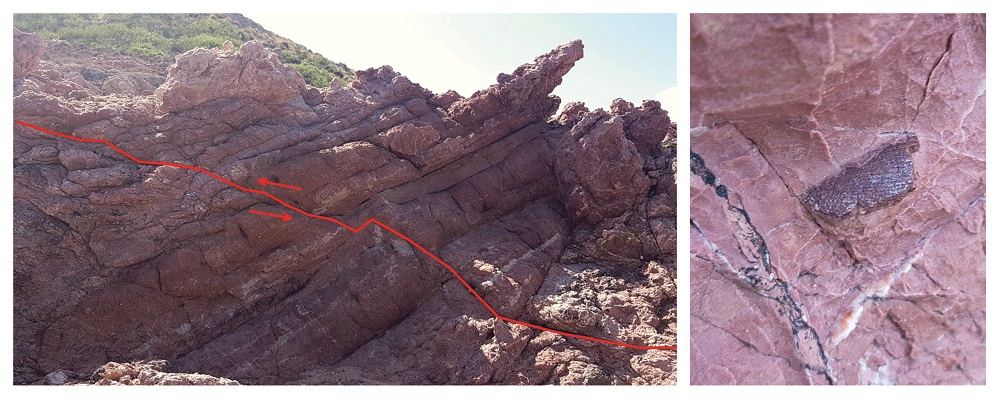
Detail of the dolomitic limestones where its disposition in strata and the existence of faults can be appreciated (left) and Aptychus (righ.).
Just at the point of the tectonic, eustatic or antropical processes</span></p></div>">outcrop of Jurassic limestones and breccias and in the coastal zone we can access a littoral cave developed in the Quaternary fossil dunes.
Access to the cave is done using an old marine rasa (flat surface caused by marine abrasion at low tide level). This surface is responsible for the eight-shape of the entrance of the cavity.
Here (point E) we can observe the cross-stratification typical of this type of deposits and the superimposition of several dune bodies with different orientations, according to the wind that formed them.
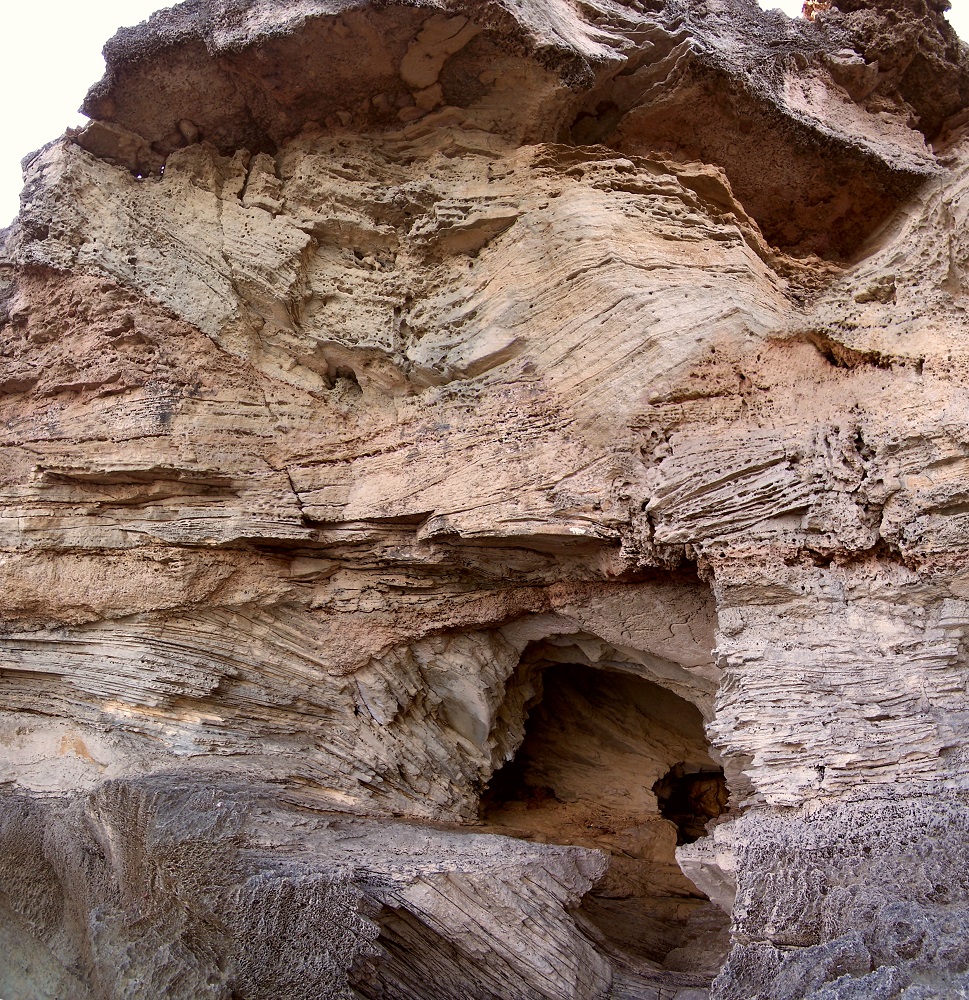
Coastal cave developed in the Quaternary eolianites. Note the marked cross-stratification
On the route to S’Arenalet, it is recommended to go down to the shore to observe several very interesting geological aspects of the fossil dunes (point F).
On one hand, when the dunes were formed there was vegetation present, which has left its imprint in the form of rhizocretions (tubular forms produced by the carbonatation of the land around the root).

Rhizocretions, a type of bioturbation produced by roots in the fossil dunes.
On the other hand, we can study the littoral exokarst, also named littoral karren, caused by dissolution processes of the calcarenites.
Near the coastline we can see that the rocky surface appears to be corroded, with sharp, cutting forms. We can see striations, pinnacles, micro-alveoli and pools (cocons in Mallorcan).
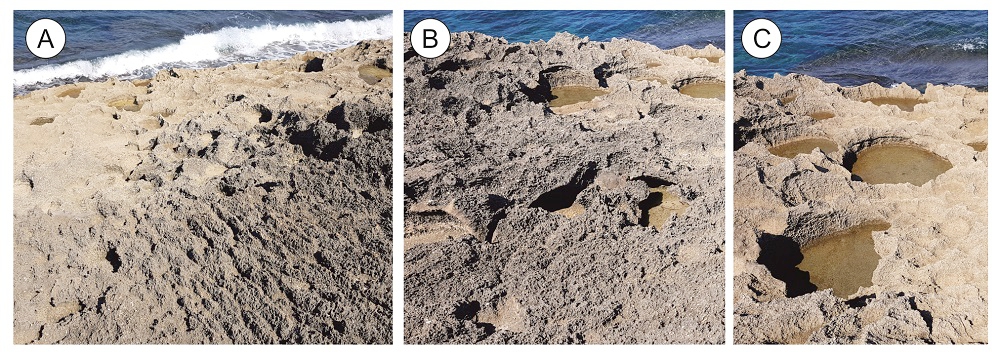
Forms of the littoral karren: striations (A), micro-alveoli and pinnacles (B) and pools (C).
