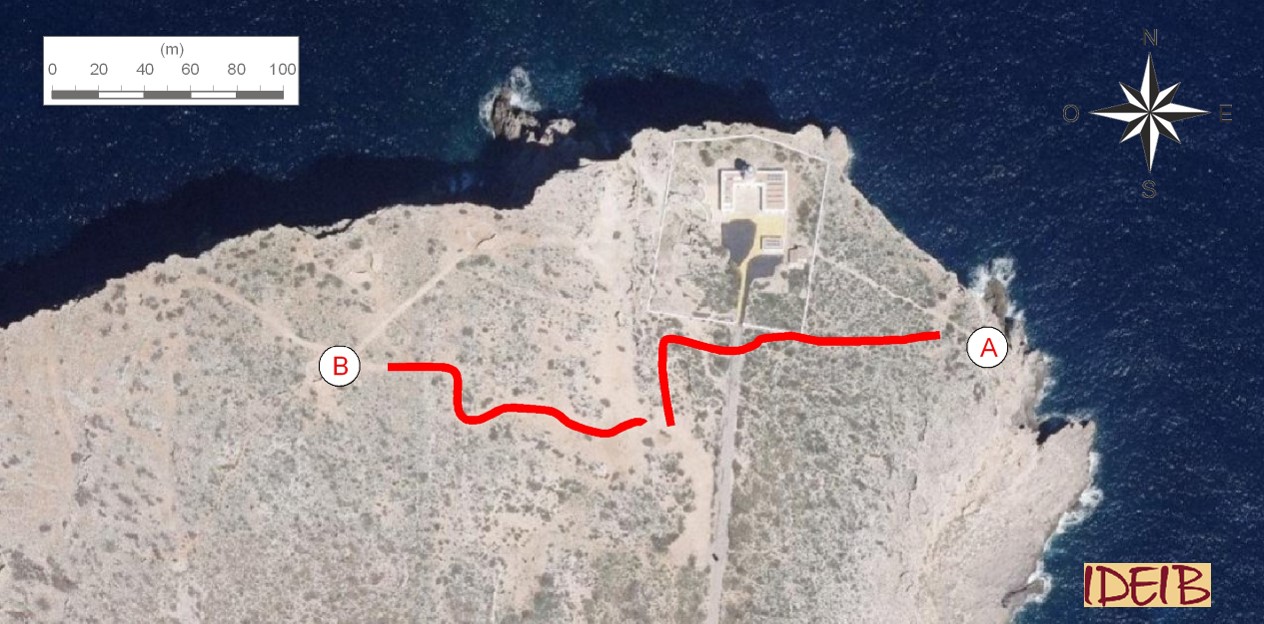
Suggested route to the stopping point.
The northernmost point of Menorca, the Cap de Cavalleria headland offers unique views of the island’s north coast. From here, you can clearly see the different geological units that make up the Tramuntana region of Menorca and its influence on the landscape. It will also allow you to recognise the rocks of the Grey Menorca. On reaching the lighthouse, there are two observation points: the first to the eastern cliffs (taking a path to the right of the lighthouse), and the second to a belvedere that you’ll find by taking the trail that leads from the car park to the military gun emplacements to the west of the lighthouse.
The first observation point will allow you to recognise the rocks of the Grey Menorca. These rocks were formed after the red ones between 240 and 110 million years ago, in the Triassic and the Jurassic, and they occupy an approximate extent of 15% of the total of the island. The lands of the Grey Menorca are made up primarily of Sedimentary rock whose main component is calcium carbonate (CaCO3). Its origin can be chemical, organic or detritic.</p><p><br></p></div>">limestone and dolomites sedimented in a shallow sea, where numerous life forms proliferated, such as ammonites and belemnites. The skeletons of these organisms, very frequently partially or completely broken by the waves, would end up creating a sediment. The cementation of the grains that form the sediment led to the formation of a rock, Sedimentary rock whose main component is calcium carbonate (CaCO3). Its origin can be chemical, organic or detritic.</p><p><br></p></div>">limestone, which over time could partially transform itself into another rock: dolomite.
You can find them, for example, at Cap de Fornells, El Toro, Bajolí, S’Arenal d’en Castell and making up a steep coastline especially at La Mola de Fornells and Cavalleria. At this point, the rocks are dolomites sedimented in the Jurassic, on which dunes were deposited in the lower Quaternary (around 2 million years ago). The contact between the two forms a stratigraphic series or successions.</p><p><br></p></div>">discordance, a surface that separates two sets of strata of different ages, which indicates that the deposition of sediments was not continuous. In this case, the stratigraphic series or successions.</p><p><br></p></div>">discordance is angular as the upper strata (the Quaternary marès) were deposited on inclined and severely eroded strata (the dolomites of the Grey Menorca).
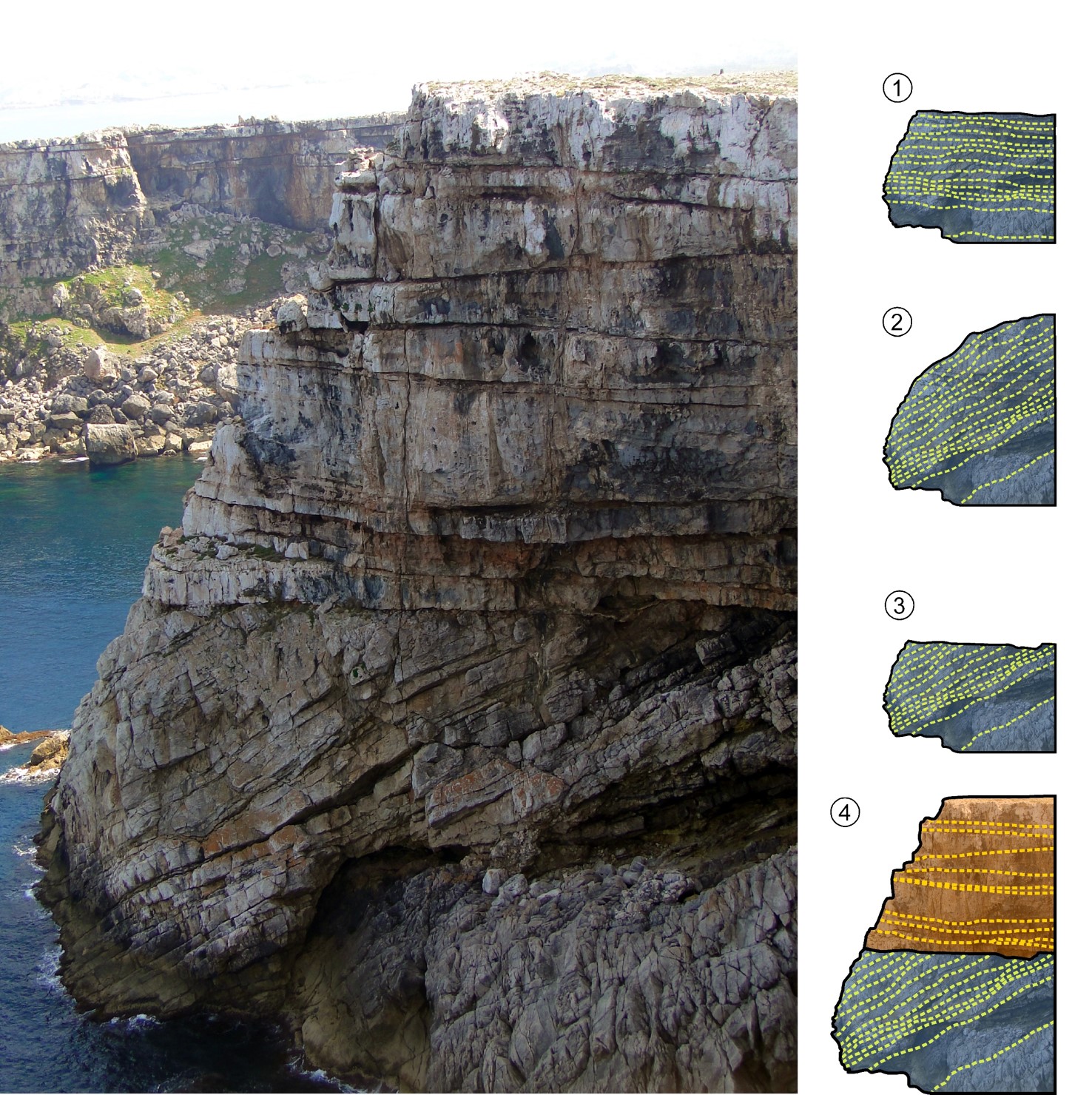
Angular discordance at Cap de Cavalleria and its evolution. The Jurassic sediments were deposited in horizontal and parallel strata (layers) (1). Then, tectonic forces caused them to incline as a whole (2). Later, the rocks underwent intense erosion, which completely destroyed the relief, forming a plain (3). Finally, in the Quaternary, horizontal strata of sand were deposited on this flat surface above the inclined strata (4) (point A).
If you go to the west of the lighthouse, you will get superb views of the geological landscape of Menorca’s north coast. Cavalleria, along with Cap and La Mola de Fornells (headland and mesa), Sanitja and Punta des Vernís, form a practically flat relief, which contrasts with the landscape that we see a little further south, around Tirant and Binimel·là, with an irregular relief due to the presence of small hills.
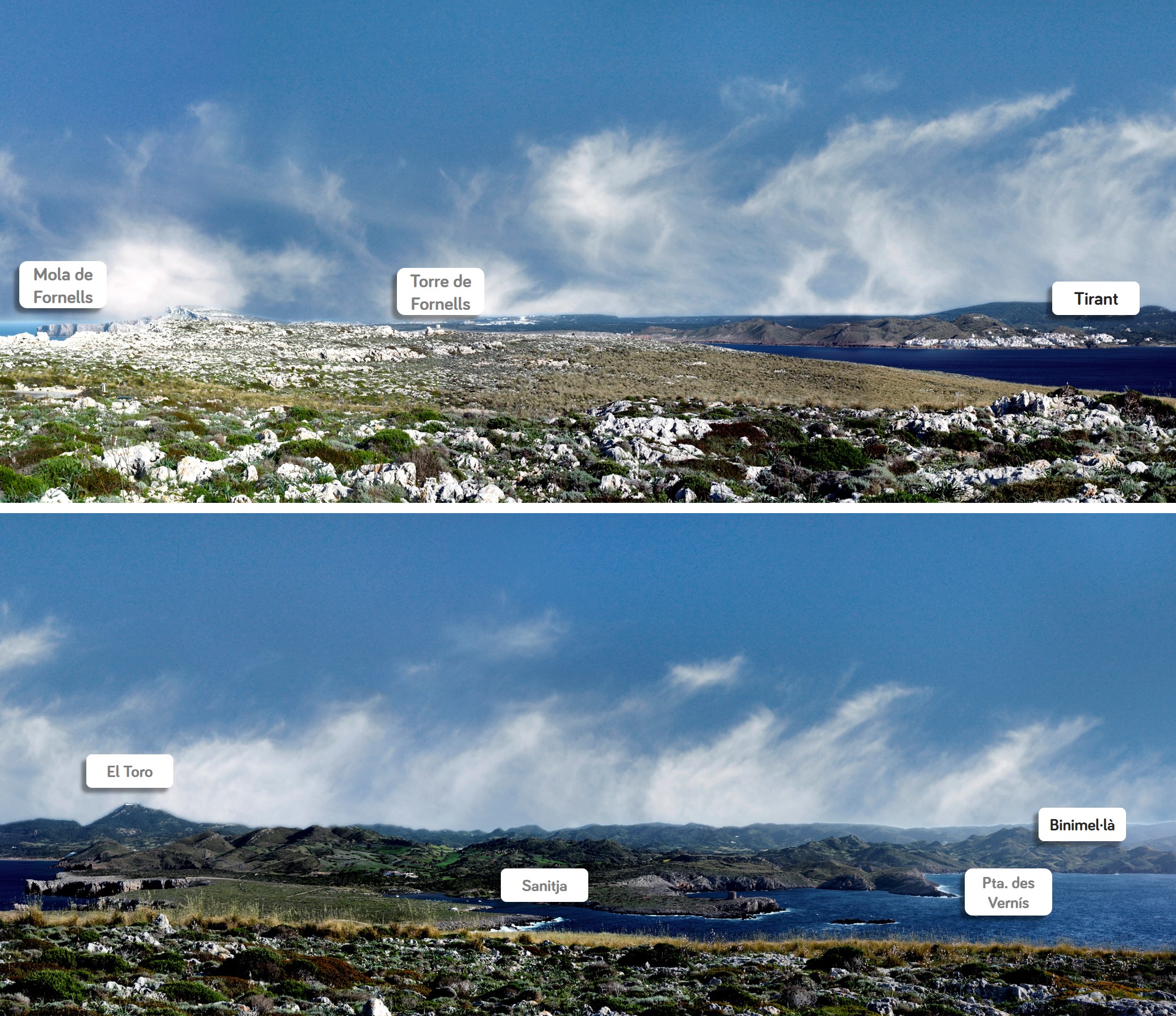
View from La Mola de Fornells to Binimel•là from Cap de Cavalleria. In the foreground, the relief is flat; by contrast, small hills dominate the background (point B).
The former are the rocks of the Grey Menorca that we have just identified at the last observation point, while the latter are the oldest rocks discovered in the Balearic Islands, formed some 400 million years ago, and which are part of the Dark Menorca. So, if there are big differences between these two sets of rocks, how is it possible to find them next to each other? You have to find the answer in the action of a fault. Millions of years ago, huge tectonic forces, that were able to cause enormous earthquakes, caused the rocks of the Grey Menorca to sink in comparison with those of the Dark Menorca, which in turn rose or remained immobile.
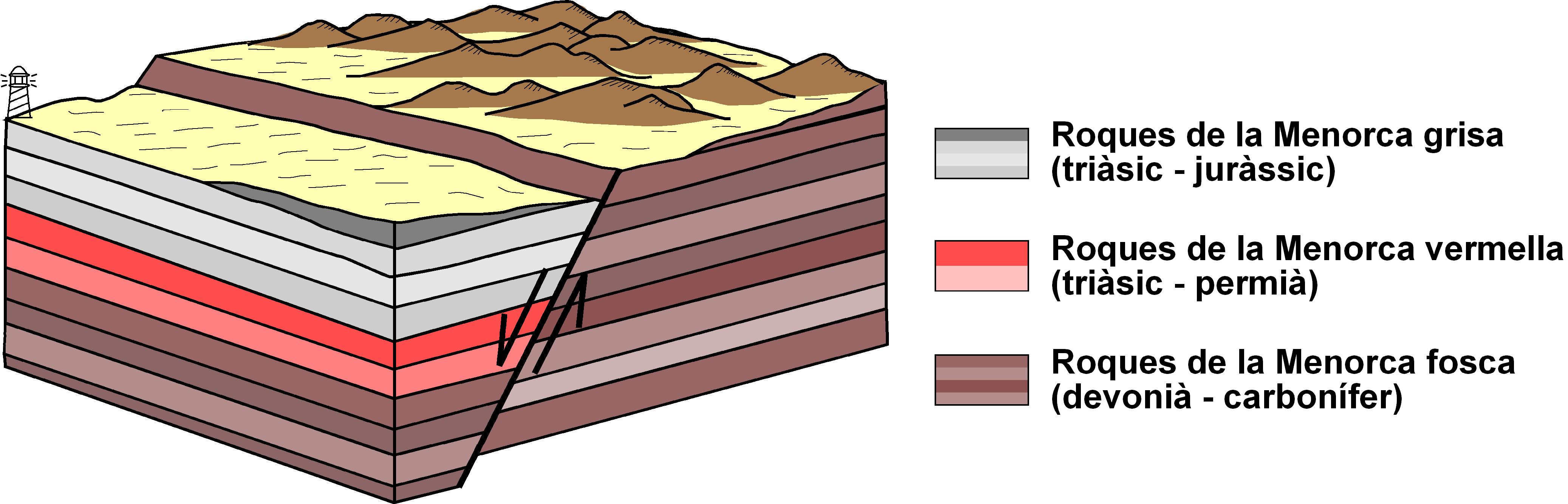
The sinking of Cap de Cavalleria (which, years earlier, formed a continuous land with the Cap and La Mola de Fornells and Sanitja – Punta des Vernís), placed its rocks at the same height as those of Tirant, sedimented many millions of years earlier.
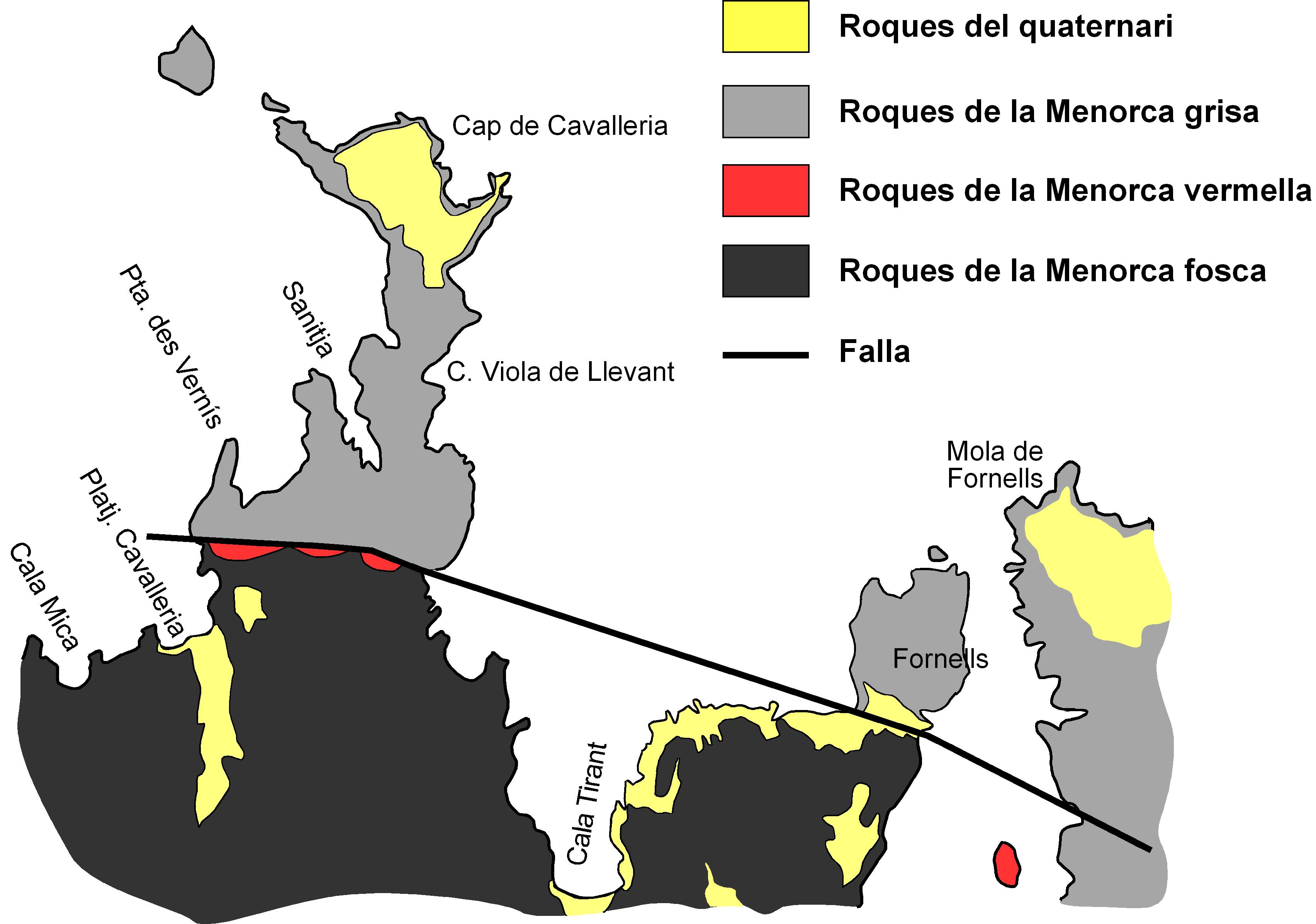
A more or less straight line is drawn on a map of this fault that follows the path demarcated by the sunken block of Tramuntana formed by the La Mola (mesa) and Cap (headland) de Fornells, Cavalleria and Sanitja – Punta des Vernís, which were once joined to form a single block.
In the background, the El Toro mountain, made up of the same grey rocks, lead us to believe that perhaps at some time Cavalleria and El Toro were at the same height and that a series of staggered faults sank Cavalleria by at least 340 metres compared with El Toro.
