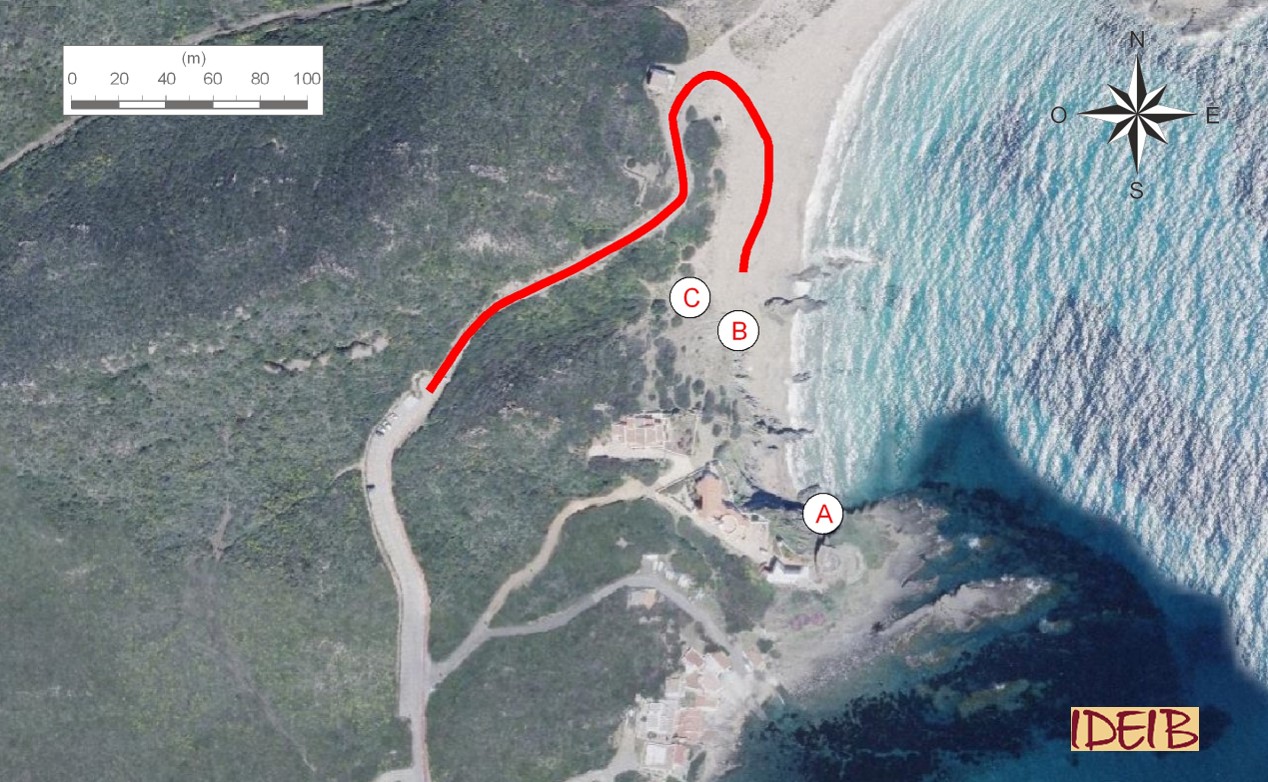
Access route to the stopping point.
We suggest recognising the rocks of the Dark Menorca at Sa Mesquida beach, on the southern side, under the defence tower crowning the Punta de sa Torre headland. We find the oldest rocks on the island in the Dark Menorca. These rocks were sedimented in the Palaeozoic era in periods of the Earth’s history called Devonian and Carboniferous (415-324 million years ago). Their rocks occupy around 15% of the island and are primarily lloselles and quartz sandstones formed on the seabed, although we also occasionally find other types of rocks.
Most of the rocks in the Dark Menorca were formed on the seabed from avalanches of sediments that reached the abyssal plain from the shelf. A huge avenue of a river may cause a sudden fall of sediments to the depths of the sea. Even a slight earthquake may cause a mass fall of sediments deposited originally on the continental shelf near the talus and some instability. In both cases, the sediments fall very quickly taking advantage of the slope of the talus in the form of a turbulent current, creating an avalanche of different types of sediments and water that accelerate as they fall downwards while separating from the seawater as a current of turbulent water.

The avalanches of sediments that formed these rocks contained different sized grains: very small (clay or silt), medium-sized (sands) and large (cobbles). As the avalanches fell down the talus, they separated from the seawater as a current of turbulent water (1). When they reached the abyssal plain, they started to slow down and the turbulent current gradually released the particles that it no longer had the strength to keep in suspension. Consequently, it first deposited the large and medium-sized grains (2) which would, over time, form the conglomerates and the sandstones, and then the finer ones (3), which would form the lloselles. Successive avalanches of sediments caused the superimposition of one on top of the other, creating a turbidite series.
Of the rocks that form a turbidite series, the conglomerates are the least frequent but the most striking. They are sedimentary rocks with cobbles of more than 2 mm that are found in a matrix that fills the gaps between the cobbles and that is usually sandy or muddy material. The conglomerates can be very different, with cobbles of different sizes or practically the same, made up of the same type of rock or different ones (which means different colours and roundedness in the same rock) or with the presence of a lot of matrix or almost without matrix.
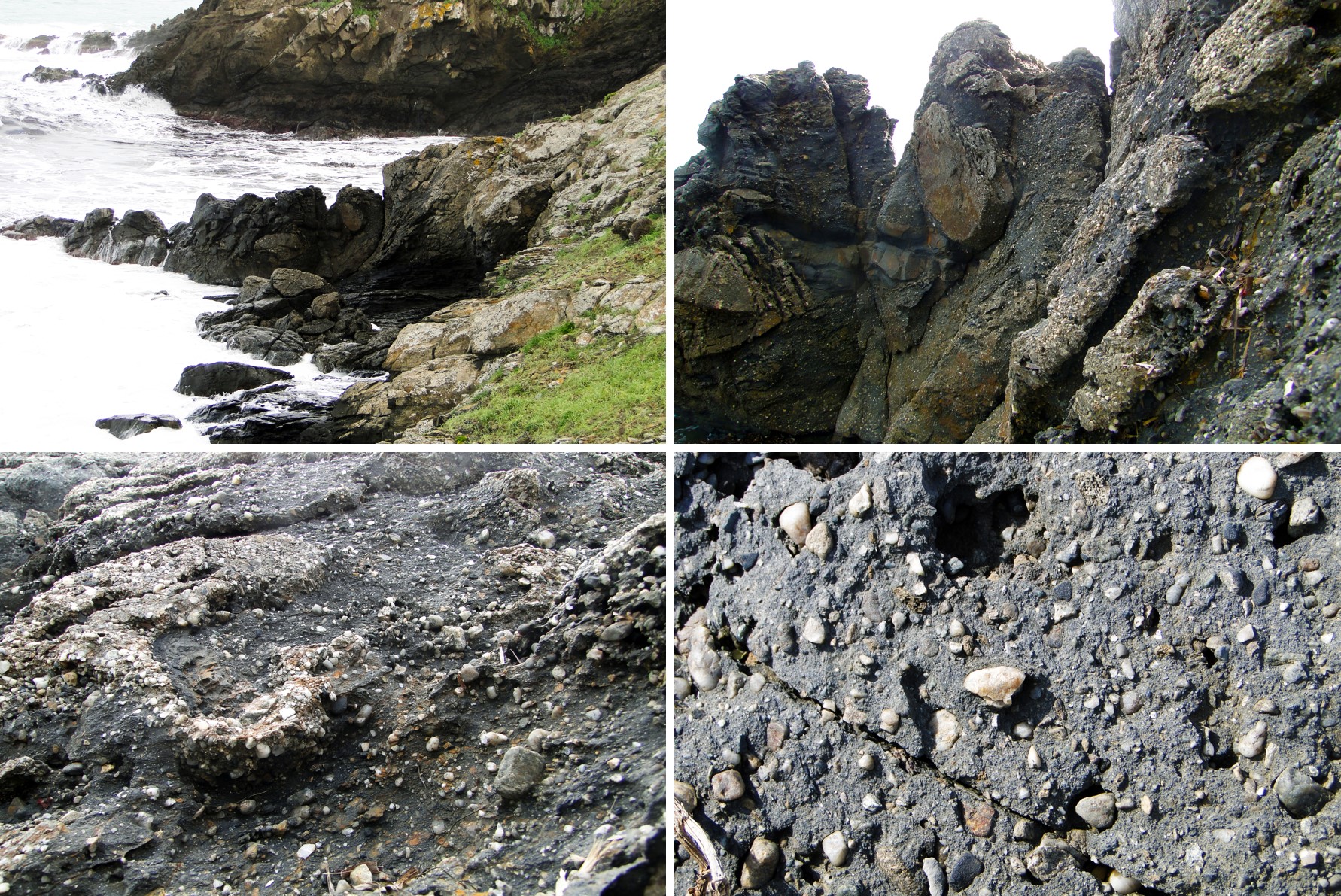
General view of Punta de sa Torre and the conglomerates that outcrop there (above) and close-up of them (below). These are conglomerates with a lot of matrix where the cobbles have travelled floating in a matrix resulting from the slippage of chaotic masses and where folded material is observed (point A).
The sandstones have a rough and rugged appearance, made up of grains of sand between which quartz mineral predominate and where we also find small fragments of other rocks, such as sedimentary rock which tends to exfoliate in small flakes, similar to sedimentary rock formed by clay.</p></div>">pelite. </p></div>">llosella, among other elements that, if you look closely, you can identify with the naked eye. They are characterised by often having alveolar or honeycomb erosion and cross laminations.
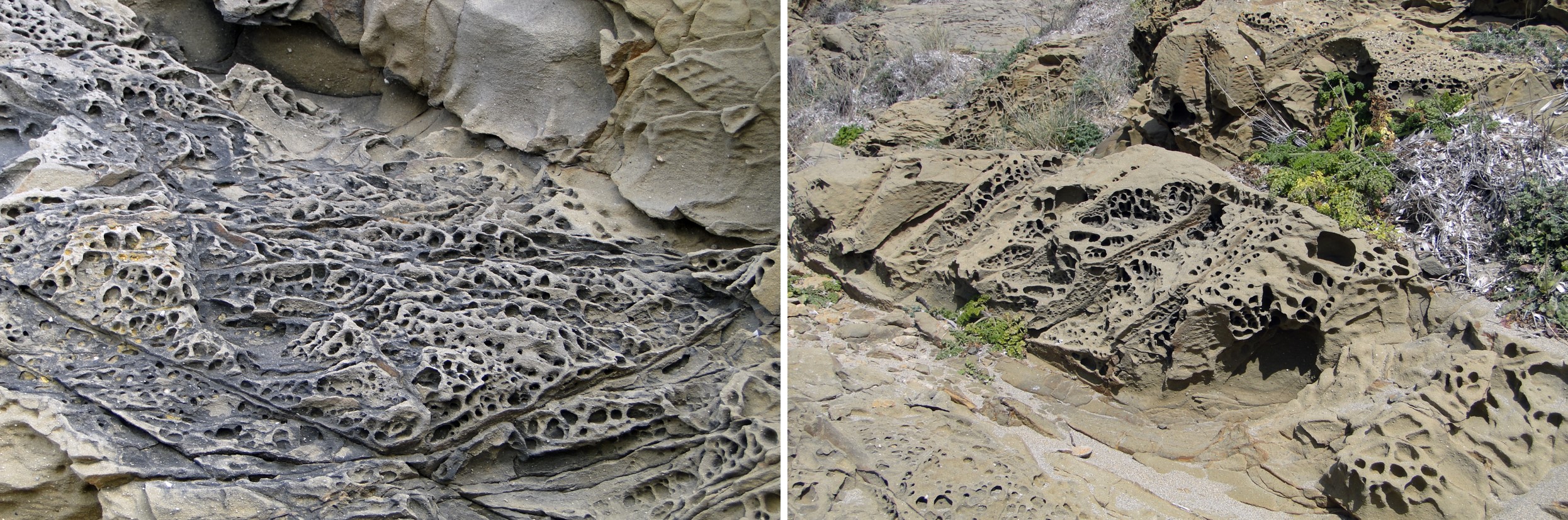
One of the most typical forms of the north Menorca landscape is alveolar or honeycomb erosion. Very often these shapes are caused by the corrosive action of salt on the sandstones and due to the uneven distribution of the cement that binds the rock particles. Erosion “drills away” at the softest points, the ones with less cement, or softer grains, which it makes jump and create cavities. On the harder parts, it sometimes leaves small protrusions, points with higher levels of cement (point B).

If you look at the sandstones close up, you will see that some of them have structures that were formed when the rock had not yet consolidated and was still an accumulation of loose sand in movement in the depths of the sea. At this point, the action of the turbulent current led to a succession of grooves and small piles of sand that give the sediments a fluted and undulating appearance. When the sediments consolidate, these structures can persist on the rocks, giving rise to fine cross-laminae in the section of a rock, which are a reflection of the currents that carried the grains of sand. Although these shapes are normally associated with sandstones formed on the Earth’s surface, sandstones constituted from turbulent currents also display them (point B).
The last material that culminates the sedimentation process of a turbidite sequence is clay, which, over time and with the transformations that it entails (compacting, tectonics, metamorphism, etc.), end up forming lloselles, a predominantly clayey rock with a slate-like appearance that is usually found in small flagstones (lloses in Menorca, hence the name of ‘lloselles’). In these types of rock, we frequently observe marks that appear to decorate the rocks. These are marks made by animals (such as worms or snails) which, during the Carboniferous, in their desire to find food, shelter or escape their predators and enemies, moved (generally during moments of calm from the point of view of the avenues of turbulence) above the sediment of the seabed leaving marks known as ichnofossils or trace fossils.
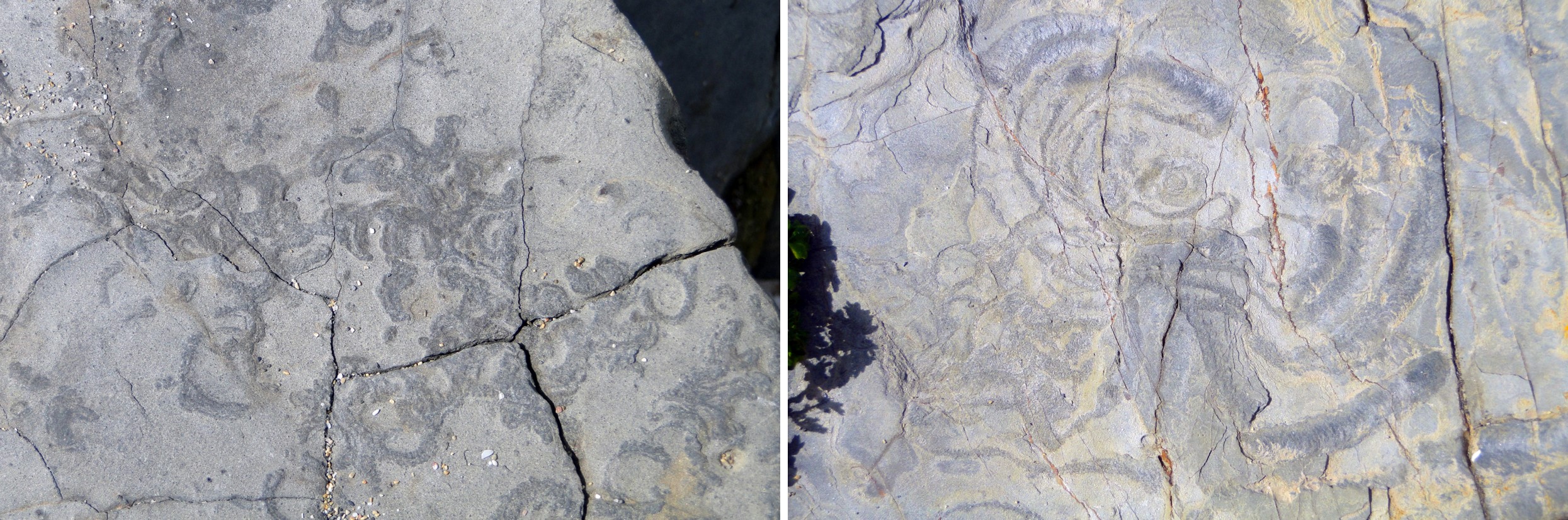
Very often we do not know which species of animal left these trace fossils, as no fossilised remains have ever been found and we have no skeletons (the hard part). Note that these traces vary a lot, given the different animals that could have created these marks and their different activity, each animal created a different one, each animal behaved differently and with a distinct body (point C).
