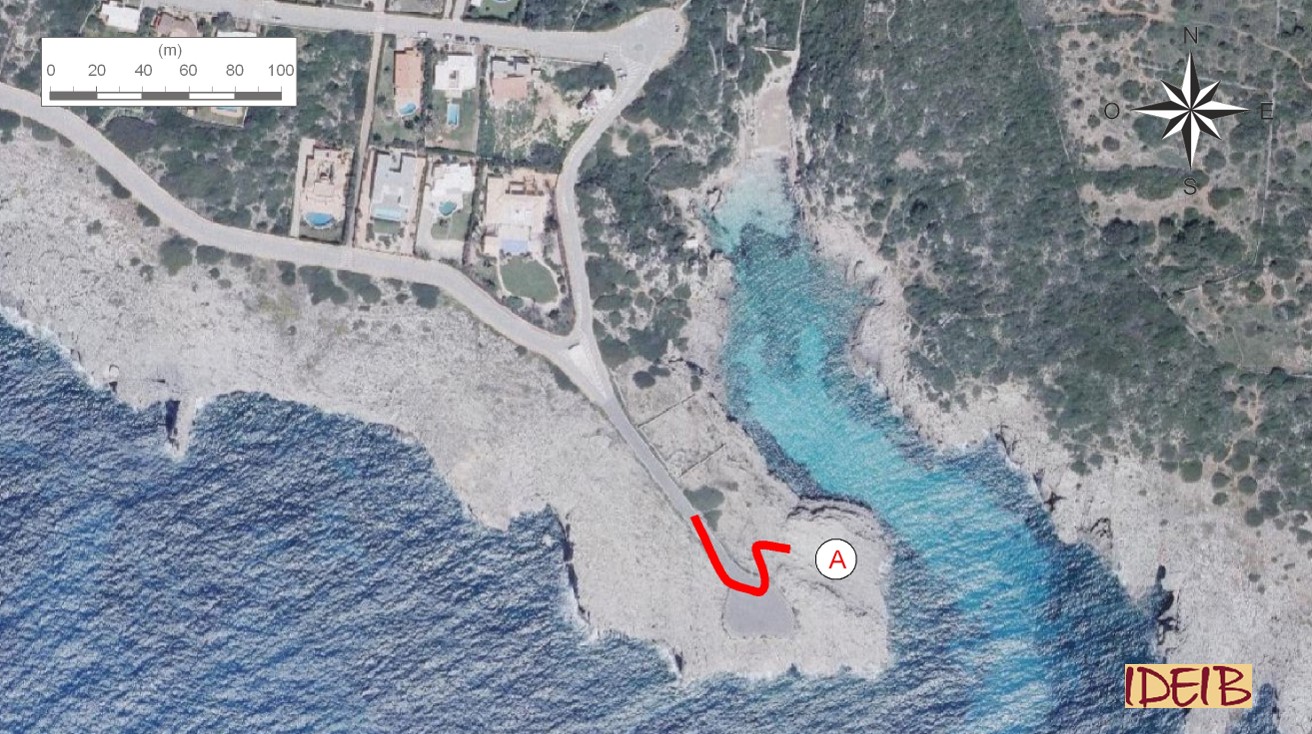
Access to the stopping point
The route ends with a visit to Cala de Binidalí to see the rocks of the White Menorca. You can access the observation point from the residential area of the cove along Carrer des Fonoll Marí Street until you reach a small roundabout at the end of the road next to the western edge of the cove.
When the Miocene began (23 million years ago), strong vertical movements occurred in Menorca that led to the rising of the Tramuntana area and the sinking of the Migjorn. This sinking allowed the sea to invade the Migjorn region and the start of the sedimentation of the island’s most characteristic rock, marès, a sandy rock formed by the accumulation of the remains of skeletons of millions of marine organisms mixed with grains of quartz and fragments of other rocks from the erosion of the mountains that formed Menorca’s Tramuntana region.
Binidalí is a cove, the continuation of a ravine, opened up by the action of an energetic stream, possibly at a time when the sea level was lower than it is now. In other words, the coastline was further to the south than at present and consequently the ravine was longer and, especially, more sloping, such that its erosive force was very much more significant. When the sea level rose, the steam’s erosive capacity was practically cancelled out, giving rise to the small ravine we see today. From a geological point of view, the cove is outstanding for an unusual concentration of rhodoliths.
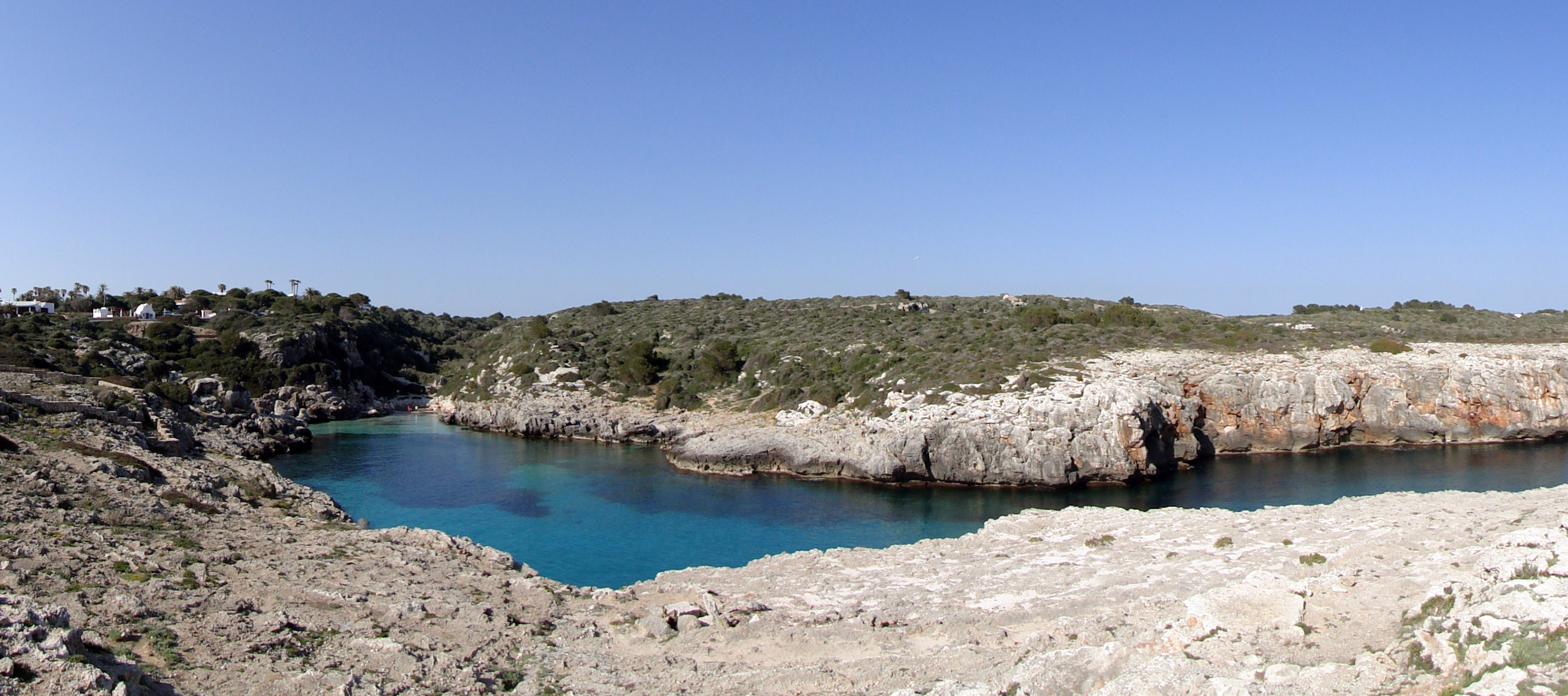
General view of Cala Binidalí from the suggested observation point (point A).
Rhodoliths are nodules of algae made up primarily of coral algae that grow around the remains of a solid, such as a cobble or a shell fragment. Since algae need light to grow, they always develop in the area between the surface of the sea water and the shallows, known as the photic zone, from which point on photosynthesis is not possible as there is insufficient sunlight.
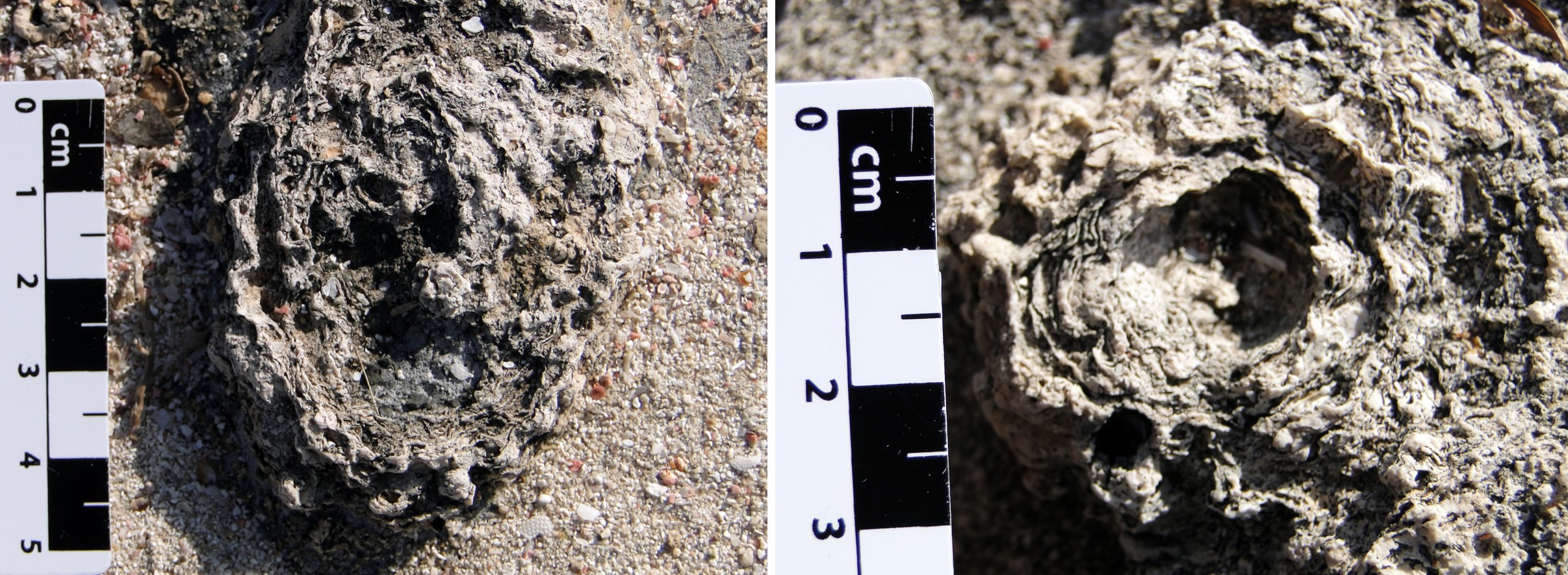
This cross-section shows that the nodules have a concentric structure as a result of their growth. Rhodoliths develop from a nucleus that may display the most extraordinary variety of natures. At the centre of the fossil, we can intuit the nucleus from where it forms (point A).
These algae are characterised by the fact that they can incorporate calcium carbonate into their tissues, in other words, they calcify, making it easy for them to become fossilised. As they grow, most of these types of algae become somewhat spherical due to the dynamics of the environment caused by the movement they are subjected to from the currents and waves. In other words, the tumbling they are subjected to by the movement of the seawater where they live gives them this shape. Despite this, their external morphology may vary, among other shapes, from spherical to more or less flat.
Red algae or rhodoliths have been present in the sea around Menorca for millions of years; they now inhabit the area from the shoreline to depths of around a hundred metres at most, they are not subjected to a fixed substratum (which makes them move and gives them their spherical shape) and are popularly known on the island as ‘crespell’’. Their ridged shaped means that they can easily get caught in fishermen’s nets. Rhodoliths can form very dense aggregations (blankets) over the subtidal coastal area, the extent of which may vary from a few metres to several kilometres. We should stress that Sedimentary rock whose main component is calcium carbonate (CaCO3). Its origin can be chemical, organic or detritic.</p><p><br></p></div>">limestone algae are one of the dominant fossils on the rocks in southern Menorca.
Consequently, the marès at Binidalí is made up principally of rhodoliths and of fragments of all sizes resulting from their destruction. In other words, these more or less complete fossils are the grains that principally constitute the rocks at Binidalí. Rhodoliths are found next to each other and are joined together by a matrix of small calcium carbonate particles forming gently south-sloping parallel layers and giving the Sedimentary rock whose main component is calcium carbonate (CaCO3). Its origin can be chemical, organic or detritic.</p><p><br></p></div>">limestone rock a granular appearance.
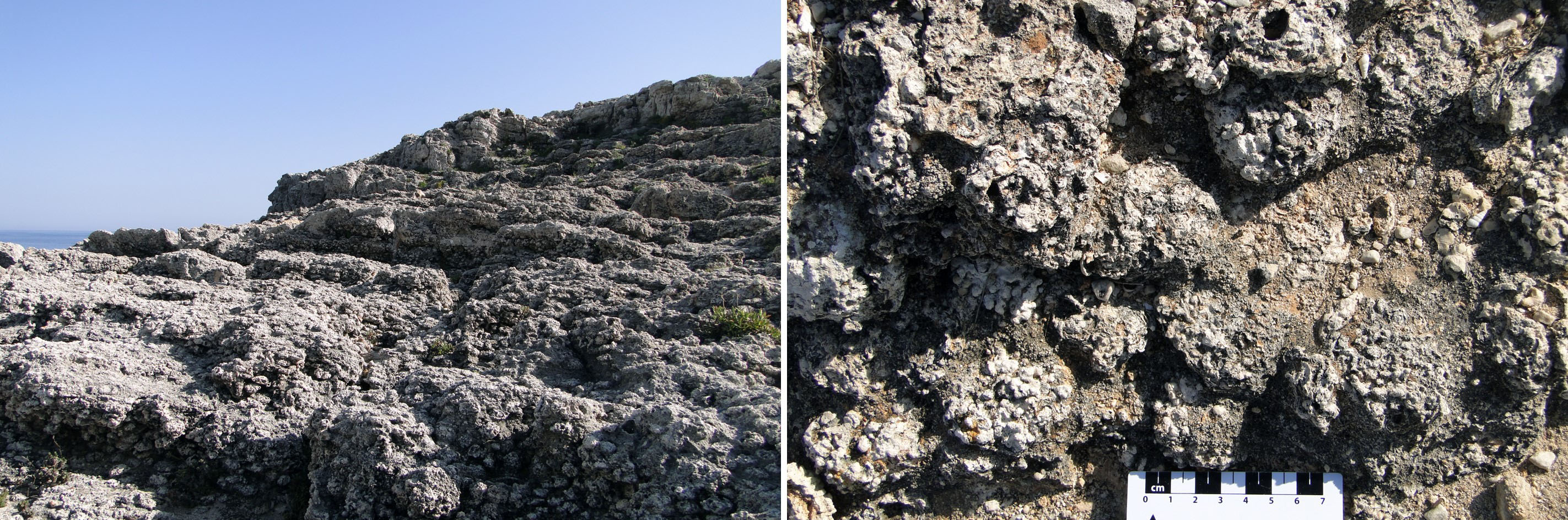
Close-up of the rhodoliths outcrop (coral algae), one of the most abundant fossils, together with the sea urchins and molluscs, in the Menorca marès (point A).
The fossils like these that make up the stopping point are exceptional and essential elements in knowing the history of our planet and, consequently, of Menorca. If they are removed from the field by non-specialists, the information that they contain will be lost, so it is essential that you do not collect these specimens in order to conserve the geological outcrops and to allow everyone to be able to enjoy them. We should not forget that fossils are geological elements that may contain exceptionally important information and must not be extracted from the field unless it is for scientific reasons, and if they are removed, they must be deposited in museums.
