
Recommended route.
As we go up towards the Punta de Sa Torre we will see that the slope is formed by grey and pink rocks. These are once again materials of the Rethian.
Just at the highest point of the road there appear some whitish rocks of granular appearance that contrast with the previous ones. They correspond to sandstones of the Lower Miocene, from some 20 Ma ago (point A). These materials are part of the Sant Elm Formation and represent relatively shallow seabeds – in them we can observe fossils of ostreids.
In contrast with the Triassic materials, which are inclined towards Cala Molins, the Miocene rocks are vertical, so the contact between them is said to be discordant.
If we approach the edge of the cliff (point B) we will see that we are standing on top of an almost vertical wall about 10 metres high. We are on the crest of a fault
<div class="ql-editor"><p class="ql-align-justify">Inverse fault in which the stratification plane.</p><p><br></p></div>">dip of the fault plane is at a low angle (generally less than 45<sup> o</sup>). It tends to refer to large-scale (regional) structures.</p><p><br></p></div>">thrust fault of one of the laminas which form the Serra de Tramuntana. The calcareous rocks, on which we stand, have been superimposed on the materials that tectonic, eustatic or antropical processes</span></p></div>">outcrop on the north-west, in Cala Clara and Cala Barques, and over the calcarenites of the Lower Miocene that we have just seen at point A (which is the reason why they are discordant).
Thrust faults are a type of tectonic structure which is produced by the fragile breakage and shortening of the earth’s crust. They occur in periods of compression of the crust. In this case, this process took place during the Alpine Orogeny (25-15 Ma), which was when the island of Mallorca acquired its structure in the form of raised and depressed zones.
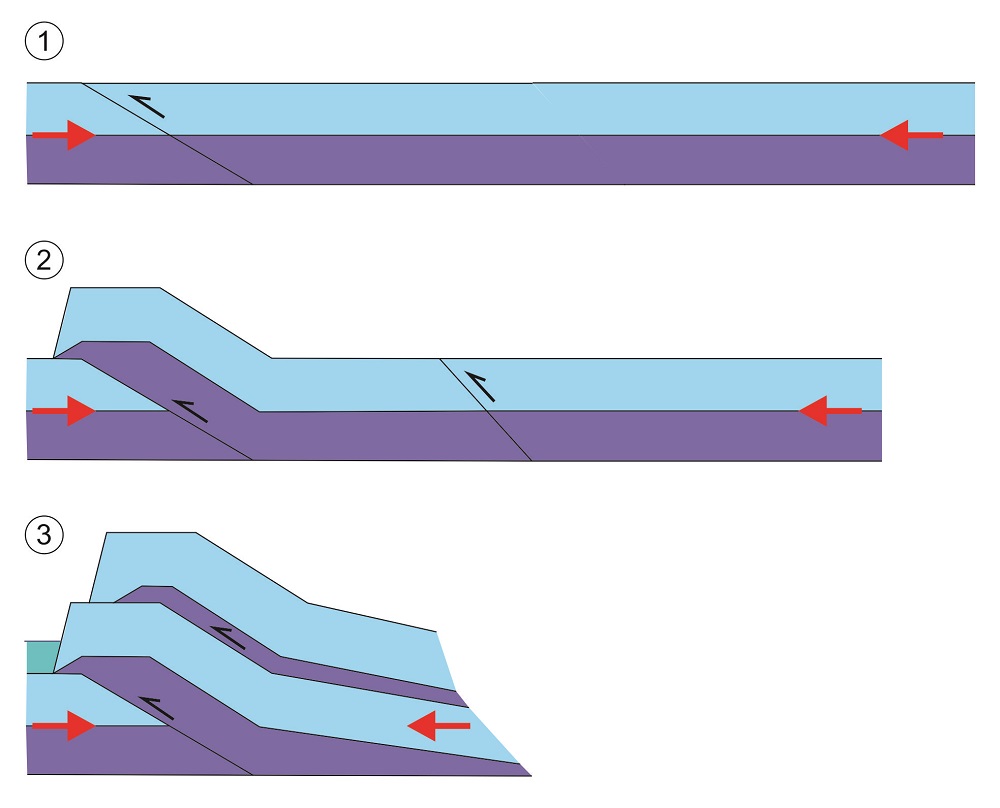
Formation of imbricated thrust faults due to compression forces. Observe the shortening of the earth’s crust.
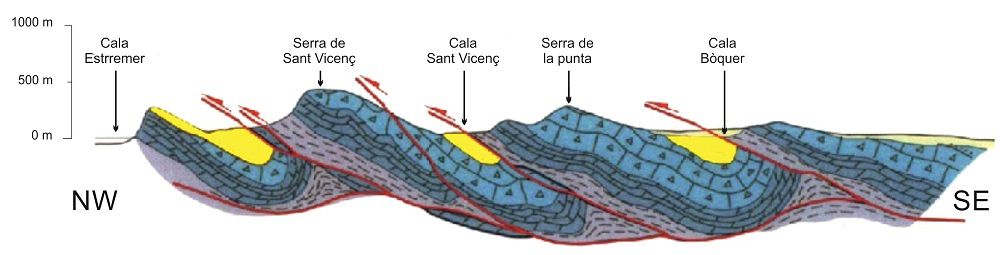
Geological cross-section of the Serra de Tramuntana in the zone of Cala Sant Vicenç (modified from IGME, 1992).
