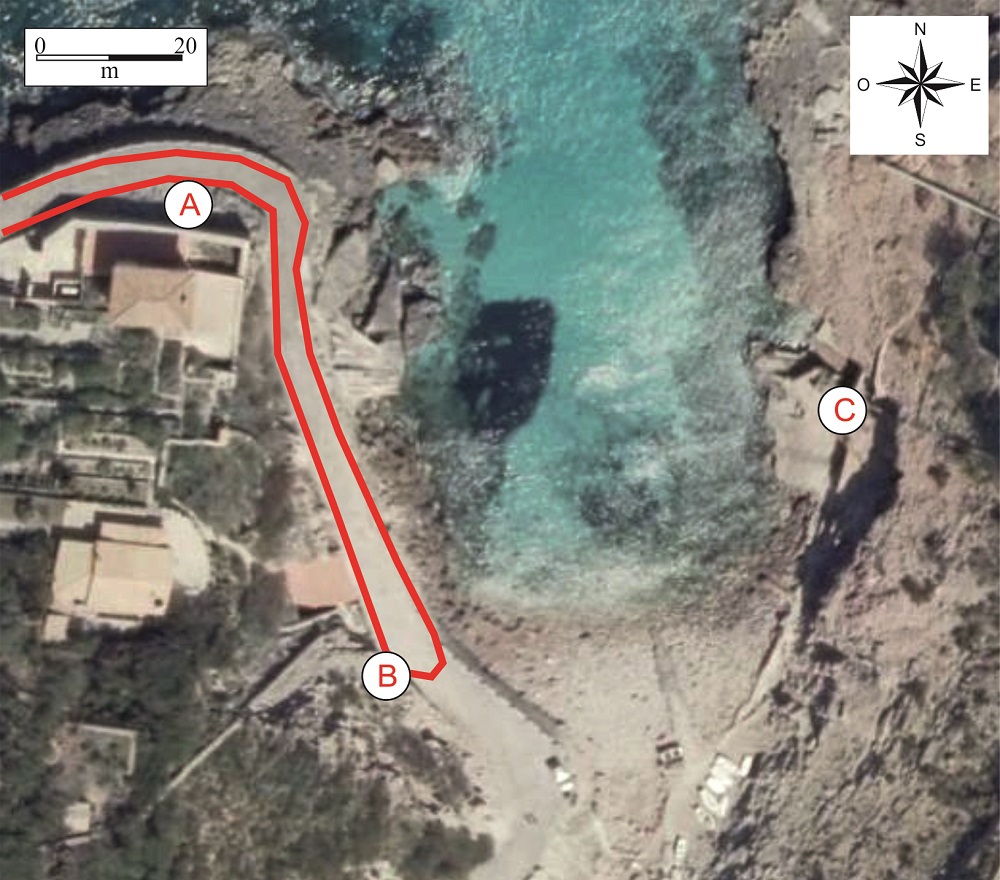
Recommended route.
Covering the rocks described above, in the coastal zone we will see sandy rocks of light brown or white colour. These are calcarenites which correspond to ancient dunes that have been fossilised. On these dunes many years ago there was vegetation which left traces in the form of rhizocretions (cemented hollows of the roots), like those observed at point A.
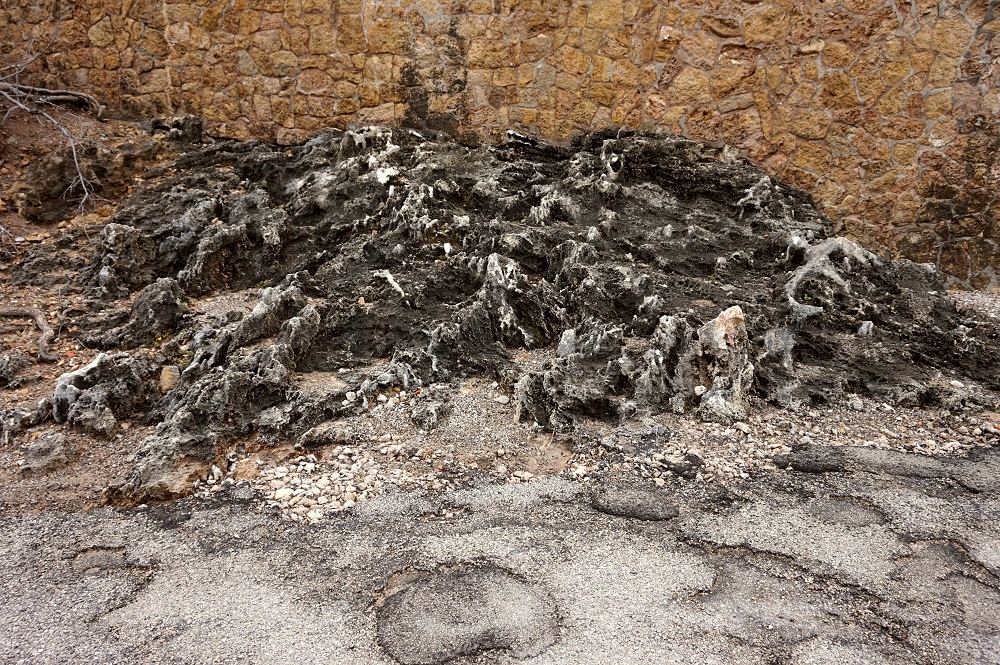
Rhizocretions in the calcarenites (point A).
At Cala Carbó we see again carbonated rocks of pink and grey colours, with interspersions of clayey materials of various colours (green, red, yellow, etc.) These are materials of the Rethian (Upper Triassic, between 208 and 200 Ma).
The rocks are fractured and deformed, displaying numerous faults and folds in the cliffs of the cove. In addition, it is observed that the strata do not have uniform top of a stratigraphical unit or stratigraphical sequence. </p></div>">thickness but display lens-shaped forms resembling sausages, that’s why they are called with the French name of boudinage.
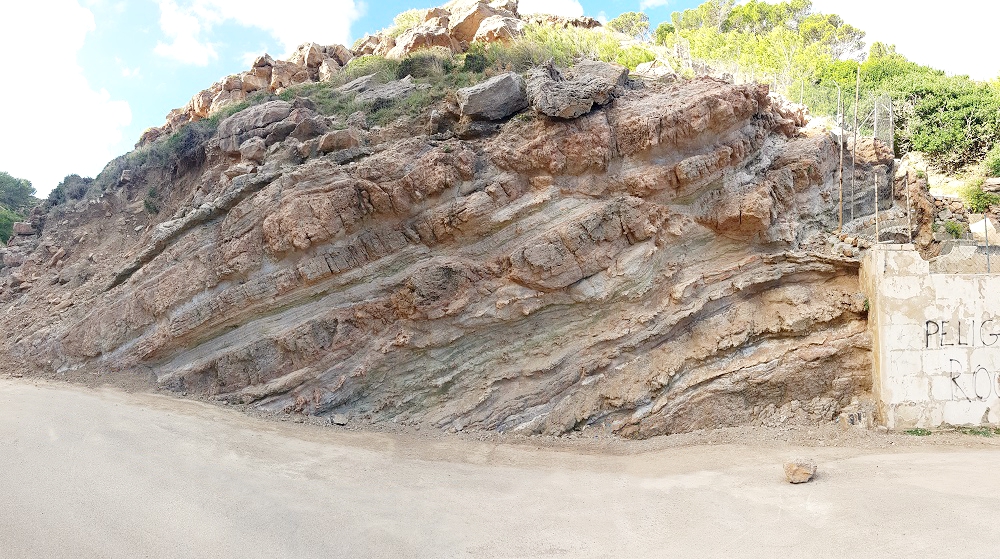
General view of the west bank, showing faults and boudinage structures (point B).

Detail of the east bank of the cove, showing several large folds (point C).
As we can see, there is a great difference between the eastern end of the cove, where the materials are intensely deformed, and the western cliff where the rocks show a planar arrangement. This indicates that just at the centre of the cove there is a contact
<div class="ql-editor"><p class="ql-align-justify">This occurs when the contact between two stratigraphic series is due to a fault.</p><p><br></p></div>">mechanical contact: a fault. Most of Mallorca’s coves have originated from faults since they are weakness zones of the rock.Observing the slope along the road as it begins to climb up the mountain, we can see that the interspersions of clays and marls gradually decrease while the proportion of calcareous layers rises. This is because the sedimentary medium in which they formed was increasingly marine.
