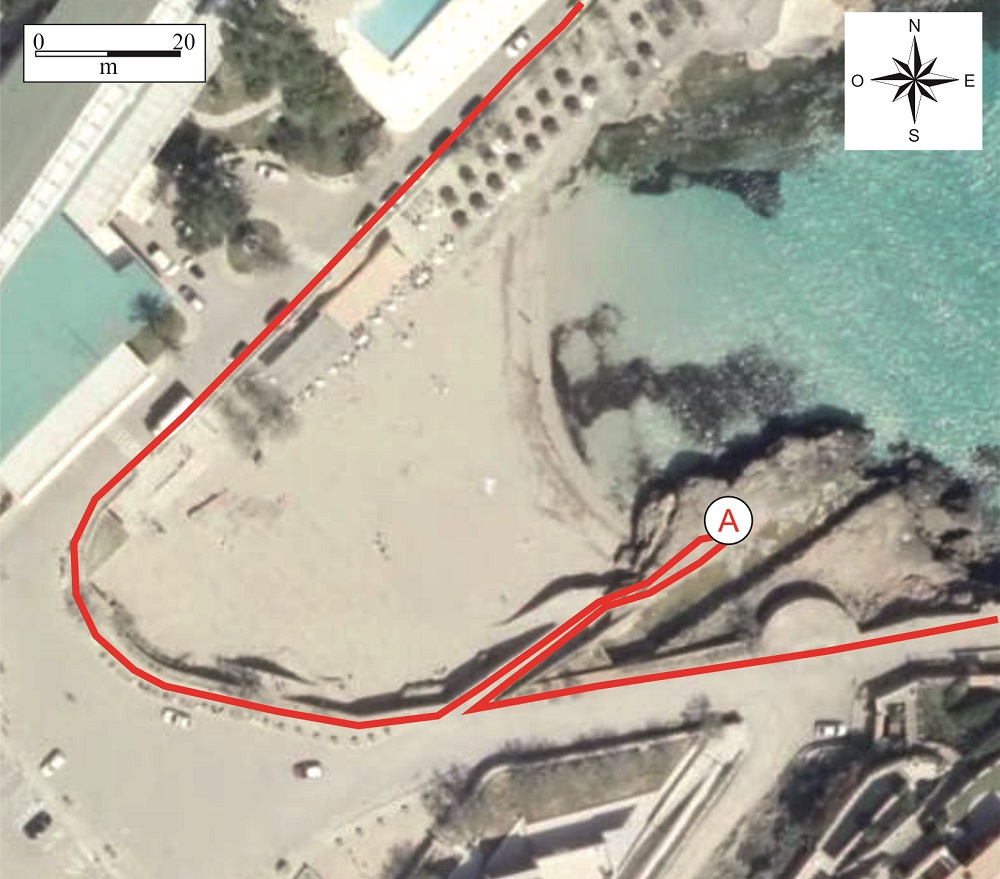
Recommended route.
Turning back towards Cala Molins, it is recommended to study the blocks of calcarenite (marès) which support the guardrails of the road. In them, in addition to being able to observe the typical cross-lamination of this type of deposits, we can find an occasional hoofprint, in both cross-section and plan, of Myotragus, an autochthonous bovine of the Balearics that is now extinct.
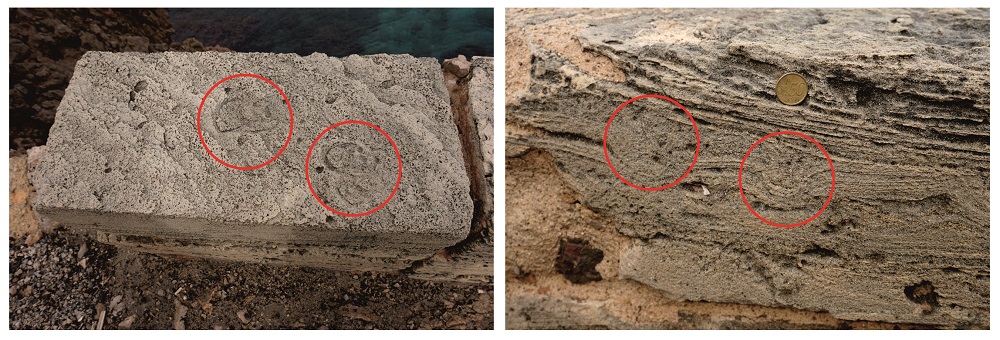
Hoofprints of Myotragus in the blocks of marès.
Continuing the route, we approach the mouth of the stream bed of Can Botana, where a Sedimentary rock originated by the precipitation of calcium carbonate from supersaturated waters, especially in zones of karstic emergences.</p></div>">travertine flow has formed (point A).
Sedimentary rock originated by the precipitation of calcium carbonate from supersaturated waters, especially in zones of karstic emergences.</p></div>">Travertine is a rock of sedimentary origin formed by the precipitation of calcium carbonate from oversaturated waters, especially in zones of karstic emergences. This precipitation tends to occur over plant matter, producing a porous internal structure with moulds of branches and leaves. The formation of Sedimentary rock originated by the precipitation of calcium carbonate from supersaturated waters, especially in zones of karstic emergences.</p></div>">travertine flows is a relatively rapid geological process, often linked to waterfalls (where the pressure of carbon anhydride is drastically reduced).
Due to the great porosity of this type of rocks, they display forms precipitation typical of caves (speleothems).

Travertine (left) and speleothems (centre and right)

Genesis of a travertine flow (point A).
