| UTM-X | UTM-Y | ||
|---|---|---|---|
| STOP 1: THE HARBOUR AND THE CASTLE | |||
| STOP 2: TOWARDS ES CALÓ DE SES GÜIES | |||
| STOP 3: CAS PAGÉS AND SA PLATGETA | |||
| STOP 4: S’ESPAUMADOR |
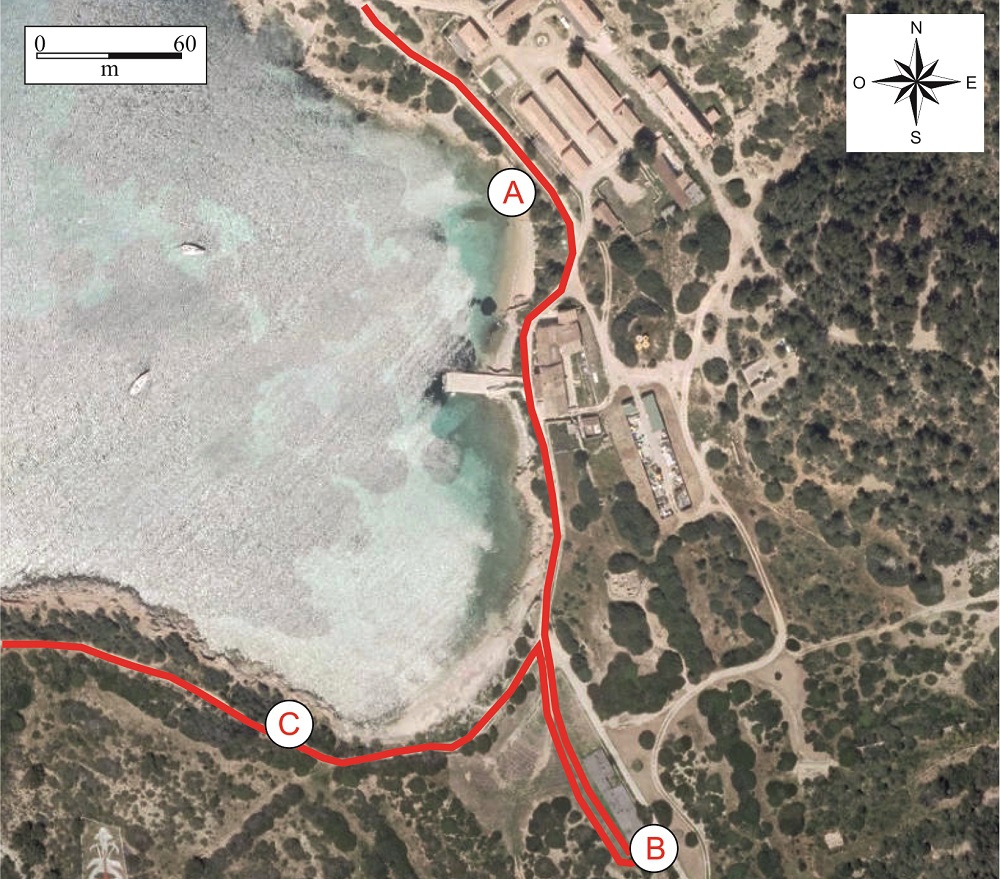
Recommended route.
Almost at the end of the military camp, the beach of Sa Platgeta begins. This is a good point for approaching the coast and studying the rocks outcropping there (point A).
In general there is a predominance of limolitic rocks and breccias, many of them related with debris, similar to what we have seen at the first stop. However, some of them correspond to ancient beaches of the Pleistocene (2.5 Ma-10,000 years). Fossils of terrestrial and marine molluscs can occasionally be observed in them.
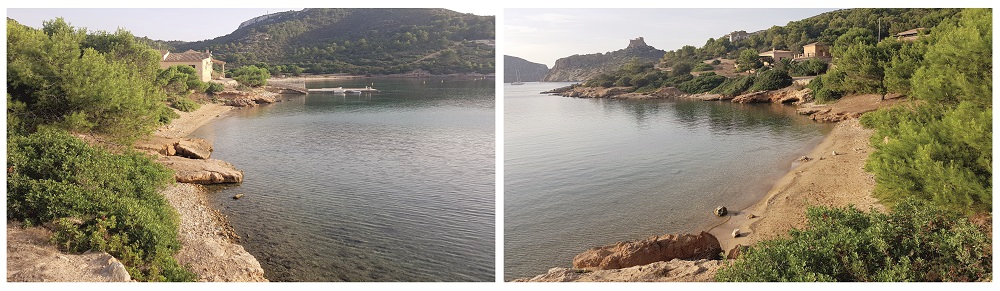
Views of the northern zone of Sa Platgeta, with rocks of the Pleistocene.
Also in this area of the coast, very close to the sea, we can observe two boreholes.
On the island, important problems of water supply are known, due to the scarcity of rainfall and the limitation of the territory, existing few springs. The boreholes that we observe correspond to surveys of salty water because the possibility of installing a small desalination plant on the island has been assessed in recent times.
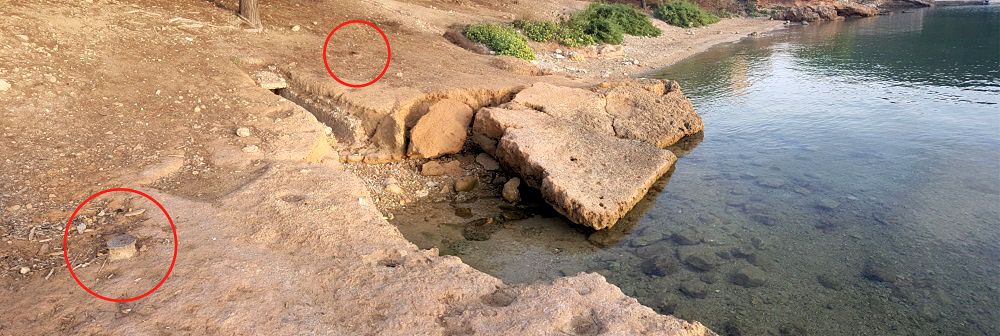
Boreholes carried out close to the sea for marine water extraction.
Behind the beach of Sa Platgeta there is a recreational area with a stone masonry perimeter wall. The rocks which compose it are mainly of local origin, but there are also some that are foreign to the geology of Cabrera and the Balearic Islands. This is the case of two granite blocks that can be seen at point B of the stop.
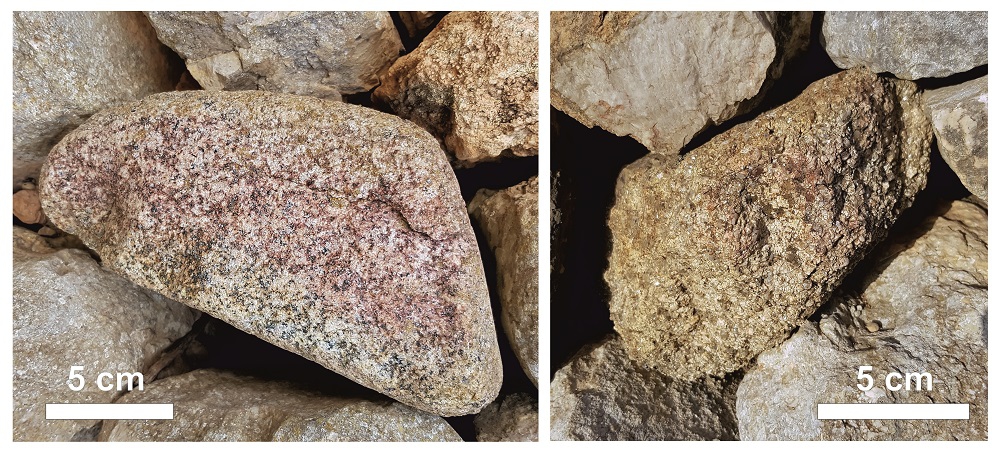
Granite blocks in the wall of the recreational area, behind Sa Platgeta.
Although this material is very commonly used in construction, the fact is that in this case the blocks were probably taken from the beach and reused in the building of the wall. The explanation of the existence of blocks of exotic rocks on the beach lies in the fact that many of the boats that formerly docked in the harbour carried ballast stones in their hold to prevent capsizing. The blocks of granite we see here are therefore vestiges of boats of past centuries that probably sank in these waters.
Finally, in the zone that includes the archaeological site of the Plà de Ses Figueres, there is an ancient quarry that provided marès, a local name given to the sand-sized clasts.</p><p><br></p></div>">sandstone composed of carbonated grains whose scientific name is calcarenite. This type of rock, very commonly used in construction in these islands because it is easy to cut, corresponds to an ancient fossilised dune.

Site of the Pla de Ses Figueres: observe the outcrops of marès in the base of the construction.
