| UTM-X | UTM-Y | ||
|---|---|---|---|
| STOP 1: THE HARBOUR AND THE CASTLE | |||
| STOP 2: TOWARDS ES CALÓ DE SES GÜIES | |||
| STOP 3: CAS PAGÉS AND SA PLATGETA | |||
| STOP 4: S’ESPAUMADOR |
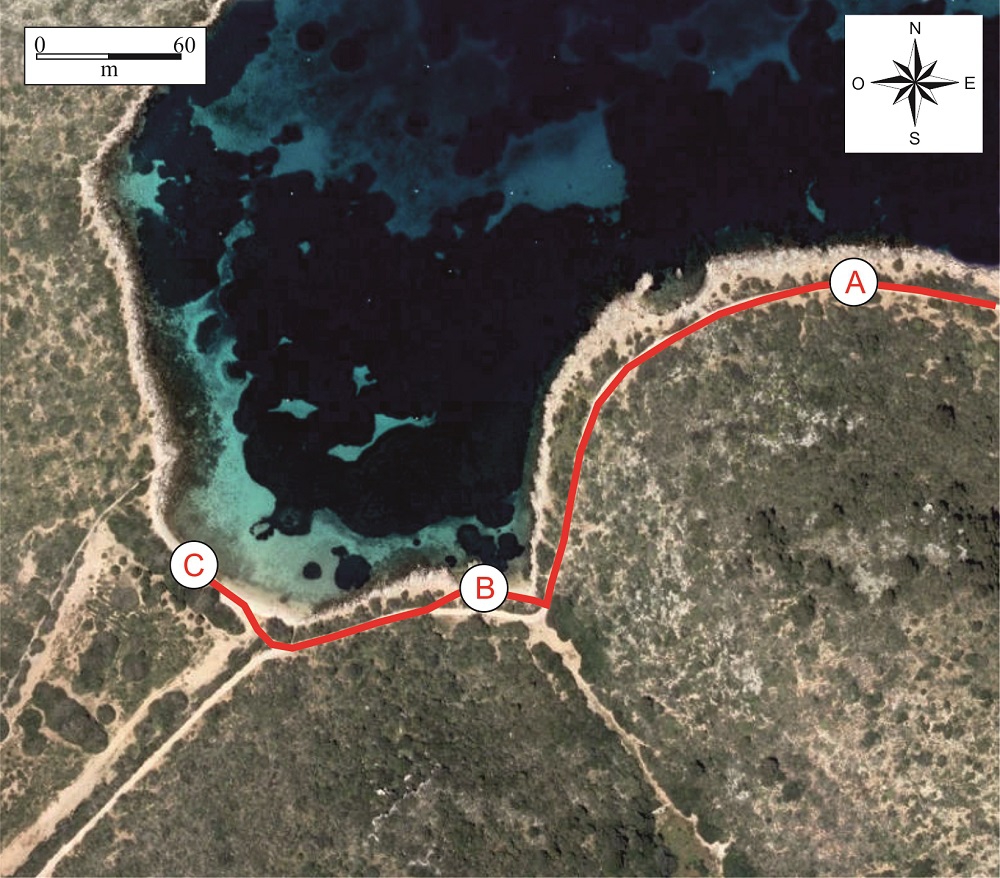
Recommended route.
Continuing our route towards the beach of S’Espaumador, we can see that the rocks, over which the path passes, have changed. Now they are grey in colour and are formed by pieces of other rocks, so they are named breccias (similar to the debris that we saw at Stop 1).
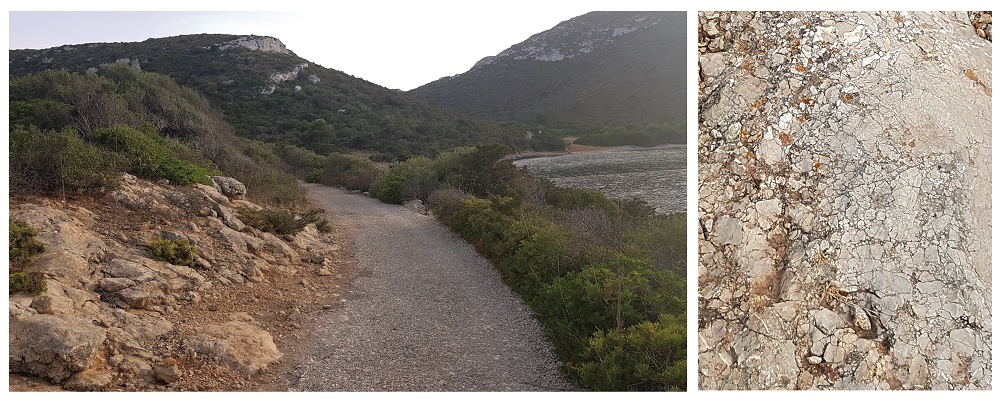
Outcrops of breccias in the path (left) and detail of the rock (right).
As the breccias are composed basically of pieces of dolomites, they are called dolomitic breccias.
Dolomites are rocks which originate from the chemical alteration of Sedimentary rock whose main component is calcium carbonate (CaCO3). Its origin can be chemical, organic or detritic.</p><p><br></p></div>">limestone, through the substitution of a part of the calcium of its composition by magnesium. In this case they appear in the form of breccias because they have been crushed and subsequently lithified again. As can be seen, this type of materials has been greatly changed from their original appearance, although it is known that they correspond to shallow seabeds. We can observe them along almost all the route in this sector.
In this case, the dolomitic breccias are from the Upper Triassic and Lower Jurassic (between 208 and 199 Ma).
Being highly fractured, they favour the processes of dissolution by rainwater (karstification) and develop an abundance of orifices and cavities. In the proximity of point B we can see some rocks that have developed sharp-edged channels on their surface. This type of morphologies is given the generic name of karren
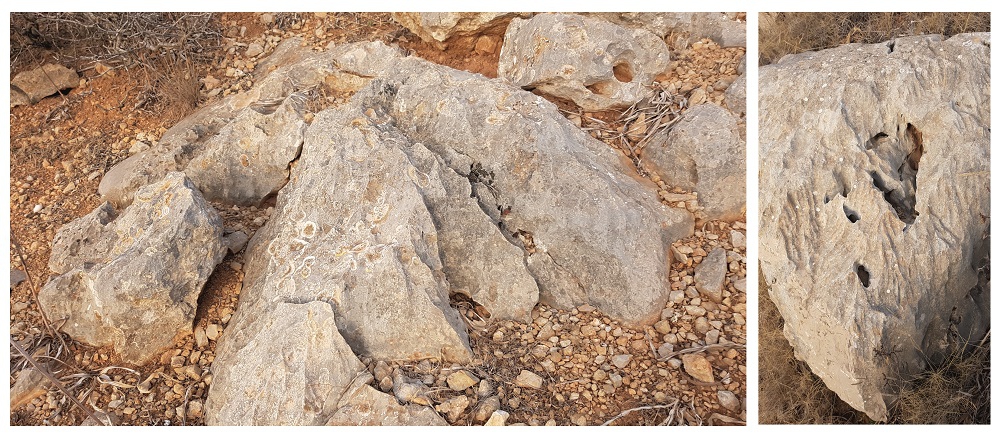
Karren developed in the dolomitic breccias.
Diverting from the path towards a small cove (point B), we see another Pleistocene tectonic, eustatic or antropical processes</span></p></div>">outcrop similar to that of the previous stop, but in this zone the exposure of the materials is rather better, revealing a very clear geological tectonic, eustatic or antropical processes</span></p></div>">outcrop.
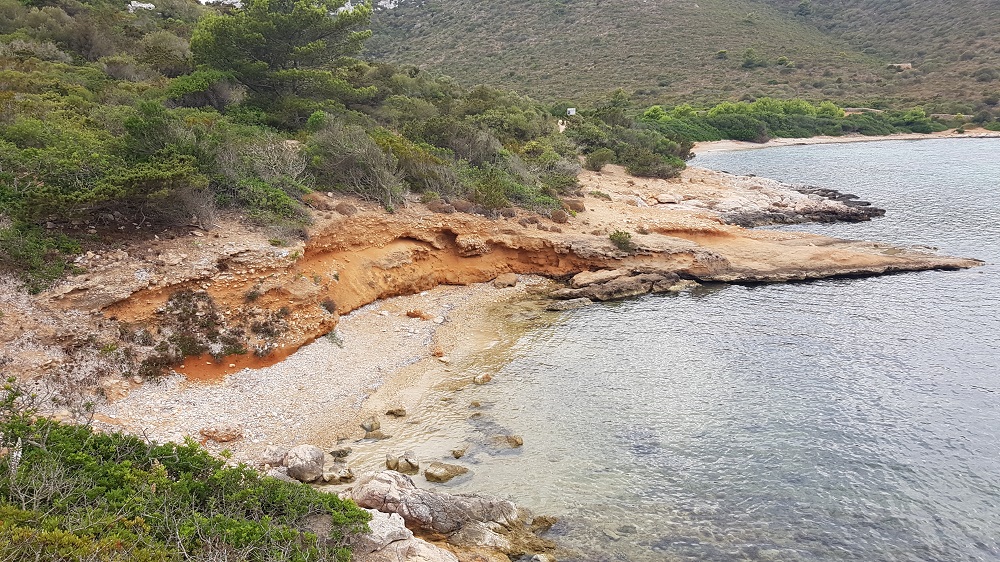
Outcrop of Pleistocene sediments.
The end point of the route is the beach of S’Espaumador (point C). The beach is composed of a multitude of pebbles originating from ancient rocks, many of which correspond to the materials described during the itinerary which have been eroded and resedimented by the sea.
However, we can also see rocks which, as at the previous stop, are foreign to the regional geology. Some of them are metamorphic. No doubt they also originate from the boats that for centuries have moored in the bay.
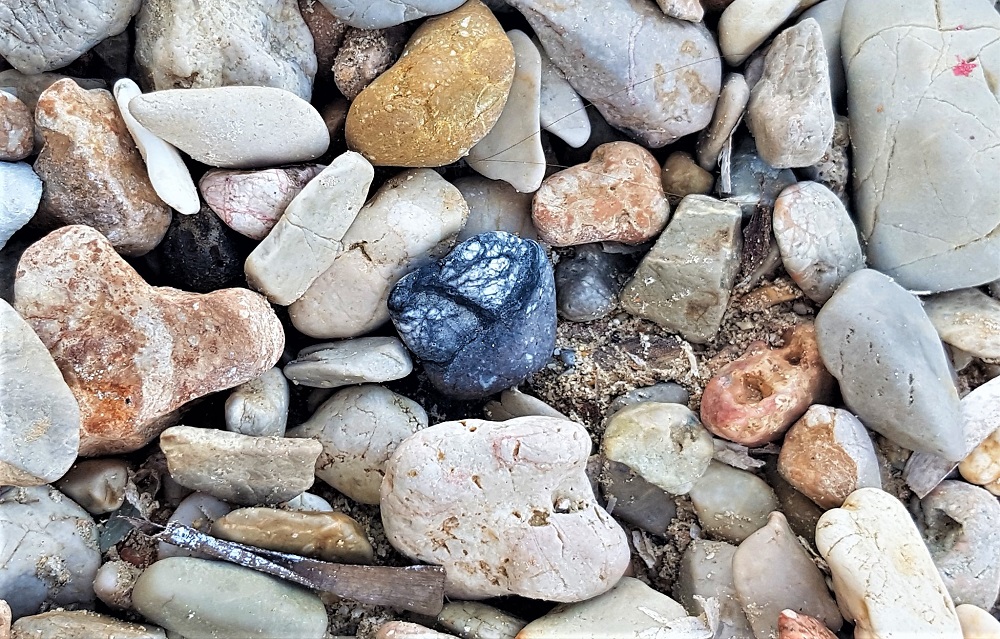
Fragment of a metamorphic rock between local rocks, among the pebbles of the beach.
