| UTM-X | UTM-Y | ||
|---|---|---|---|
| STOP 1: THE HARBOUR AND THE CASTLE | |||
| STOP 2: TOWARDS ES CALÓ DE SES GÜIES | |||
| STOP 3: CAS PAGÉS AND SA PLATGETA | |||
| STOP 4: S’ESPAUMADOR |
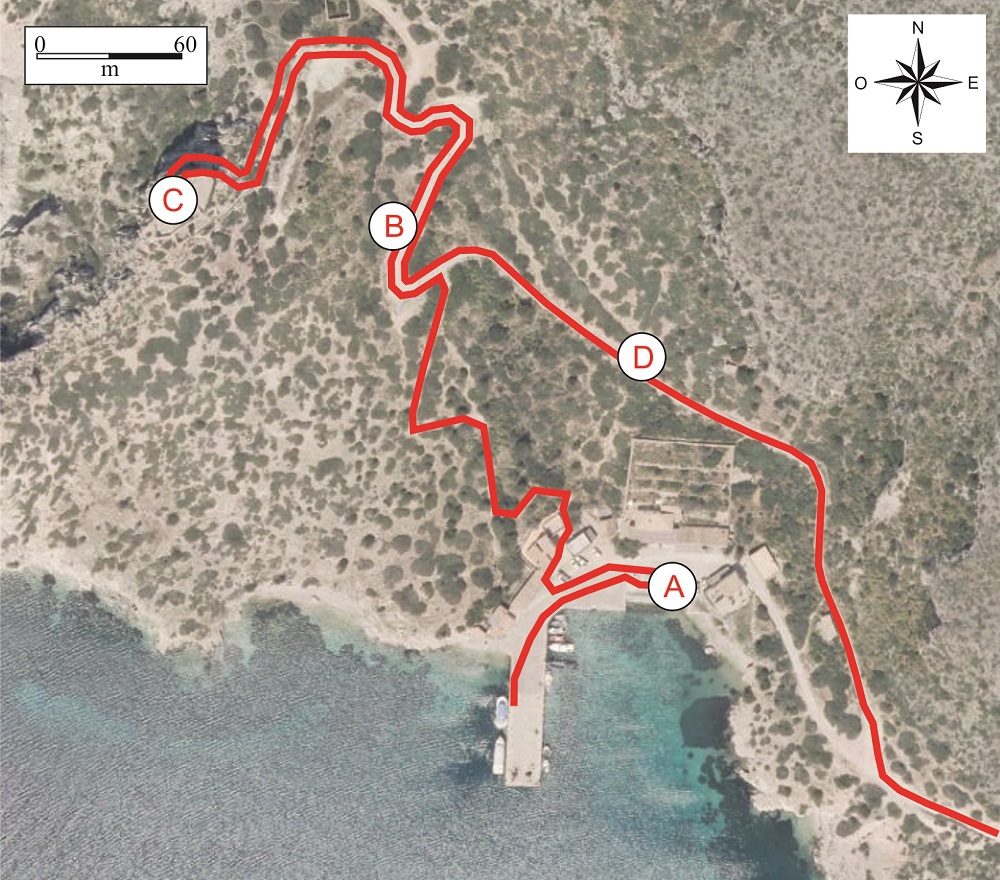
Recommended route.
The harbour of Cabrera is built on lands of the Upper Jurassic (165-145 Ma), whose bright yellow-grey strata are easy to observe in the cliffs overlooking the sea. These strata were deposited long before the island existed, in deep waters (pelagic environment) where sedimentation was very scarce, meaning that each level took several thousand years to form.
In general they contain an abundance of marine fossils, although they tend not to be in a good state of conservation. The most notable fossil is the aragonite, normally in spiral from and with ornamentation. Its <span style="color: black;">abundance and diversity during the Mesozoic makes it a basic fossil for the relative dating of rocks of marine origin. </span></p></div>">ammonite, a cephalopod mollusc equipped with a segmented outer shell, usually in the shape of a flat spiral, which it used to regulate floatation.
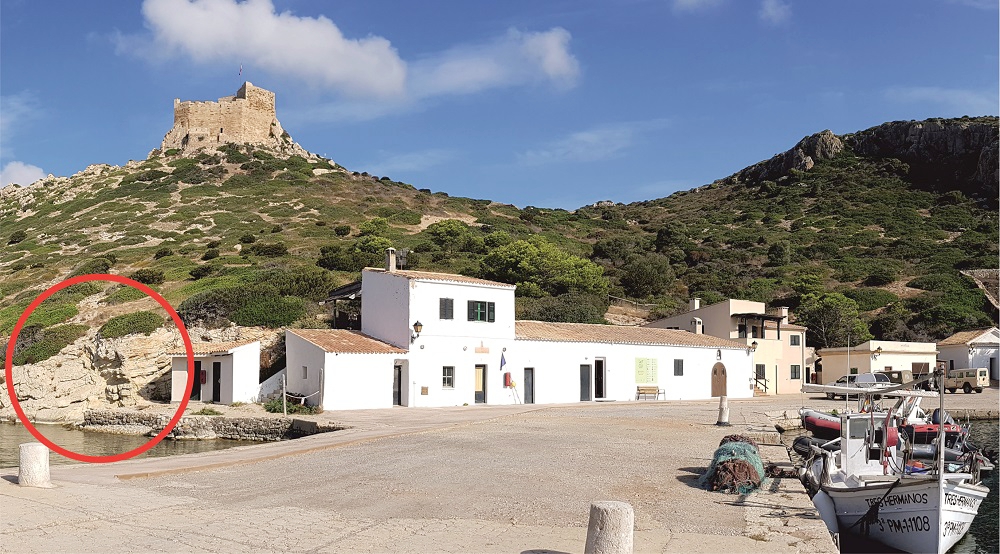
Outcrop of Upper Jurassic materials in the harbour of Cabrera.
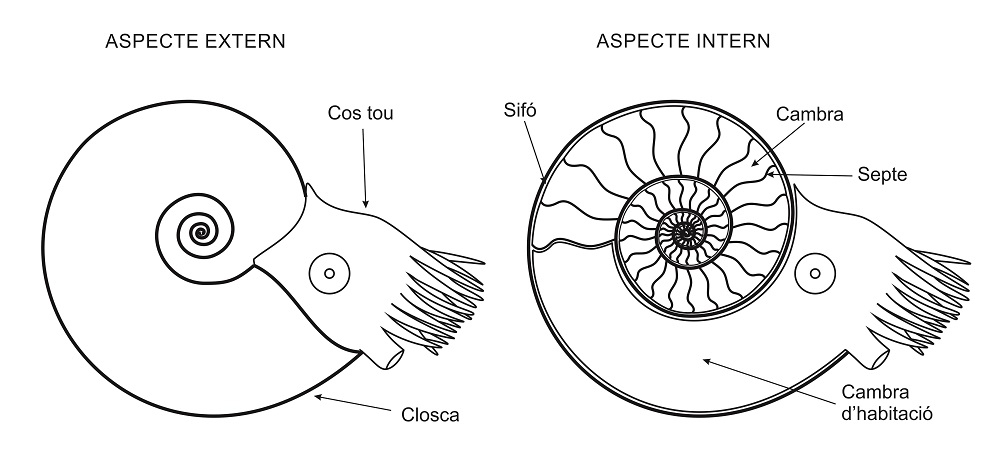
Diagram of the structure of an ammonite
In the case of the harbour of Cabrera, curiously, the place where these fossils are best observed is not in the naturally exposed rock but in the stone paving slabs of the dry dock (point A).
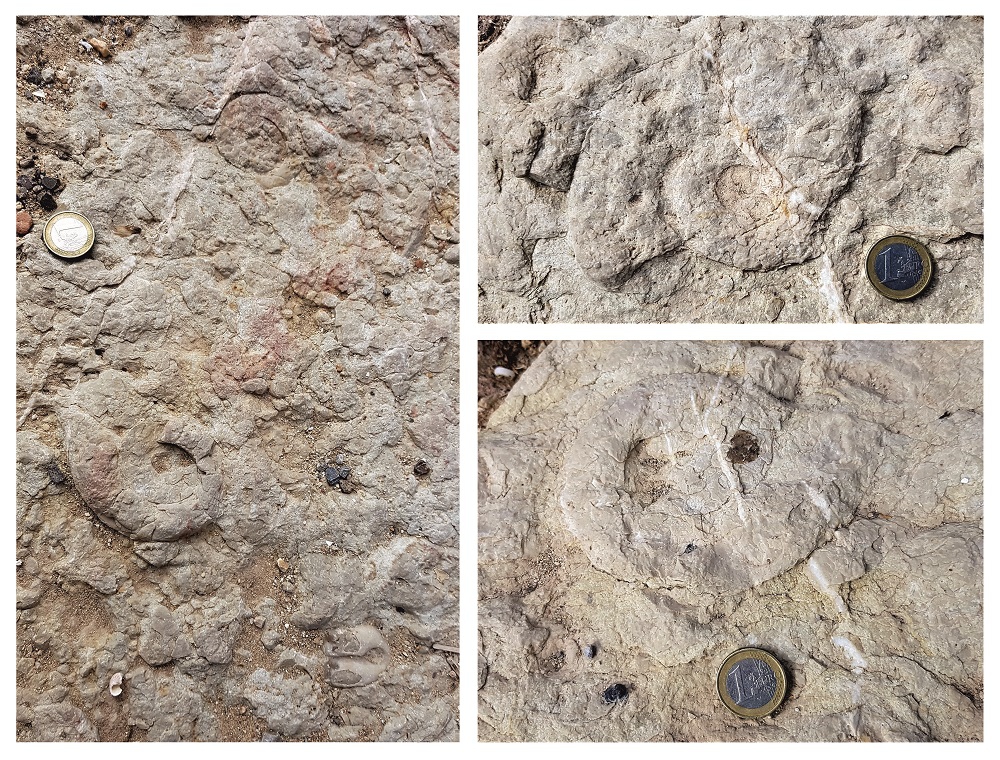
Three examples of rocks of the Upper Jurassic containing ammonites in the pavement of the harbour of Cabrera.
Walking up towards the historic castle of Cabrera from the harbour itself, we continue to see the same materials of the Upper Jurassic which tectonic, eustatic or antropical processes</span></p></div>">outcrop beside the footpath (point B). In this area there is a notable contrast between some zones where the strata are clearly seen, while in others the materials appear in a totally chaotic and fragmented form. This is due to the tectonic activity that raised the reliefs of the island over 20 Ma ago.
A little higher up, in a zone of curves, we will see that the Sedimentary rock whose main component is calcium carbonate (CaCO3). Its origin can be chemical, organic or detritic.</p><p><br></p></div>">limestone strata display greater top of a stratigraphical unit or stratigraphical sequence. </p></div>">thickness and contain nodules of flint.
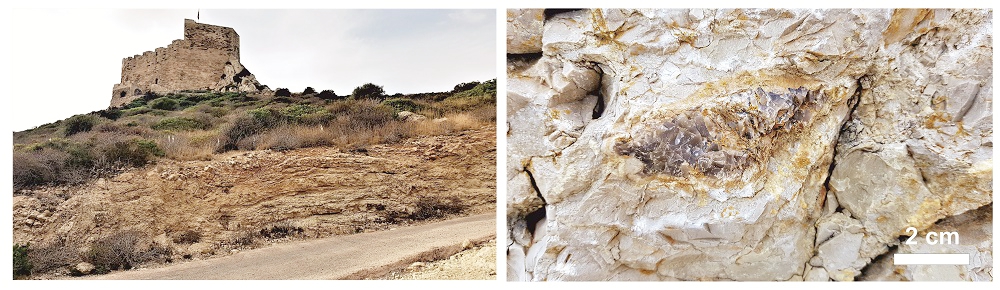
Levels of the Upper Jurassic cut through by the track that leads to the castle (left) and detail of the nodules of flint (right).
Finally we reach the castle, built on Lower Jurassic limestones. The contact between these limestones and the stratified limestones of the Upper Jurassic, that we have seen previously, is of a mechanical type, by means of a fault.
It is recommended to climb up the steep spiral staircase to enjoy the magnificent views of the harbour (point C). Apart from their scenic value, these views offer us the opportunity to appreciate the geological variety of Cabrera.
Looking to the east, towards the nearest hills, we notice that the slope below which the harbour lies is crowned by an escarpment of notably harder materials. Like the rocks on which the castle stands, they are Lower Jurassic limestones.
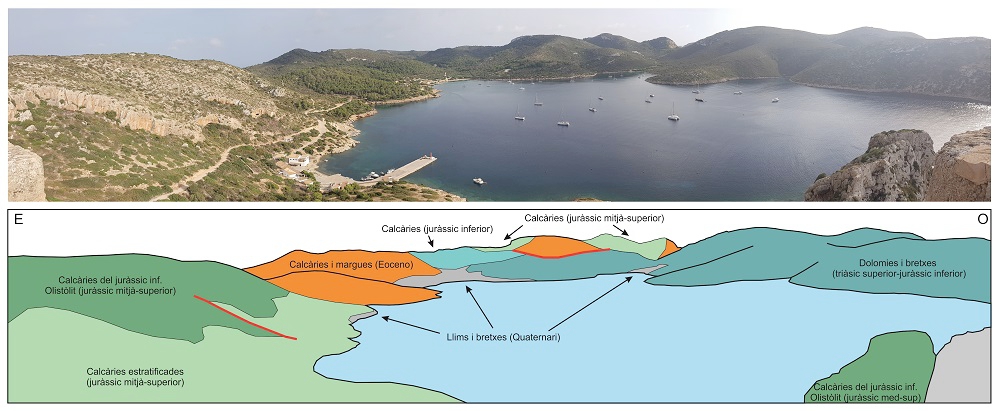
View from the castle and geological interpretation. The red lines represent visible faults in the panoramic view.
The Lower Jurassic limestones have been interpreted as olistolites, and they correspond to enormous masses of material that slid down the continental slope and ended on the seabed where the Upper Jurassic materials, we mentioned earlier, were being deposited. Olistolites are very common in Cabrera, and they denote the intense tectonic activity of that time, which favoured these movements of materials.
Towards the south there appear Eocene rocks some 45 Ma old, constituting the oldest Tertiary geological record of the Balearic Islands.
Finally, the hills to the west are composed of dolomites and breccias from the Upper Triassic and Lower Jurassic (237-175 Ma), being the oldest materials of the island with the exception of some small outcrops of volcanic materials and gypsums, also from the Upper Triassic, not visible from the castle.
In the depressed zones of the coast there is an abundance of sediments from the Quaternary (2.5 Ma-present), mostly corresponding to fossilised beach remains.
Walking down the dirt road towards the coast, in the left-hand slope (point D) we can see several examples of debris, also from the Quaternary: they are composed of pieces of rock which are locally cemented (calcareous crusts and breccias).
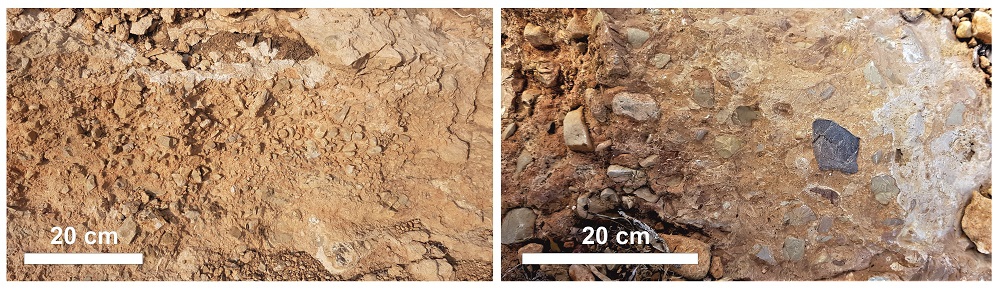
Slope deposits, with incipient cementation (left) or highly cemented (right).
Finally, we can comment that the contact between the olistolites and the stratified limestones is an area prone to the formation of cavities due to the circulation of water, which dissolves the rock in a process known as karstification. The most notable example is the Cova des Teatre, observable from the track.
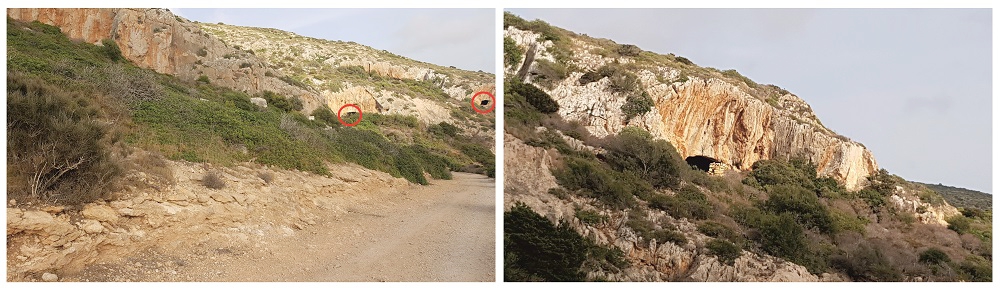
Caves at the foot of the escarpments, seen from the track (left), and detail of the Cova des Teatre (right).
