| UTM-X | UTM-Y | ||
|---|---|---|---|
| STOP 1: THE OLIGOCENE COAST | |||
| STOP 2: THE RANDA CALCARENITES | |||
| STOP 3: VIEWPOINT OF MORRO D’EN MOLT | |||
| STOP 4: VIEWPOINT OF THE SANTUARI DE CURA |
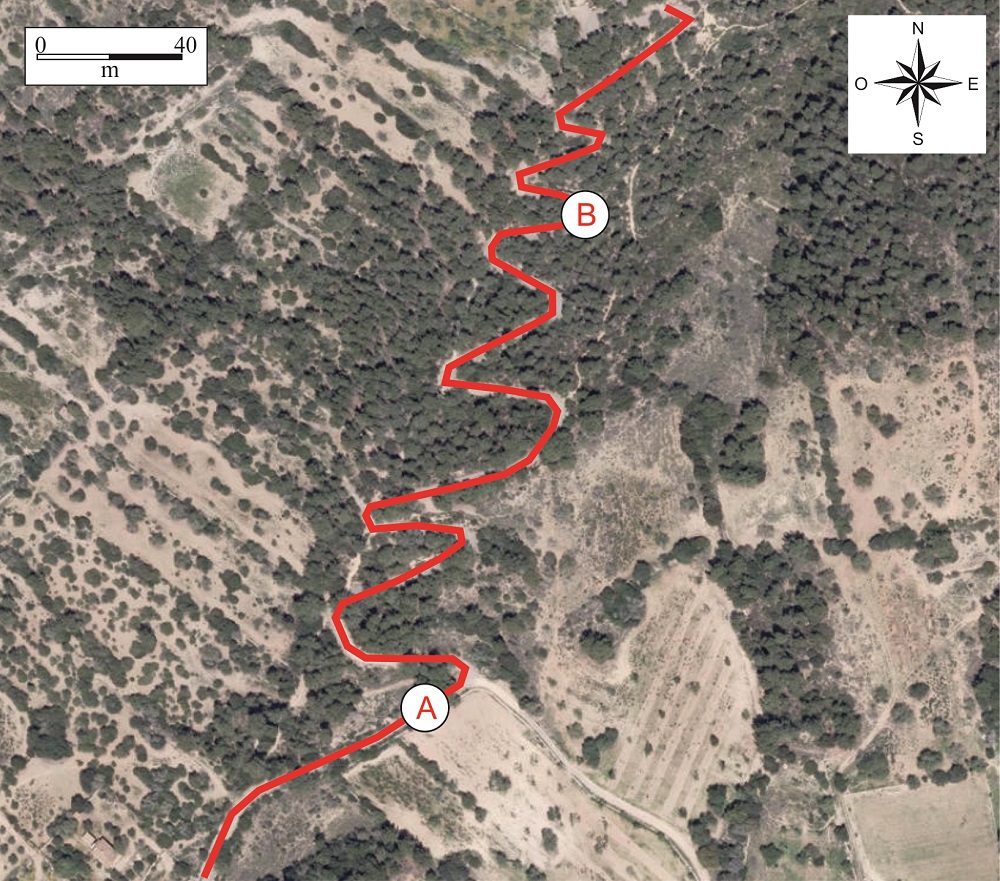
Recommended route.
During the Oligocene (34-23 Ma), Mallorca had a geography very different from today’s, with large systems of lakes and rivers surrounded by a tropical coastline. The terrestrial fauna and flora consisted typically of moist woods inhabited by mammals, while corals grew in the coastal waters.
The first materials we find on the old path leading up to the sanctuary of Gràcia originated in a coastal environment and contain both continental and marine levels.
At the start of the path (point A) we can see a small site of oncolites, rounded structures that resemble pebbles but in reality are produced by the growth of layers of colonies of cyanobacteria around a core, which can be a small twig, the shell of a Mollusc equipped with a fleshy foot and with the body generally protected by a single-piece shell, normally in a spiral shape. The gastropods include snails and limpets, among others.<strong> </strong></p><p><br></p></div>">gastropod or even an earlier colony.
As we climb, we can observe sandstones and conglomerates of whitish and ochre colours, rocks formed by old sands and gravels, now cemented, representing retreats and advances of the coastline.
In the upper part of the route (point B) we can find fully marine deposits that contain fossils. The most characteristic are the nummulites, a type of foraminimera (single-cell organism) with a segmented lens-shaped shell. The nummulites are among the largest cells that have ever existed, reaching diameters of 10 cm, but the ones we can see in Gràcia are relatively small in size, less than one centimetre.
Associated with these fossils there appear organisms typical of shallow waters. The most notable are the infaunic sea urchins, a type that does not live fixed to the substrate, like those that commonly inhabit the coasts of Mallorca, but moves around buried in sandy beds. We can also see molluscs like gastropods and bivalves. Along with these there appear fragments of branching corals.
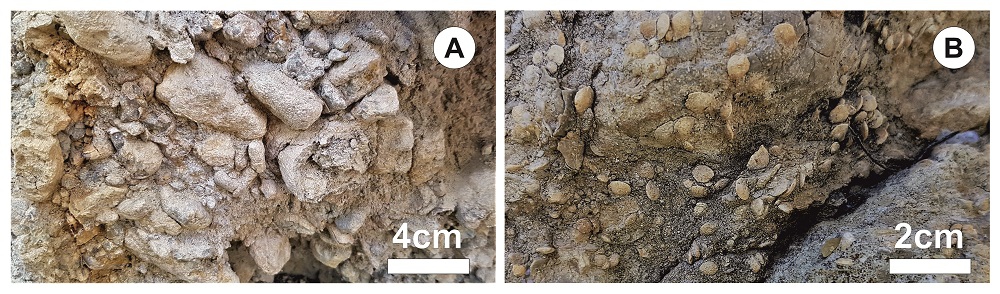
A) Accumulation of oncolites. B) Accumulation of nummulites.

A) Infaunic sea urchin. B) Fragments of branching corals.
