| UTM-X | UTM-Y | ||
|---|---|---|---|
| STOP 1: THE OLIGOCENE COAST | |||
| STOP 2: THE RANDA CALCARENITES | |||
| STOP 3: VIEWPOINT OF MORRO D’EN MOLT | |||
| STOP 4: VIEWPOINT OF THE SANTUARI DE CURA |
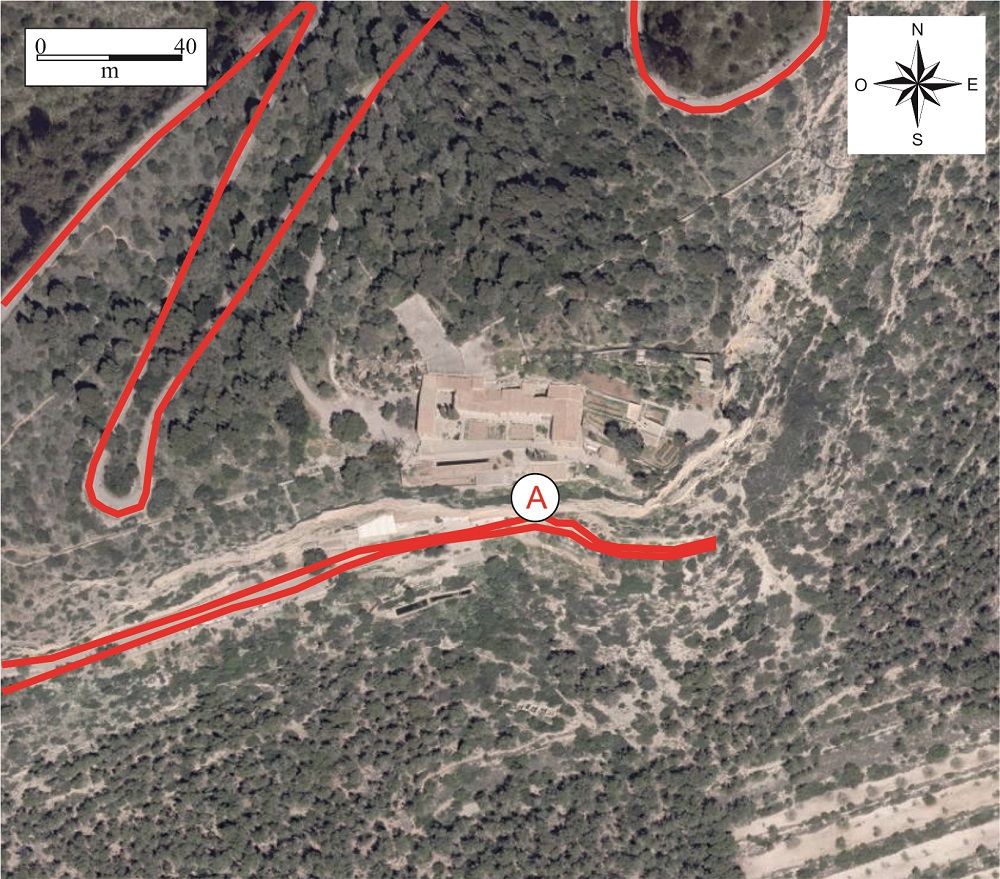
Recommended route.
Approximately 25-15 Ma ago, within the framework of a geological process known as the Alpine Orogeny, the island of Mallorca became structured into a series of raised zones (horst) and depressed zones (graben).
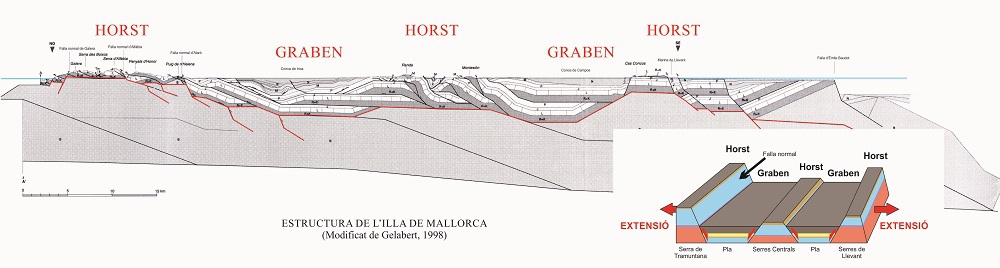
One of the horsts corresponds precisely to the Serres Centrals, whose highest point is the peak of the Puig de Randa, at 543 metres.
The Puig de Randa is constituted primarily of materials from the Burdigalian-Langhian age (Lower and Middle Miocene, 20.4-13.8 Ma ago), deposited just before the raising of the island.
The Santuari de Gràcia is located just at the contact point between two superimposed stratigraphic sequences: the Banyalbufar Formation and the Randa Calcarenites Unit, making it a good place for studying them.
At the base of the cliff, only visible behind the sanctuary (point A), there appear greenish-grey marls that correspond to the turbidite sediments of the Banyalbufar Formation, deposited at a great depth.
Turbidites are a type of deposit formed by successive avalanches of materials on the continental shelf, usually caused by tectonic activity.
The marls present chaotic undulating shapes which contrast with the horizontal stratification of the calcarenites that compose the shelf and correspond to rockslides within the turbidites themselves, named slumps.
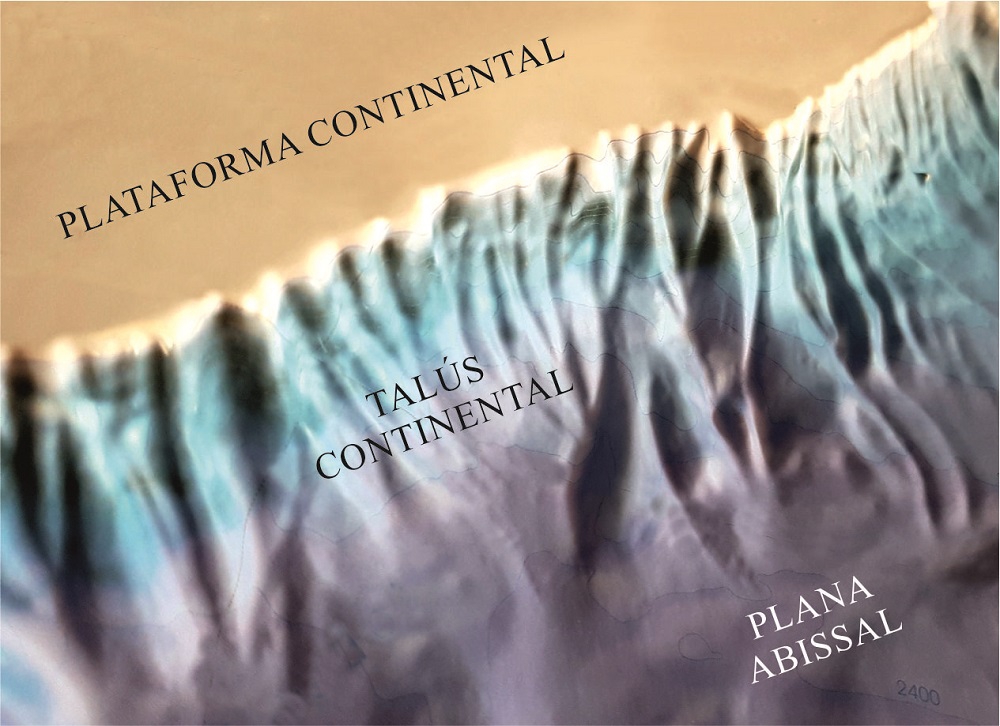
Structure of the limit of the continental shelf, where the turbidites originate.
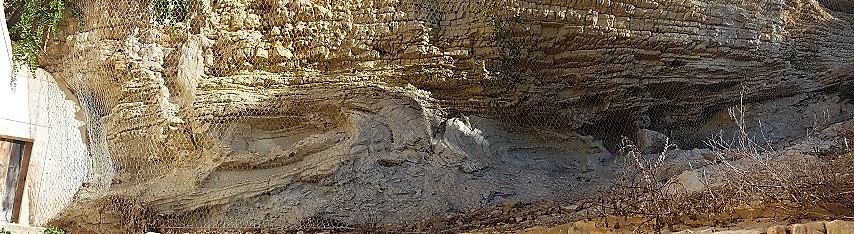
Detail of the slumps observed at the base of the cliff behind the sanctuary (point A).
In contrast, the cliffs of the sanctuary, over 40 m in height, are composed entirely of bioclastic calcarenites with clearly-marked stratification of centimetric order belonging to the Randa Calcarenites Unit and corresponding to platform deposits.
The upper levels of this unit display a marked cross-lamination which can be seen in the paving slabs of the terrace of the sanctuary. This type of structures is a product of the ebb and flow of the waves and the marine currents in shallow seabeds.
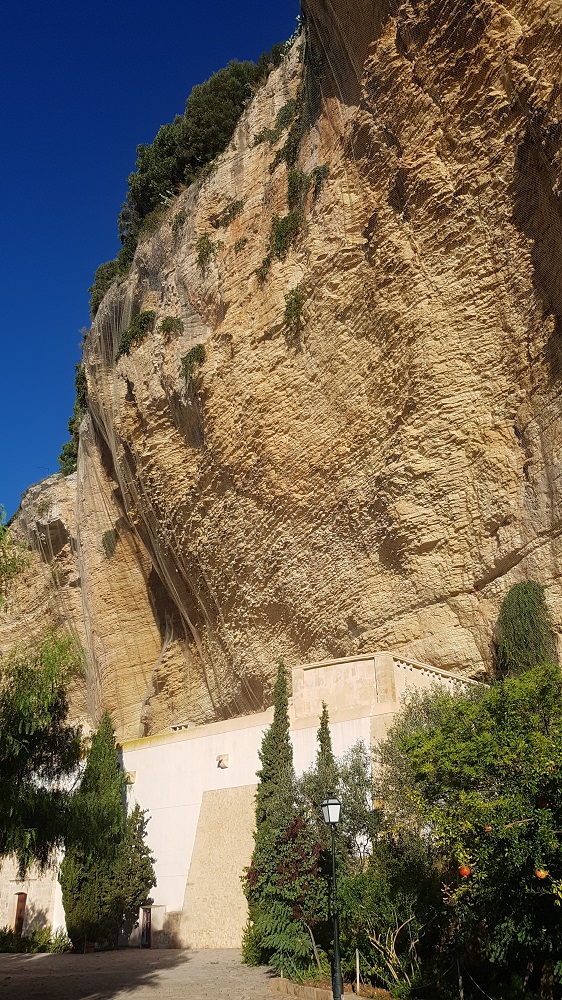
Bioclastic calcarenites that make up the cliff.
The Santuari de Nostra Senyora de Gràcia is also an exceptional spot for observing different stabilisation methods of rocky slopes.
The entire cliff is covered by a triple-torsion mesh which in some parts has been reinforced with a network of steel cables fixed by means of steel bars.
The triple-torsion meshes, also called stone-retaining meshes, prevent the small rocky blocks from falling freely by trapping them in their interior. They do not work if the blocks exceed a certain size because they can break, so they are complemented with networks of steel cables. The meshes are fixed with metal stakes at the head and base of the embankment, while the nets are anchored to it with steel bars, which can also be used to fix large rocky blocks.
At the base of the cliff, dynamic screens have been installed. These are flexible metal structures designed to intercept the trajectory of the falling rocks. Each screen is designed to withstand a certain impact force (a determined maximum block size), and in contrast with the walls, which are rigid elements, they deform and absorb the energy of the impact without breaking. In order to increase their capacity to stop masses in movement, they are fitted with elements that absorb the impact.
Finally, the non-rocky embankments have been protected by means of projected concrete, also called gunite or shotcrete, or by triple-torsion meshes weighted at their base.
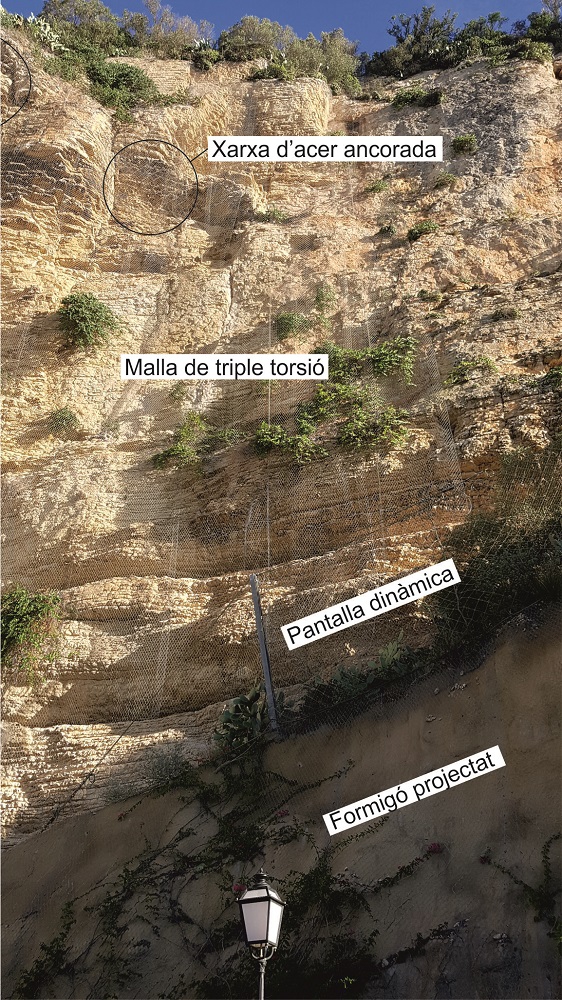
Stabilisation methods.
