| UTM-X | UTM-Y | ||
|---|---|---|---|
| STOP 1: GYROGONITES AND FOSSIL BEACHES | |||
| STOP 3: FOSSIL PLANTS AND ANTCIENT RIVERS. | |||
| STOP 4: THE EROSION OF THE COAST. | |||
| STOP 5: THE ANTICLINE. |
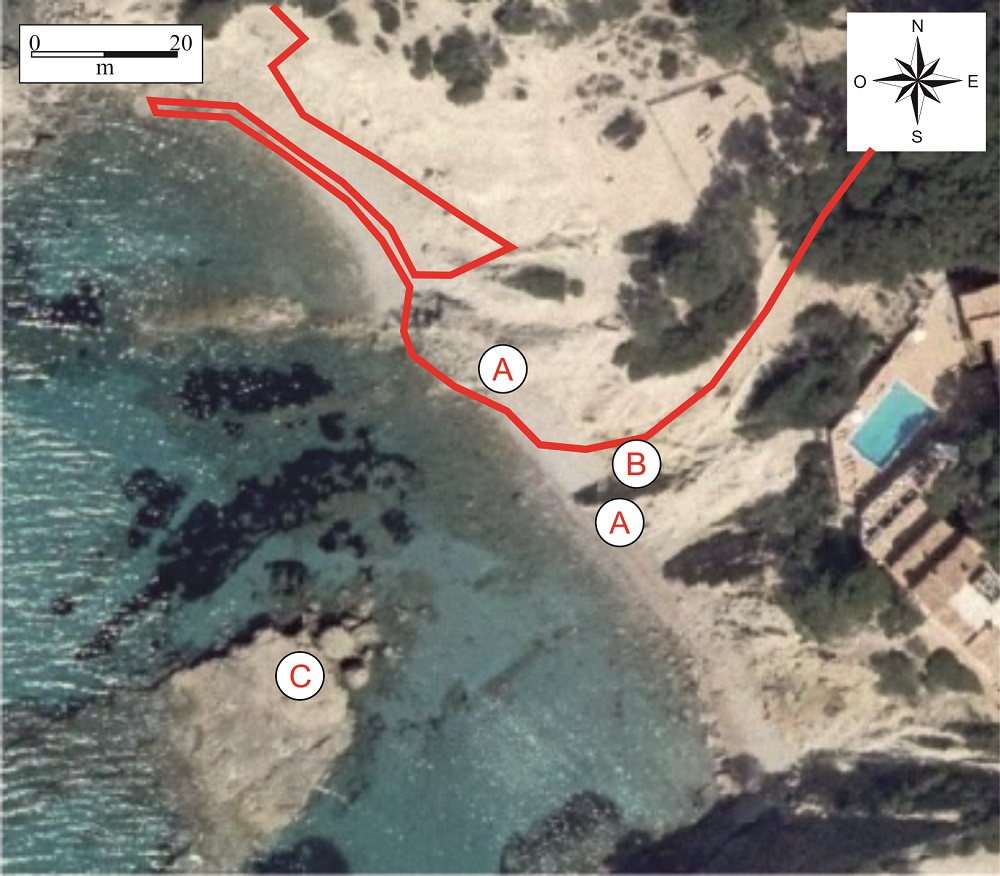
Recommended route.
To reach the next stop we can either continue along the coastline, if the sea permits, or walk down from the clifftop by a small stream bed in which there was once a stairway, now practically non-existent.
At this stop we can see clearly the different resistance behaviour of the materials against littoral erosion.
This inequality is called differential erosion and is the reason why the coast presents an irregular morphology, in the form of projections (promontories) and entrances (coves).
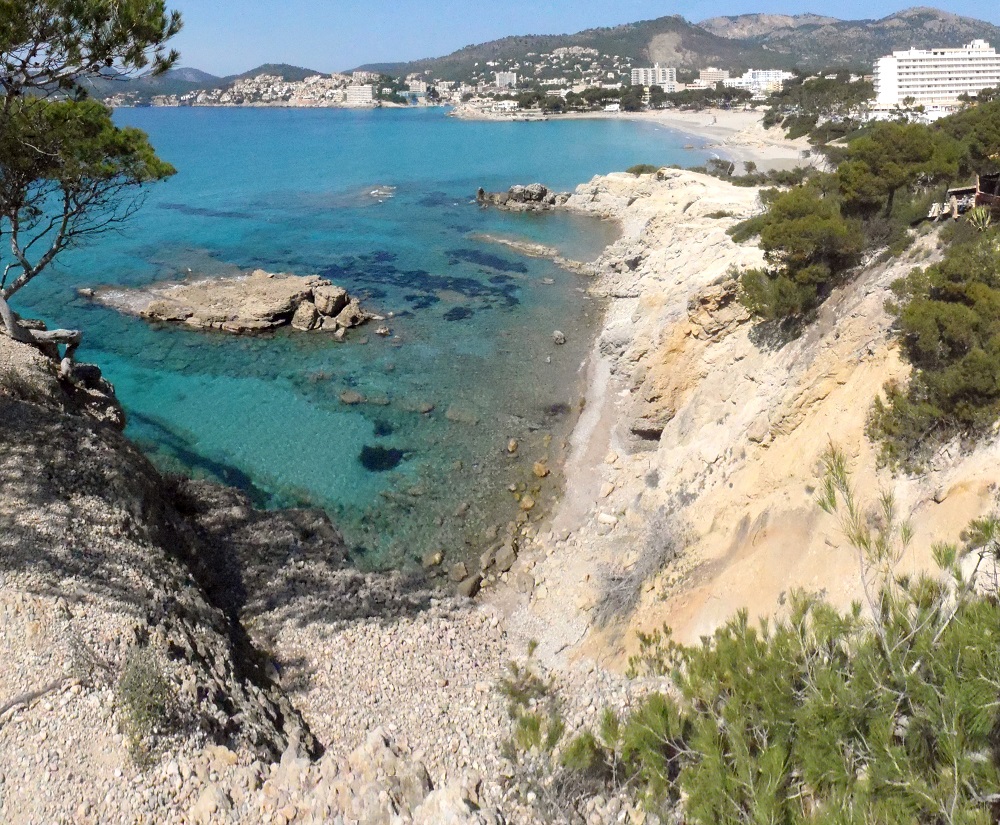
General view of the zone, showing the existence of hard layers (projections) and soft layers (entrances).
On the one hand, siltstones correspond to soil-type materials, which behave in an isotropic manner, and when they break they create rotational/circular morphologies. They are more easily eroded, so they generate entrances (coves) in the coast. In the case of steep slopes, like those of this part of the coast, the surface erosion caused by rainwater tends to form channels which create rills like those observed in the descent to the cove (point A).
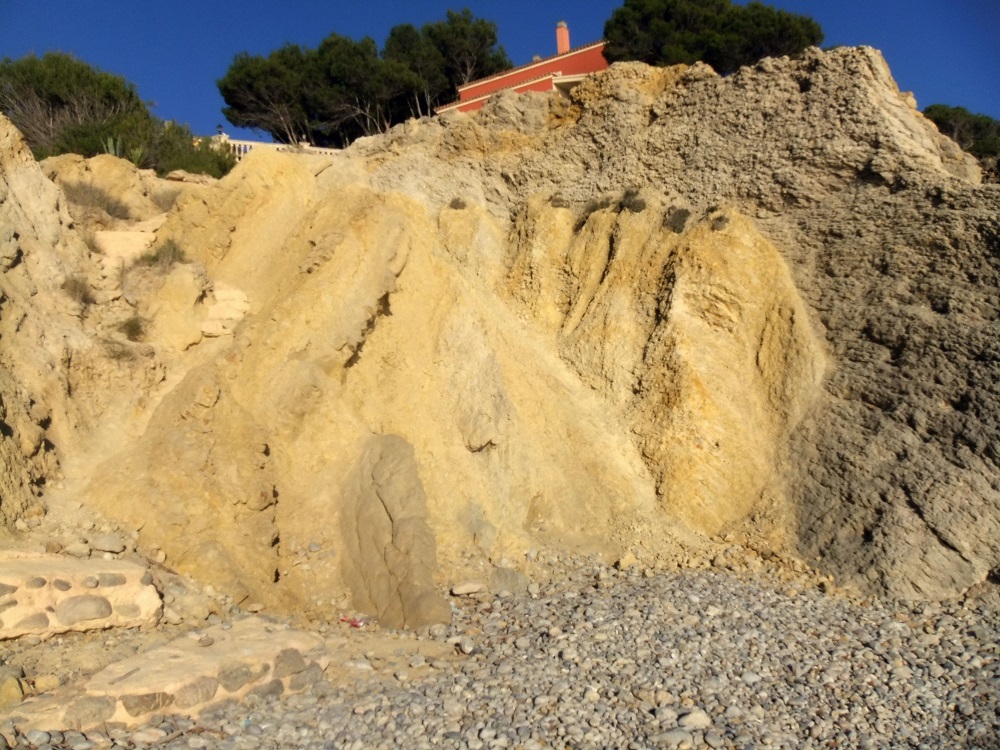
Erosion in rills in the siltstones.
On the other hand, limestones, sandstones and conglomerates are rocks which behave in an anisotropic manner (they break along weakness planes) and cause planar or wedge slides or detachments, like those observed at point A. As they take longer to erode, they give rise to projections along the coast (promontories).
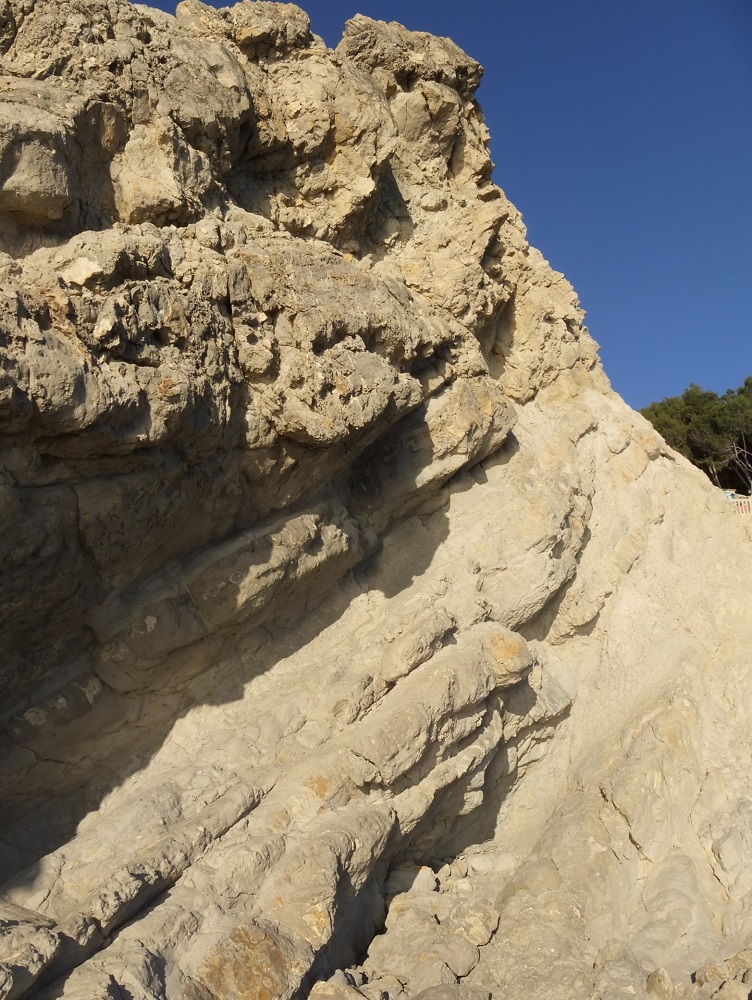
Rocky strata whose erosion causes detachments
Another product of this same marine erosion is the Illa dels Gorrions. This islet consists entirely of a paleodune from the Pleistocene, similar to what we saw at the first stop. It displays the cross-stratification typical of this type of calcarenitic rock and rhizocretions.
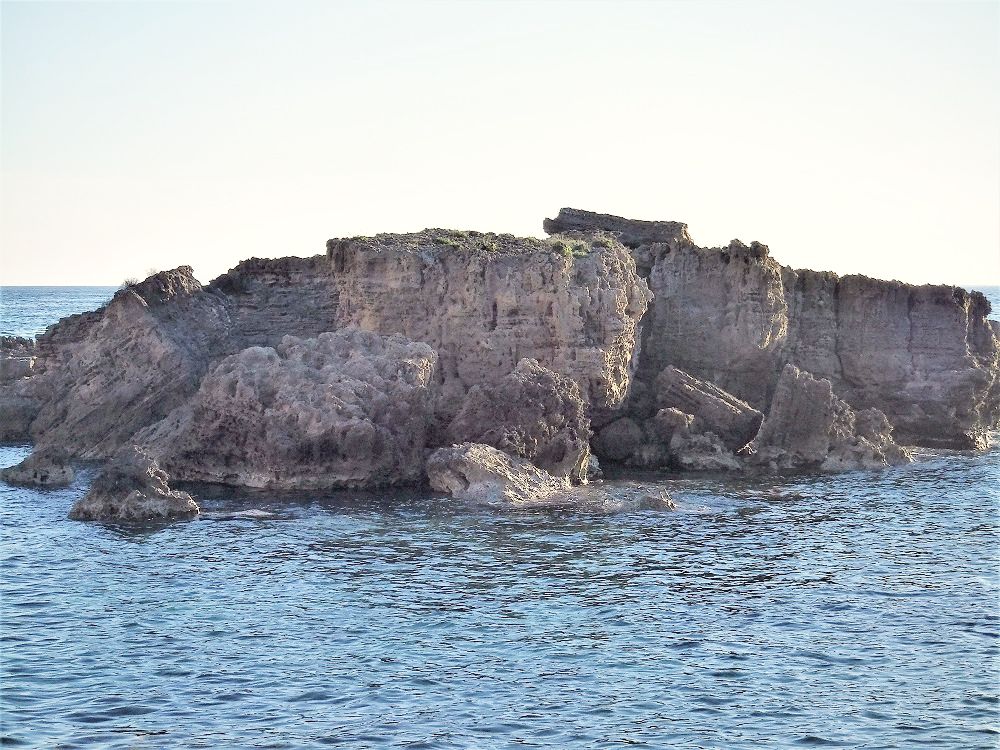
The Illa dels Gorrions, an isolated surviving vestige of the erosion of the Pleistocene marès (point C).
