| UTM-X | UTM-Y | ||
|---|---|---|---|
| STOP 1: GYROGONITES AND FOSSIL BEACHES | |||
| STOP 3: FOSSIL PLANTS AND ANTCIENT RIVERS. | |||
| STOP 4: THE EROSION OF THE COAST. | |||
| STOP 5: THE ANTICLINE. |
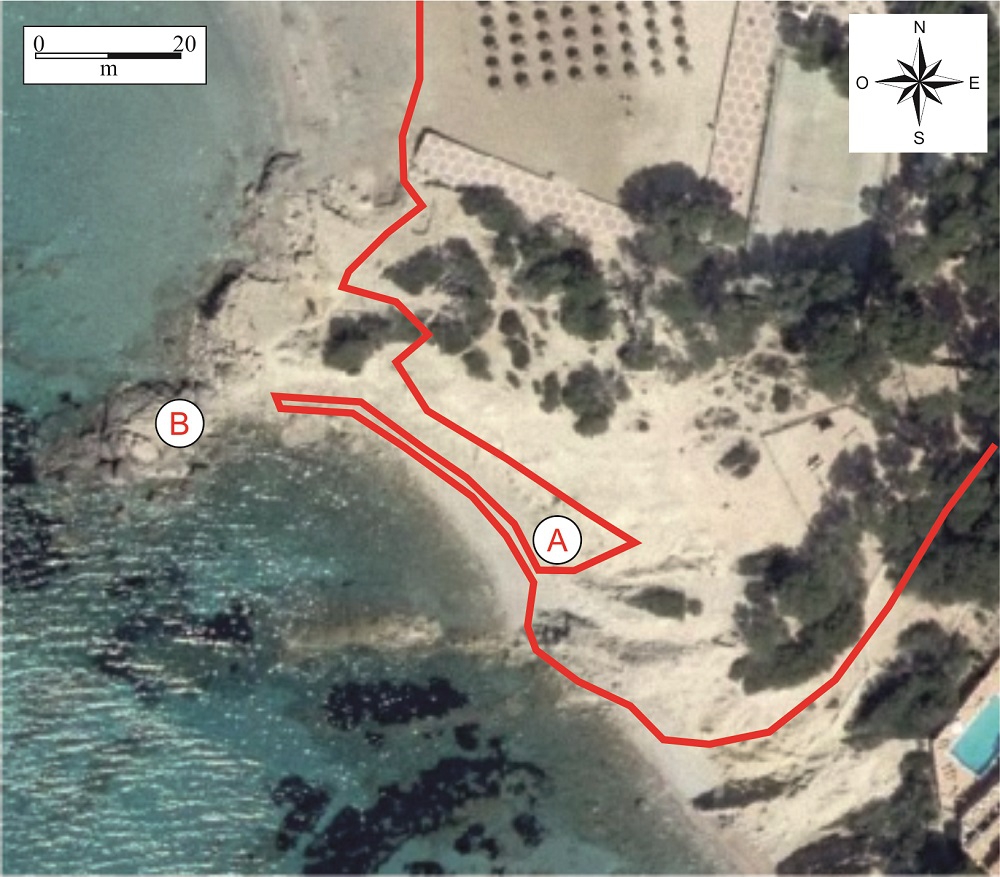
Recommended route.
The route continues at the south-east end of the Platja des Morts, where there is a cliff shoreline formed by layers of conglomerates, sandstones, limestones and whitish and yellowish siltstones. This is once again the Cala Blanca Formation.
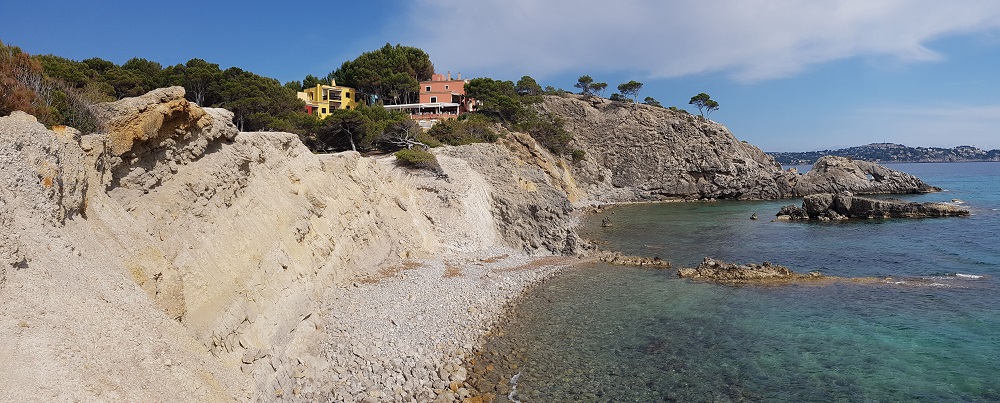
General view of the cliffs in the zone of stop 3.
The most notable feature of this zone are the vegetal remains, fossils of both well-preserved and decomposed leaves forming layers rich in organic matter. The fossil record of plants here tells us of a predominantly dry environment but with abundant watercourses which permitted the proliferation of hygrophilous forests, that is, forests adapted to damp conditions. The coastline of the time would have been relatively close by, since the species studied include ferns adapted to living in coastal environments.
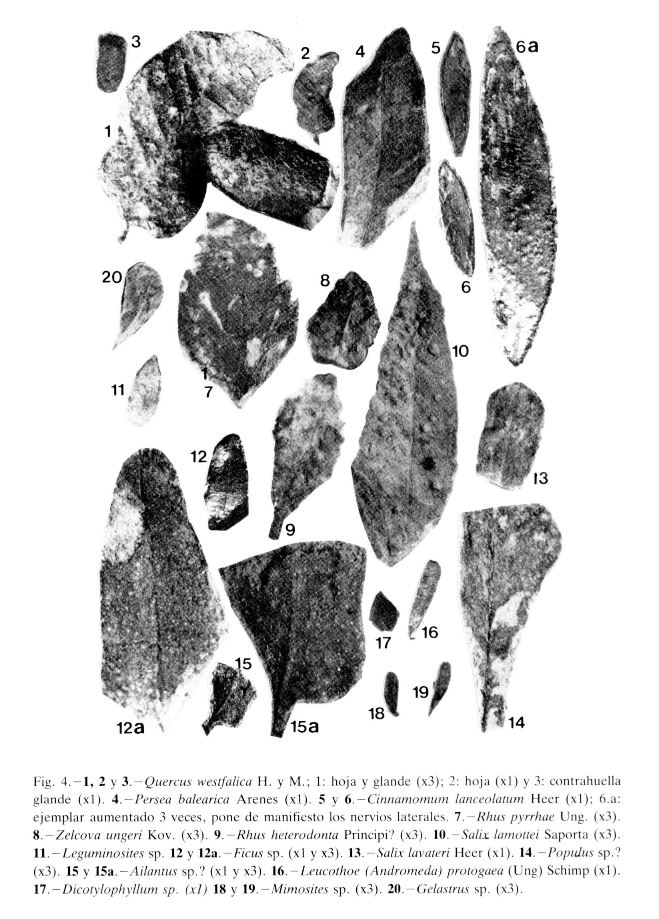
Part of the flora of the Cala Blanca Formation found in Peguera (taken from Álvarez Ramis & Ramos, 1986).
There is a good example of layers with organic matter at point A of this stop, where the carbonous remains of decomposed vegetation stand out for their black colour among the light grey siltstones in which they are incrusted. To reach point A we have to walk down a small stream bed that cuts through the siltstones.
In addition, at the northern end of the coast it is interesting to observe the conglomerates which also belong to the Cala Blanca Formation (point B).
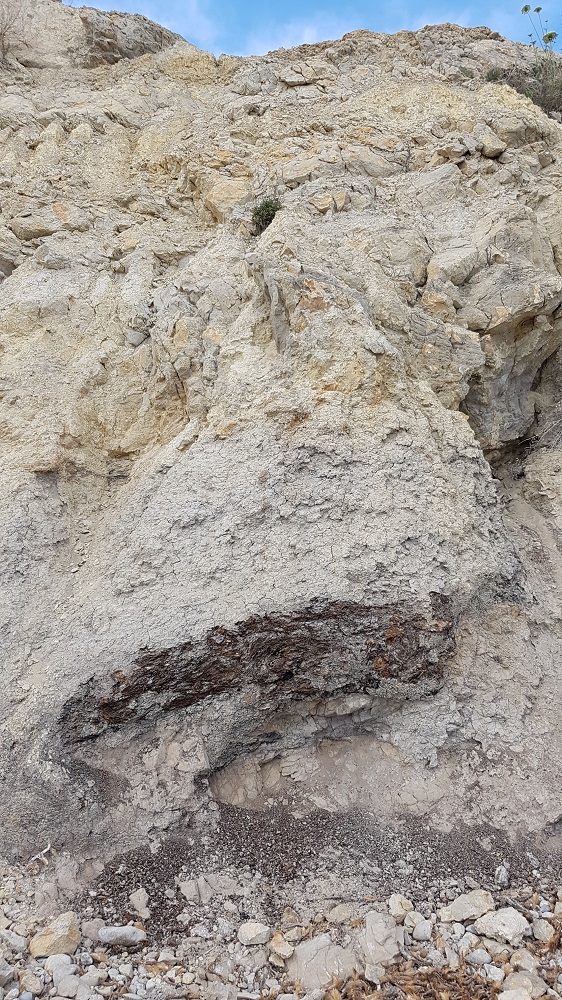
Layer with dark-coloured carbonous remains (point A).
The conglomerates are sedimentary rock. It refers to pieces of rocks and hard biologic remains which have been eroded and transported.</p><p><br></p></div>">clast-supported, with rounded edges with marks of pressure-dissolution, very polygenic (edges of different nature and origin) and a sandy matrix firmly cemented by carbonates. They have channelled bases and, locally, lenticular morphologies. They correspond to river channels whose affluence direction is NNE-SSW.
Conglomerates at the northern end of the coast. Note how the conglomerates alternate with narrower layers.
