| UTM-X | UTM-Y | ||
|---|---|---|---|
| STOP 1: THE MIOCENE OF CAP DE BARBARIA | |||
| STOP 2: MIOCENE AND QUATERNARY OF CALA SAONA | |||
| STOP 3: S’ESTANY DES PEIX | |||
| STOP 4: PUNTA DE SA PEDRERA |

Recommended route.
Cala Saona is itself a unique area within the geology of Formentera as it is the only inlet on the island associated with a river course (Cala Saona Canal), which contributed to its formation.
If you look at a geological map, you shall see a large fault parallel to the river, which suggests that the formation and route of the river course is due to the area of weakness created in the rock upon fracturing, which is more susceptible to being affected by dissolution.
The rocky substrate on which the Cala is formed corresponds to the Late Miocene period (11 to 7 Ma), the same material as at Cap de Barbaria. However, there are no fossil reefs here rather a set of continental materials, breccias, silts and calcarenites, which represent the emerged lands behind the corals.
On top of this Miocene period there is a series of quaternary materials: Pleistocene and Holocene. From the Pleistocene there are fossil dunes, the main source of marès on the island. Sometimes these contain fossils such as the shells of land gastropods or moulds of vegetation roots that populated the dunes.
In these sediments, in an area near the inlet, one of the most important and rare fossils of the Balearic Islands was found. It is the remains of a tortoise nest, from which various eggs were recovered, which luckily were preserved in the marès of the area.
By studying the nest, it was possible to deduce the length of the shell of the female that laid the eggs, around 80 cm. This denotes the existence of a species of almost gigantic measurements that no longer exist today.
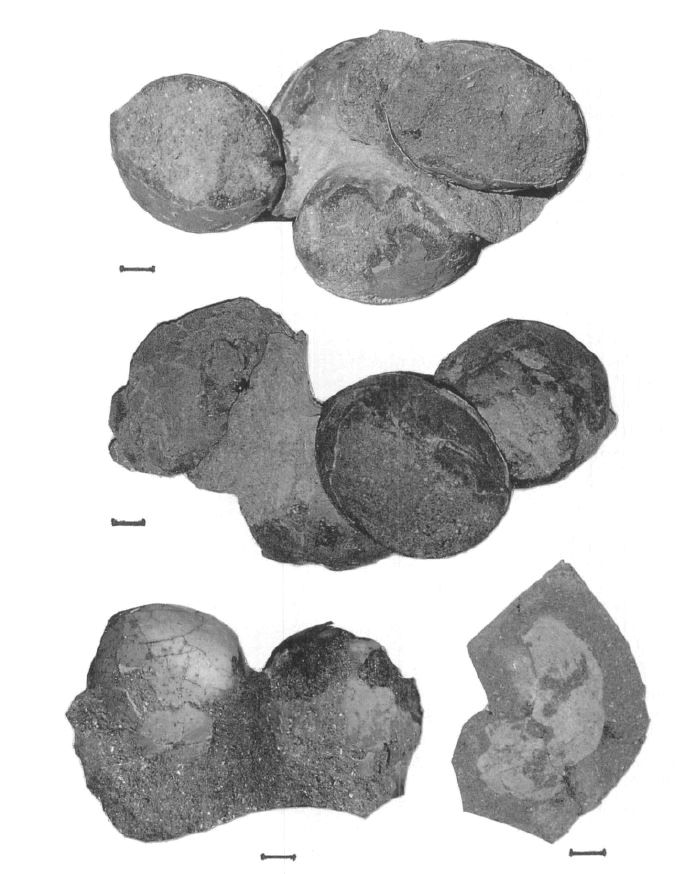
Remains of the Pleistocene tortoise nest found near Cala Saona. Taken from Filella-Subirà (1999). Scale: 1 cm.
Regarding the Holocene materials, we have the inlet itself. This comprises a small system of dunes that support a local coastal community of flora and fauna.
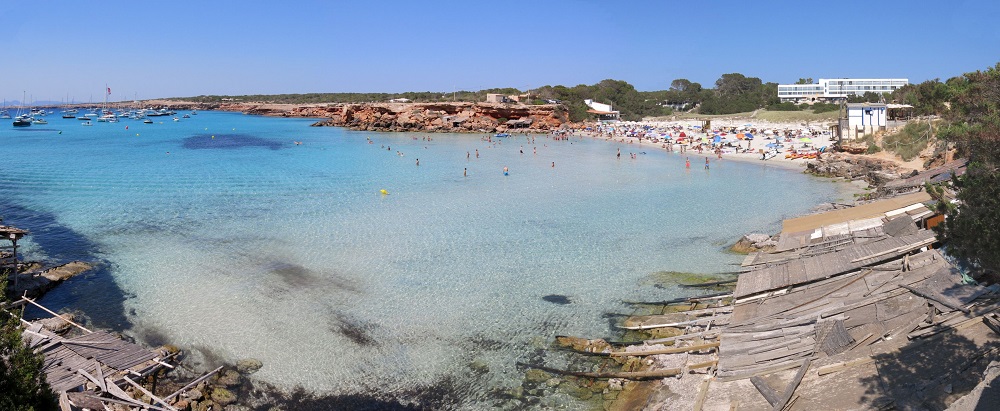
Panoramic view of Cala Saona. In the background, red cliffs formed by Miocene silts.
