| UTM-X | UTM-Y | ||
|---|---|---|---|
| STOP 1: THE MIOCENE OF CAP DE BARBARIA | |||
| STOP 2: MIOCENE AND QUATERNARY OF CALA SAONA | |||
| STOP 3: S’ESTANY DES PEIX | |||
| STOP 4: PUNTA DE SA PEDRERA |
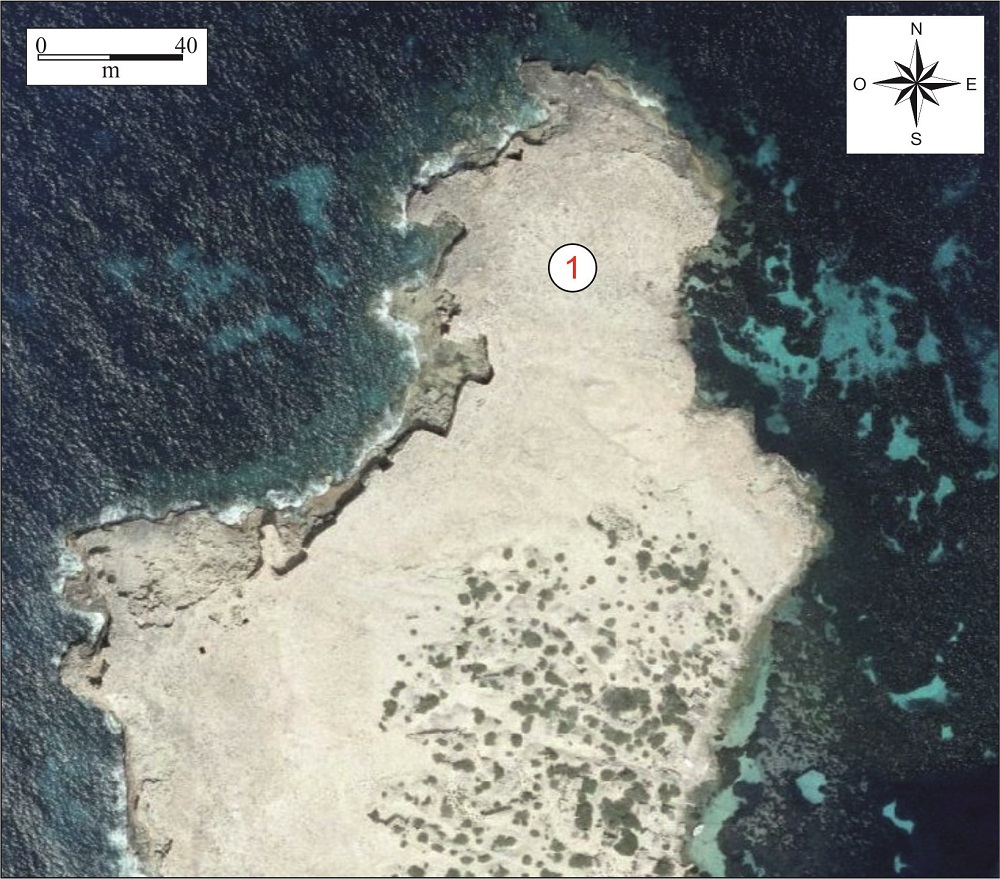
Orthophoto of Punta de sa Pedrera.
On the oldest materials of Formentera (Late Miocene) a great variety of Quaternary sediments is deposited. Among these the fossil dunes stand out, formed by a type of rock that is technically called aeolianite but has the well-known common name of marès. In the sector between Can Marroig and Punta de Sa Pedrera the most characteristic outcrops can be seen.
This type of site, common in the Balearic Islands, principally originated during the Pleistocene period, a particularly productive moment regarding the formation of dunes.
This high level of production results from the low sea level arising from important glacial periods that affected the Earth at that time. The drop in the sea level left large areas of the sea bottom exposed to the air. The dominant winds of the time caused the sand to move and the formation of dune fields which are now fossilised.
The dunes, over an extended period of time, were deposited one on top of another, favouring the intercalation of red silt layers corresponding to the fossilised soils formed during the most humid and warm periods. The latter were named paleosols.
In the Balearic Islands, the materials comprising the aeolianites are mainly formed by small fragments of mollusc shells and microfossils (usually foraminifers) that live in the Posidonia fields. Therefore, the existence of dunes and beaches on our coast is a fact that is strongly linked to the existence of marine communities associated with the cited marine plant.
As animal shells are made from calcium carbonate, the aeolianites of the Balearic Islands are also made from this same compound.
The sedimentation of the dunes is due to the wind that drags the sand and accumulates it in specific places.
As the wind makes directional changes, the grains of sand gradually accumulate and create layers of sand that deposit according to the wind direction.
Cross-stratification is formed from grains of sand accumulating on the sliding face. Changes in wind direction complicate this cross-lamination.
The area is not particularly diverse in fossils that are identifiable with the naked eye, although there is a type that can be easily observed at some points: the rhyzocretions. These are basically moulds of the plant roots that populate the dunes when they are active. They can be identified by their typical tube shape.
Due to its high value as a construction material, as it is a rock that is easy to cut and relatively hard, the marès in the area has been exploited in numerous quarries. Their walls show the stratigraphy of the fossil dunes, although the natural, wind-sculpted walls can also be seen.
