| UTM-X | UTM-Y | ||
|---|---|---|---|
| STOP 1: ZEBRA FACIES | |||
| STOP 2: IGNEOUS ROCKS OF CANAL D’EN MARTÍ | |||
| STOP 3: QUATERNARY OUTCROPS | |||
| STOP 4: OLISTOSTROMIC UNIT |
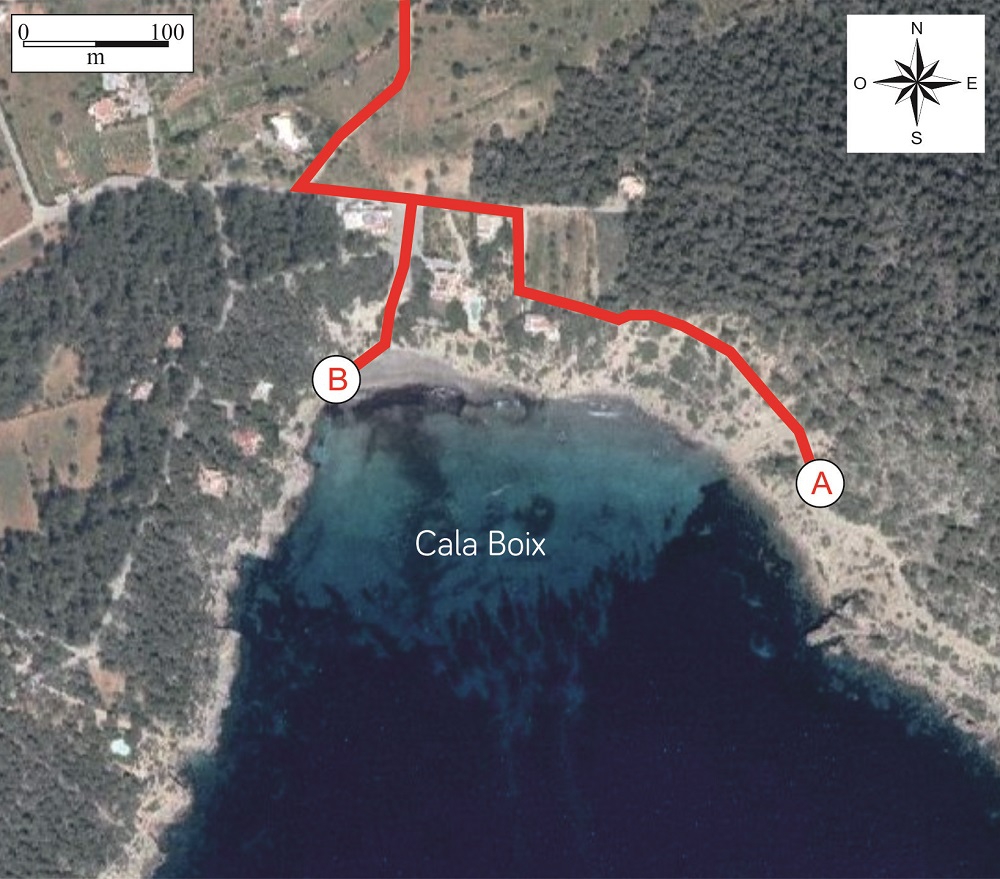
Cala Boix stops.
At Cala Boix it is possible to find two different Middle-Lower Miocene outcrops. One is on the left bank (looking towards the sea) of Cala Boix and corresponds to the recognised olistostromic unit and the other is on the right bank and also has olistoliths.
The olistostromic unit is formed by sub-angular or moderately rounded clasts of a few centimetres to some decimetres surrounded by a sandy-clay bed. It is also possible to find some collapsed blocks that can be decametric or kilometric. The age and lithology of the clasts and blocks are diverse, but the Triassic redeposited materials seem to be predominant.
The second Miocene unit comprises a set of layered marls, margo-limestones and argillaceous limestones of varying colouration between yellow, white and grey. Although it is not yet officially named an olistostromic unit, heterometric blocks of Triassic or Jurassic materials (olistoliths) can be found.
Both units are often linked to thrust faults.
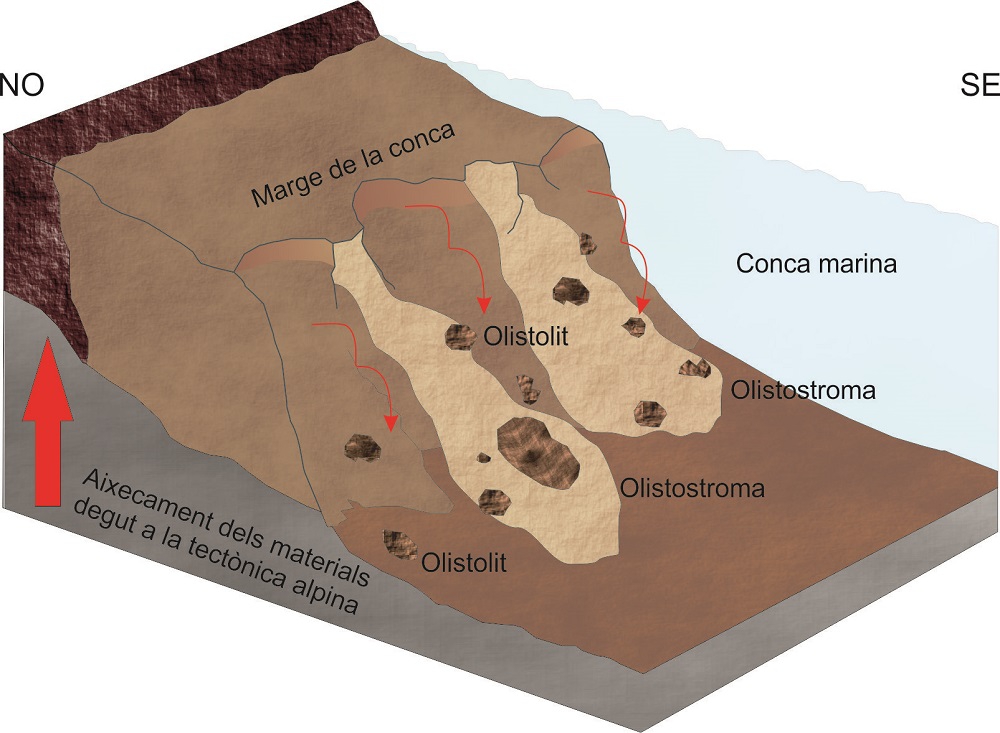
Formation of olistostromes from olistoliths.
In this sector the Miocene sediments were deposited on a shallow seabed that was very compartmentalised and with many faults due to Alpine tectonics. As the bank of the basin rose due to the fault
<div class="ql-editor"><p class="ql-align-justify">Inverse fault in which the stratification plane.</p><p><br></p></div>">dip of the fault plane is at a low angle (generally less than 45<sup> o</sup>). It tends to refer to large-scale (regional) structures.</p><p><br></p></div>">thrust fault, this suffered rapid break down that caused erosion of the previously deposited and lithified materials. These eroded sediments of different lithologies, ages and sizes filled the seabed giving rise to the olistostromic unit, with a chaotic appearance.The top of a stratigraphical unit or stratigraphical sequence. </p></div>">thickness of the olistostromic unit is very variable. At Cala Boix, up to 55m has been identified but in other areas of Eivissa several hundred metres can be measured.
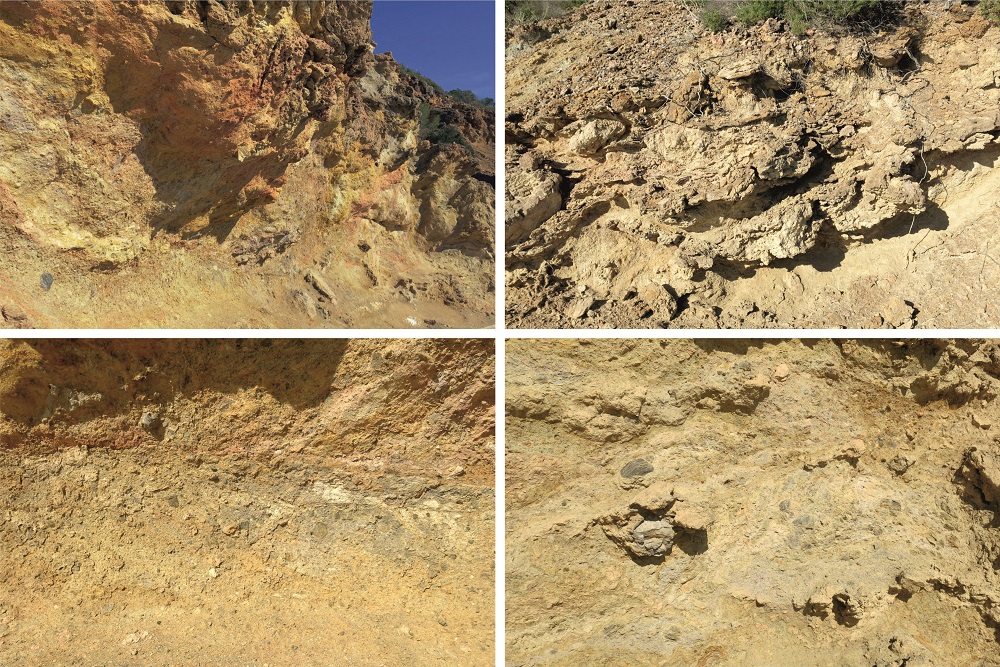
Appearance of the olistostromic unit at Cala Boix (point A).
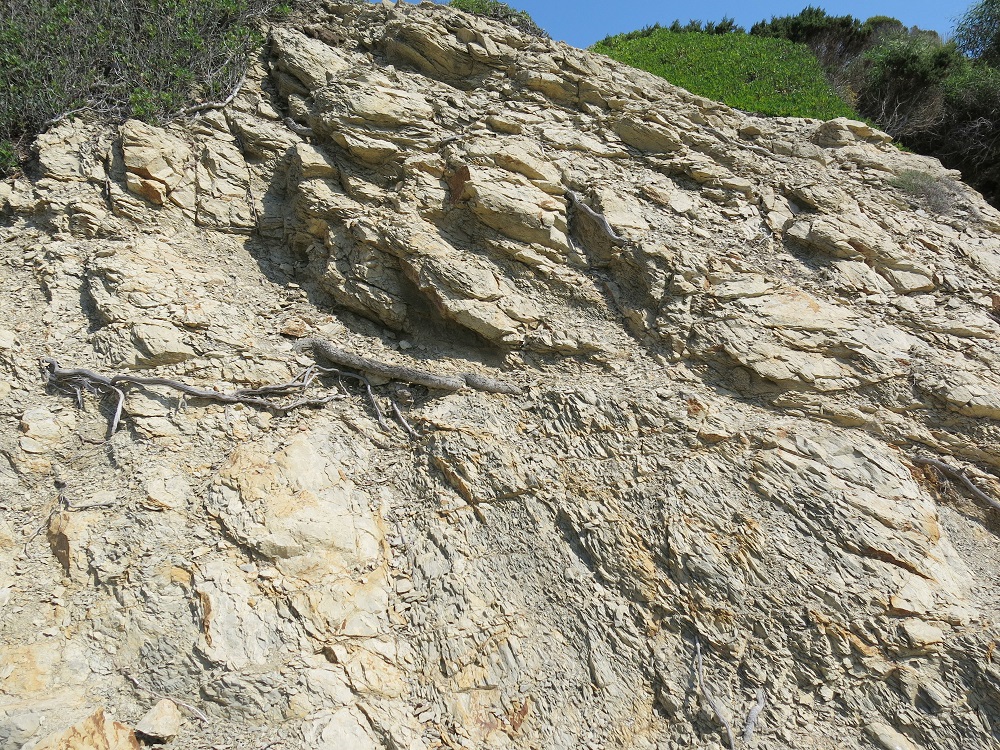
Appearance of the Miocene unit on the right bank of Cala Boix (point B).
