| UTM-X | UTM-Y | ||
|---|---|---|---|
| STOP 1: ZEBRA FACIES | |||
| STOP 2: IGNEOUS ROCKS OF CANAL D’EN MARTÍ | |||
| STOP 3: QUATERNARY OUTCROPS | |||
| STOP 4: OLISTOSTROMIC UNIT |
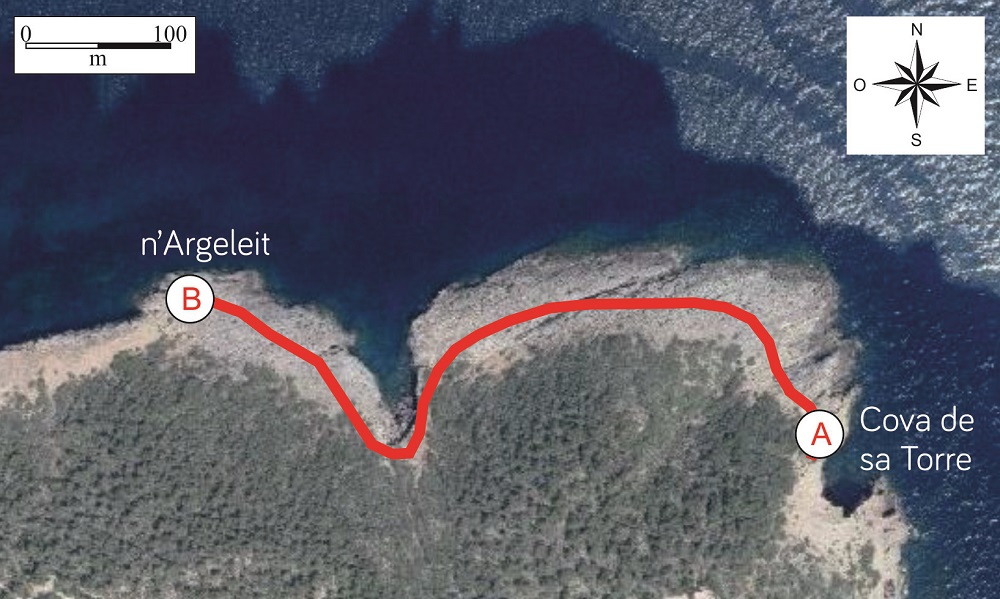
Points of special geological interest in the Punta d’en Valls area.
The Triassic zebra stratigraphic unit and reflect the specific environmental conditions in which they were formed.</p><p><br></p></div>">facies correspond to the oldest rocks of Eivissa. They are located mainly between Es Puig d’en Mestre and Sa Punta d’en Valls and all around the islet of Tagomago.
They are dark grey crystalline dolomites that display abundant veins of dolomite and white calcite that give the unit its striped appearance and the name of zebra stratigraphic unit and reflect the specific environmental conditions in which they were formed.</p><p><br></p></div>">facies.
Due to their dolomitisation it is not possible to find fossil remains, but there are numerous traces corresponding to bioturbation of organisms that lived buried in the sediment when it was still soft.
Above them there is a unit of dolomites and dark layered limestones lying in a discordant manner. They display a relative wealth in fossil fauna and help to date the zebra stratigraphic unit and reflect the specific environmental conditions in which they were formed.</p><p><br></p></div>">facies unit.
Both the zebra stratigraphic unit and reflect the specific environmental conditions in which they were formed.</p><p><br></p></div>">facies unit and the dolomites and layered limestones were formed from carbonated sediment accumulated on the continental shelf under a shallow sea (Panthalassa), at the edge of the megacontinent Pangaea. This was a generally restricted environment of clear and shallow waters.
It can be considered that episodes of scarce sedimentation occurred because it is possible to find layers of reddish, greenish and yellowish colourations between the grey strata. These layers would correspond to ferruginous crusts hardened by oxides of iron and manganese which in contact with oxygen produced the different tonalities.
Due to the tectonic compressive processes which occurred during the Alpine Orogeny, the surface of this Triassic unit was exposed, creating relief. This fact is reflected in the arrangement of the strata, which are verticalised in a large part of the tectonic, eustatic or antropical processes</span></p></div>">outcrop and give rise to Fold of convex shape.</p></div>">antiform folds.
Cova de sa Torre, in the north-east cliffs of Torres de Campanitx (better known as Torre d’en Valls) is considered the core of an Fold of convex shape.</p></div>">antiform fold, responsible for the relief of the hill where the tower is located.
As seen in the photograph, the strata that emerge inside the cave is greatly fractured and has many faults. This is due to the great tensions suffered by the materials as they fold. In the hinge area of the antiforms, the forces are distensive causing cracks to open and the formation of normal faults.
The weak areas created by this folding and the presence of intercalations of marls (of green and yellow tones) between the dolomite strata has allowed erosion to act with greater force on this area, giving rise to a cave.
What can be currently seen is an entrance to the cliff, more like a bite that has removed part of it rather than a cave. This is because, over time, erosion removed the basal support from the cave roof and it collapsed.
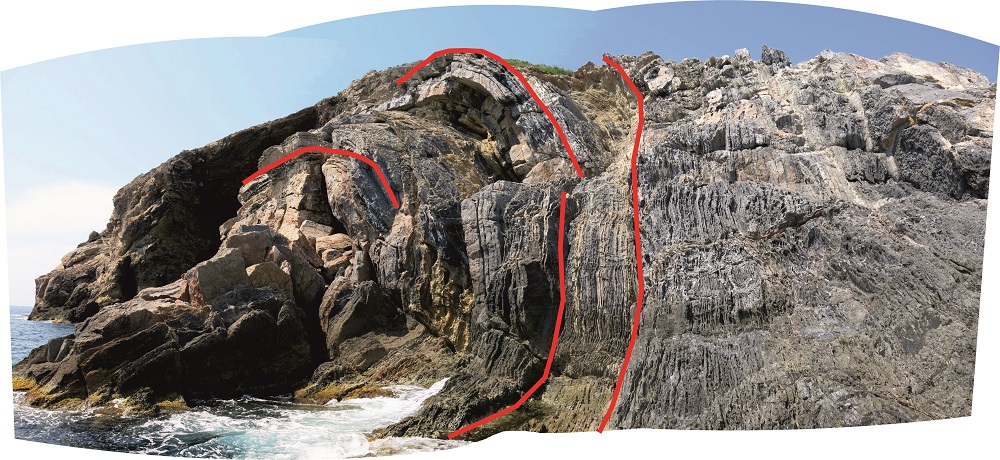
Cova de sa Torre, corresponding to the core of an antiform fold. The fractures of the hinge area can be seen originating from the tectonic forces (Point A of the stop).
Another Fold of convex shape.</p></div>">antiform fold found in the Zebra stratigraphic unit and reflect the specific environmental conditions in which they were formed.</p><p><br></p></div>">facies tectonic, eustatic or antropical processes</span></p></div>">outcrop is in the n’Argeleit area. In this case the dolomites give rise to a small, very well-defined fold with a very verticalized flank that is submerged in the sea.
