| UTM-X | UTM-Y | ||
|---|---|---|---|
| STOP 1: ZEBRA FACIES | |||
| STOP 2: IGNEOUS ROCKS OF CANAL D’EN MARTÍ | |||
| STOP 3: QUATERNARY OUTCROPS | |||
| STOP 4: OLISTOSTROMIC UNIT |
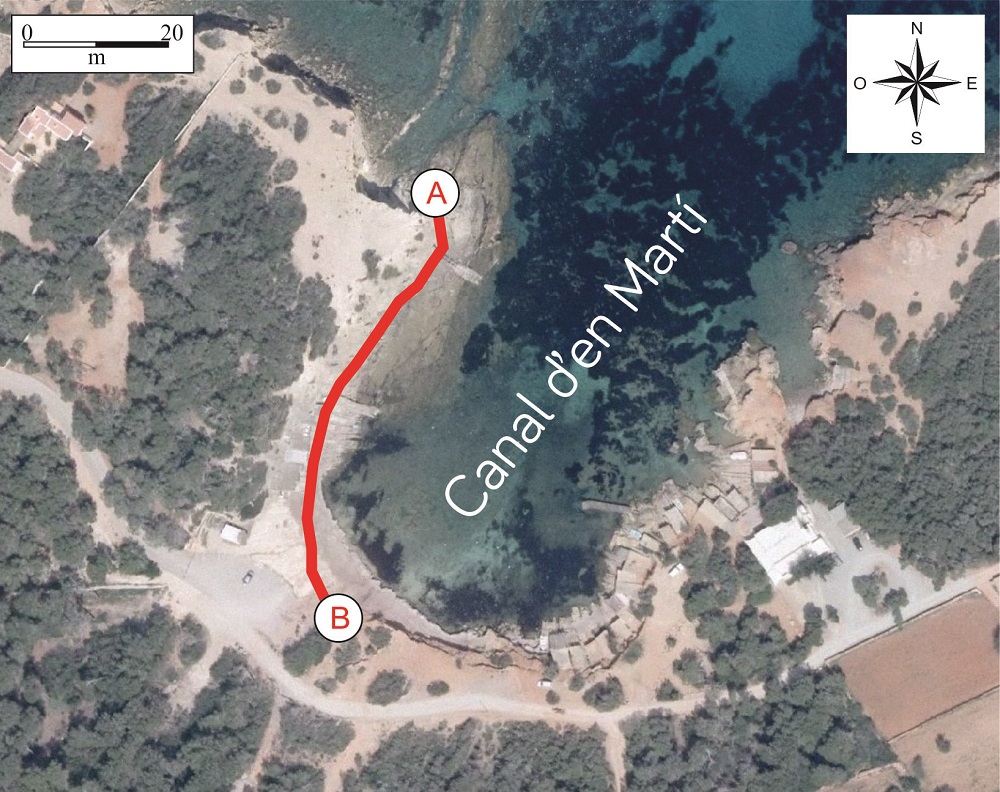
Punts destacats dintre de la parada de Canal d’en Martí.
Between Canal d’en Martí and Punta Llagosta there is an tectonic, eustatic or antropical processes</span></p></div>">outcrop of rocks that differ from the sedimentological normality of the island of Eivissa: igneous rocks.
This type of rocks is formed from the cooling and solidification (crystallisation) of melted rocky material (magma). Depending on the depth within the Earth at which the magma crystallises and the time it takes to do so, igneous rocks can be classified into:
• Plutonic rocks: This type of rocks are those formed from magma that has cooled and solidified at a certain depth inside the Earth, giving rise to igneous bodies with relatively perfect and complete crystallisation because the cooling time is long. This type of rocks would never tectonic, eustatic or antropical processes</span></p></div>">outcrop on the surface if it were not for tectonic and erosive processes. They are also known as intrusive rocks.
• Hypabyssal rocks: These rocks are formed in the tubes that drive the magma from the interior of the Earth to the surface. They tend to display medium-grade minerals but often display similar characteristics to plutonic or volcanic rocks. They are also known as subvolcanic or filonian rocks.
• Volcanic rocks: These are the rocks that crystallise on the surface of the Earth, in subaerial conditions and with fast cooling. They give rise to igneous bodies with very deficient crystallisation, even reaching the point of not presenting a crystalline structure and being a vitreous material. They are also known as extrusive rocks
The igneous rocks found between Canal d’en Martí and Punta Llagosta have been classified like a plutonic rocks by the authors Spiker and Haanstra in 1935 and Beauseigneur and Rangheard In 1968.
These rocks have a massive appearance and a dark grey-green colour. They display numerous fractures where magmas of different compositions circulated along and crystallised (dykes). As a result of the intense meteorisation that has affected them they present alveoli, popularly known as beehives.
The magma that has crystallised in the fractures presents a different composition from that of the rock in which it intruded. Sometimes, due to its chemical properties, it is easier to erode and it forms channels which, when filled by the sea, resemble artificial man-made structures to provide access for fishing boats, but nothing could be further from the truth.
It is certainly not known when these igneous rocks originated, but in this tectonic, eustatic or antropical processes</span></p></div>">outcrop it seems this occurred during the Miocene, because the materials of this period seem to be affected by the contact aureole of igneous rocks.
Another interesting aspect, although not a geological one, is the archaeological site of purple on the right bank of Canal d’en Martí. This is the remains of Mollusc equipped with a fleshy foot and with the body generally protected by a single-piece shell, normally in a spiral shape. The gastropods include snails and limpets, among others.<strong> </strong></p><p><br></p></div>">gastropod shells that the Phoenicians, and later the Romans, used to extract the purple colour.
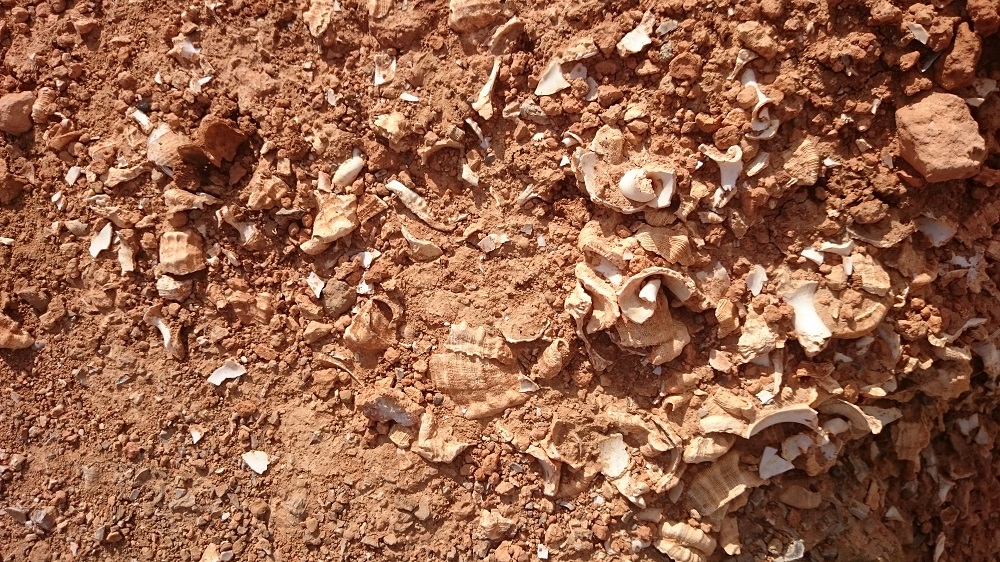
Accumulation of gastropod shells from the Canal d’en Martí archaeological site (Point B).
This dye, more valuable than gold, was used for dying fabrics later exported from Eivissa to the rest of the Mediterranean.
The Mollusc equipped with a fleshy foot and with the body generally protected by a single-piece shell, normally in a spiral shape. The gastropods include snails and limpets, among others.<strong> </strong></p><p><br></p></div>">gastropod species most used for extracting purple are Hexaplex trunculus and Bolinus brandaris. The dye comes from some glands these animals have and which secrete an initially transparent mucus that, in contact with the air, oxidises and turns purple.
On the Pityusic coast there are more than 40 purple archaeological sites.
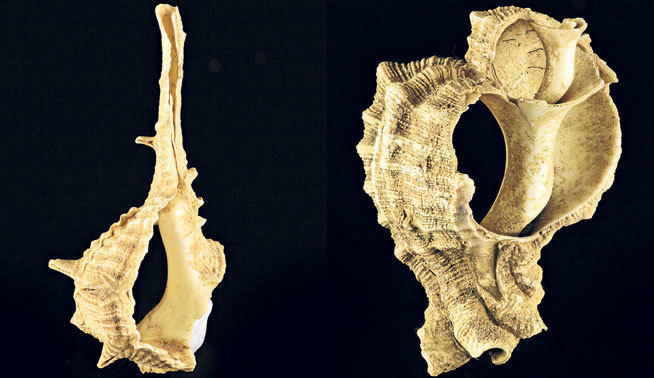
Gastropod of the species Bolinus brandaris (left) and Hexaplex trunculus (right). Specimens from the Sa Xanga site (Pink Salt). Photograph from the Eivissa newspaper taken by Joan Costa.
