The sector between the harbour and Sa Creueta’s cape consists mainly of rocky strata of nodular appearance and yellowish colour, inclined towards the south. These are sandy limestones from the Upper Jurassic (165-145 Ma) which have been deposited in deep waters (pelagic environment) where sedimentation was very scarce and each level took several thousand years to form. These strata erode relatively easily, giving rise to gentle slopes.
In clear contrast, in a more or less local manner, there appear isolated layers of massive interspersed limestones which present greater resistance to erosion and generate projections. They are limestones from the Lower Jurassic and have been interpreted as olistolites.
Olistolites are enormous masses of material that have slid down the continental slope and have deposited among sediments of the seabed.
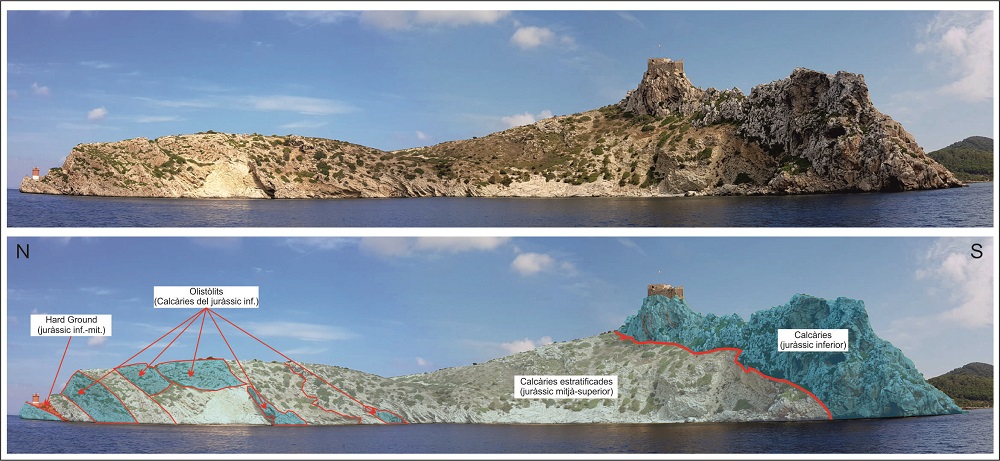
Geological interpretation of the cliffs of Stop 1.
The limestones on which the castle stands have also undergone intense deformation that has generated enormous folds observable in their north face, where we are now.
Close from the Sa Creueta lighthouse, over limestones from the Lower Jurassic, there is an tectonic, eustatic or antropical processes</span></p></div>">outcrop of a hard ground.
A hard ground is a stratum formed during a period of little or no sedimentation, so it tends to represent hundreds of thousands or even millions of years. One of its most characteristic features is the presence of crusts of minerals deriving from iron and manganese, which give it reddish, purple and blackish colours. However, the aspect that tends to attract most attention is the enormous abundance of fossils, in this case of ammonites. Along the coastal route we will observe several examples of hard ground.
