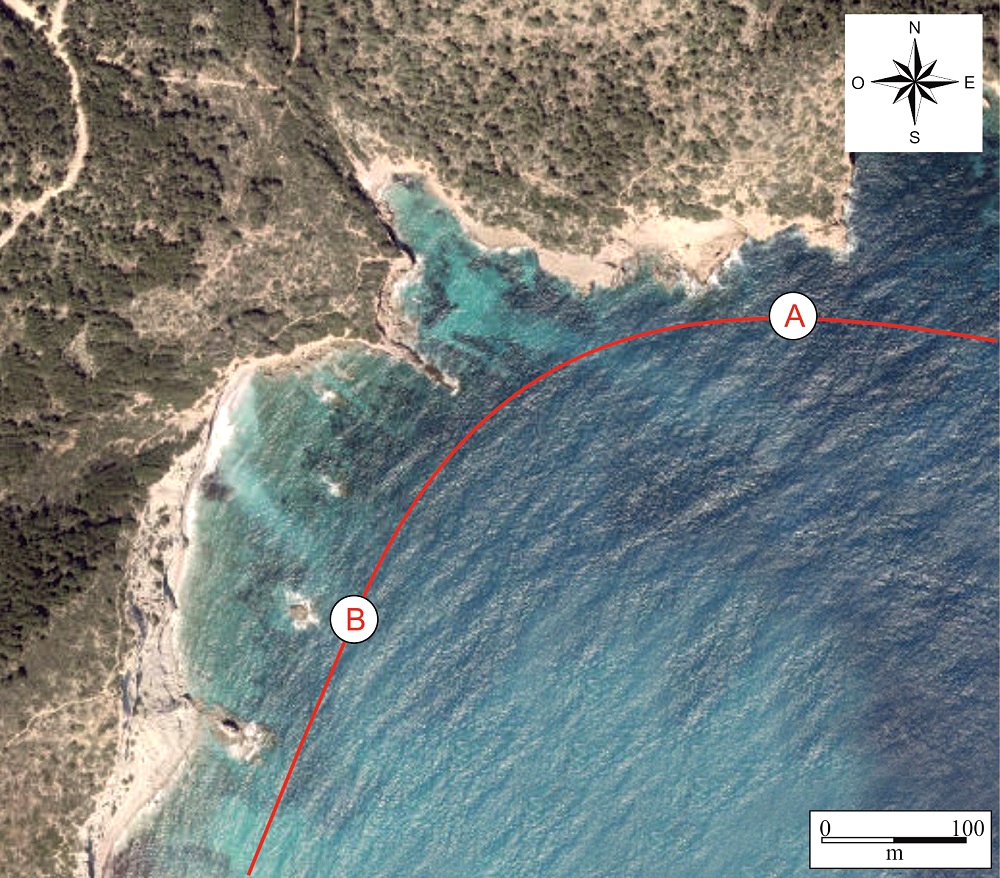
Recommended route.
Once we pass Cap de Sa Carabassa, the coastline begins to lose height and there appear rocks of yellowish-ochre colour and grainy texture. These are limestones and siltstones of the Eocene and are some 45 Ma old. They constitute the oldest Tertiary geological record of the Balearic Islands.
In these materials we can see an enormous marine abrasion arch (point A). This type of arch is generally produced by the dismantling of a littoral cave.
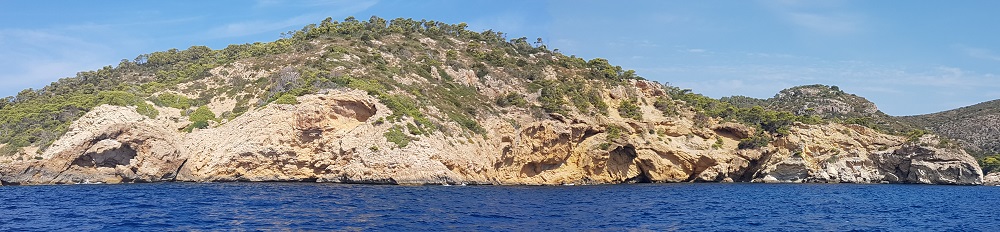
The Eocene limestones are notable for their orangey or yellowish colour. To the left we can see an abrasion arch.
At the other side of the Caló des Macs (point B), there appear Pleistocene fossil dunes (calcarenites), with very marked cross-stratification, lying over some grey marls, possibly from the Lower Cretaceous, by an contact
<div class="ql-editor"><p>Surface which contact two stratigraphical units or series which are not consecutive in the time due to an alteration, disgregation and elimination of part of the lower unit or series before the deposition of the later. Is a type of tectonic (faults and joints) or igneous. </p><p><br></p></div>">discontinuity. </p></div>">erosive contact.Due to the arrangement of the calcarenites is horizontal and the Cretaceous rocks are inclined (that is, they display a stratification plane.</p><p><br></p></div>">dip), the contact corresponds to an angular stratigraphic series or successions.</p><p><br></p></div>">discordance.
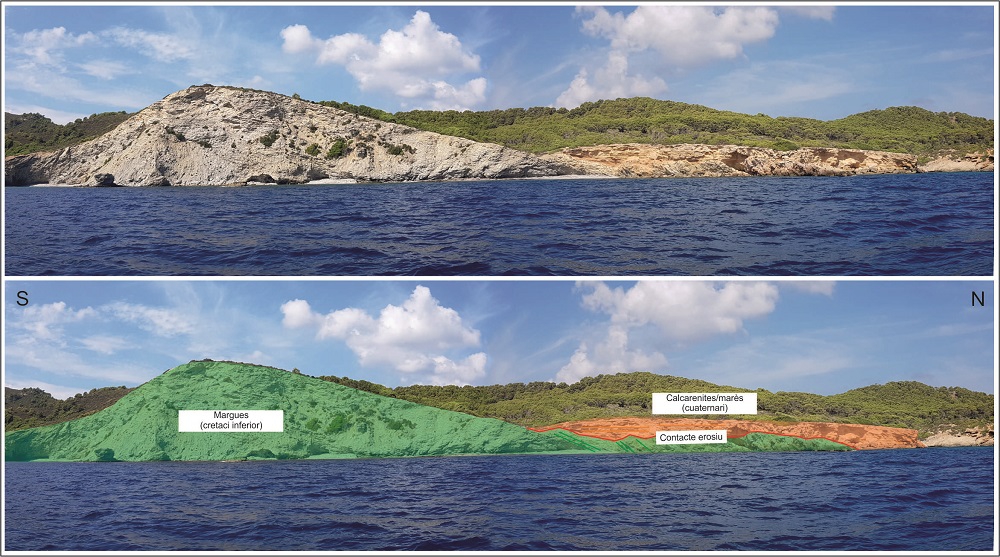
Marls of the Lower Cretaceous covered by Pleistocene fossil dunes.
