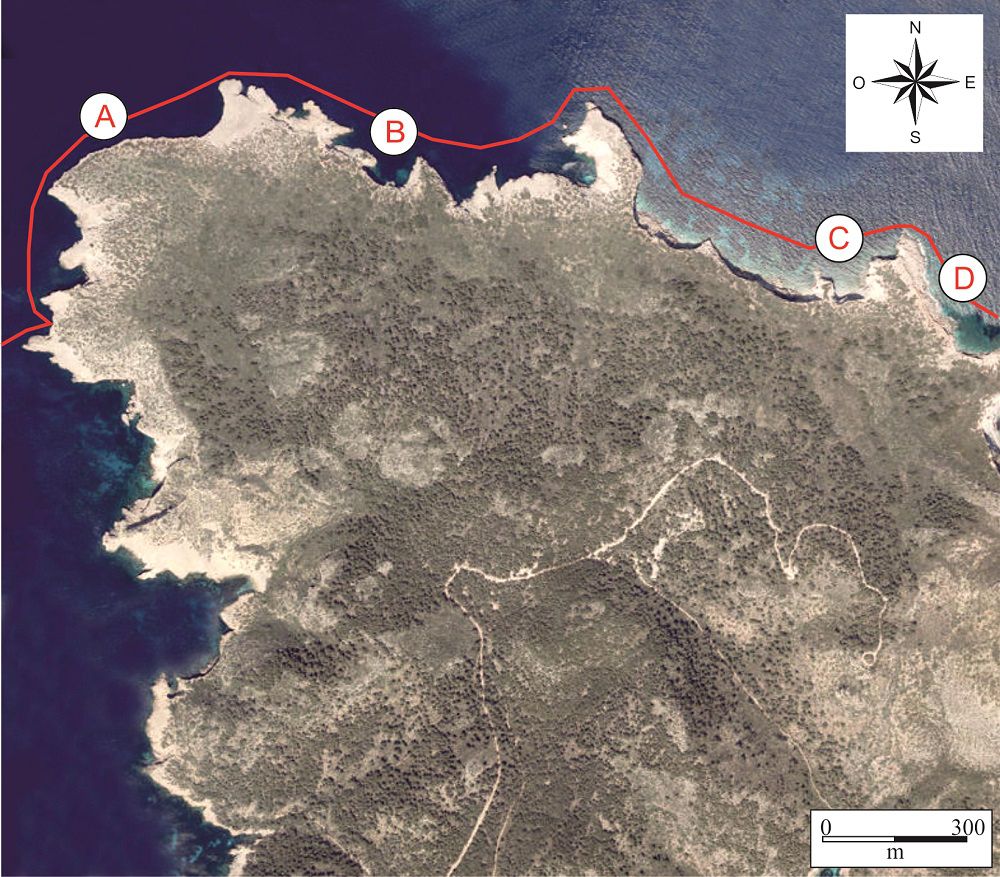
Recommended route.
The next stop begins at Cap des Morobutí (point A), where the Lower Jurassic limestones appear very well stratified in layers of metric top of a stratigraphical unit or stratigraphical sequence. </p></div>">thickness. Locally it can be seen that they are folded and affected by numerous faults (breakage surfaces of the rock which have undergone displacement).
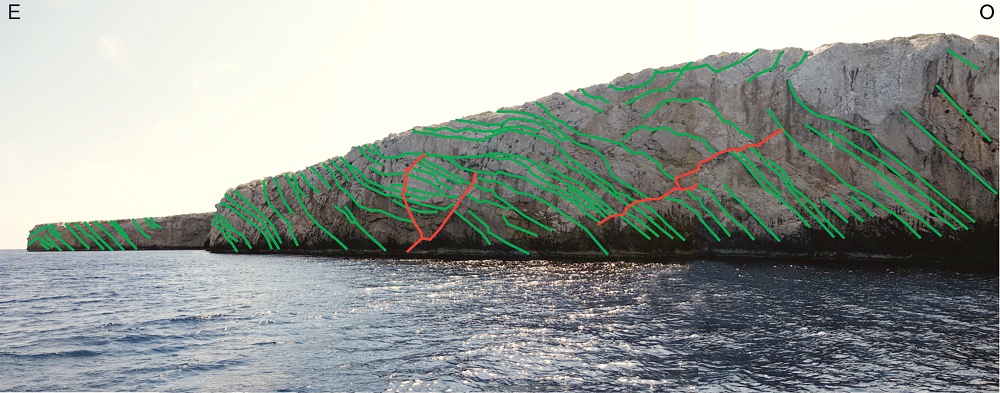
Presence of faults (in red) and folds affecting the rocky strata (in green) at the Cap des Morobutí (point A).
A little farther along, at point B, the limestones are restricted to the base part of the coastal cliffs and, finally, they are replaced by the stratified yellowish limestones of the Middle-Upper Jurassic. In the contact between the two we can observe a reddish-colour surface that corresponds to a hard ground, similar to what we saw at the first stop.
As occurred in the area of the castle, olistolites are common, interspersed between the stratified limestones of the Middle-Upper Jurassic.
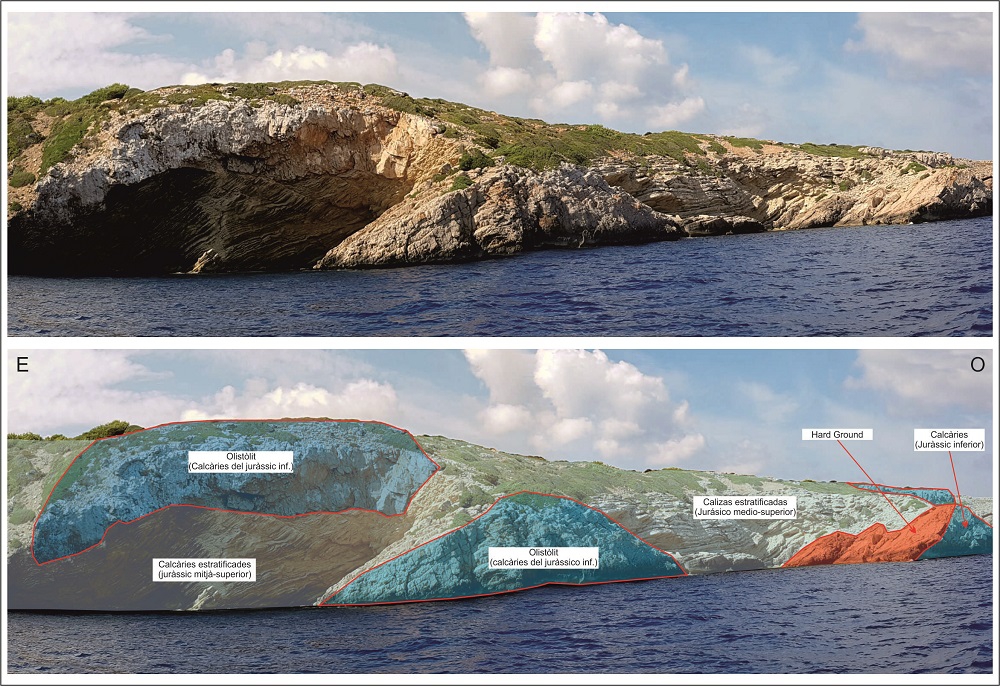
Stratified limestones with olistolites of the Middle-Upper Jurassic and hard ground over limestones of the Lower Jurassic (point B).
All the rest of the coast corresponds to the pelagic sediments of the Middle-Upper Jurassic, although near of Sa Punta de Sa Corrent (point C) there are grey marls which are probably from the Lower Cretaceous and are affected by numerous folds.
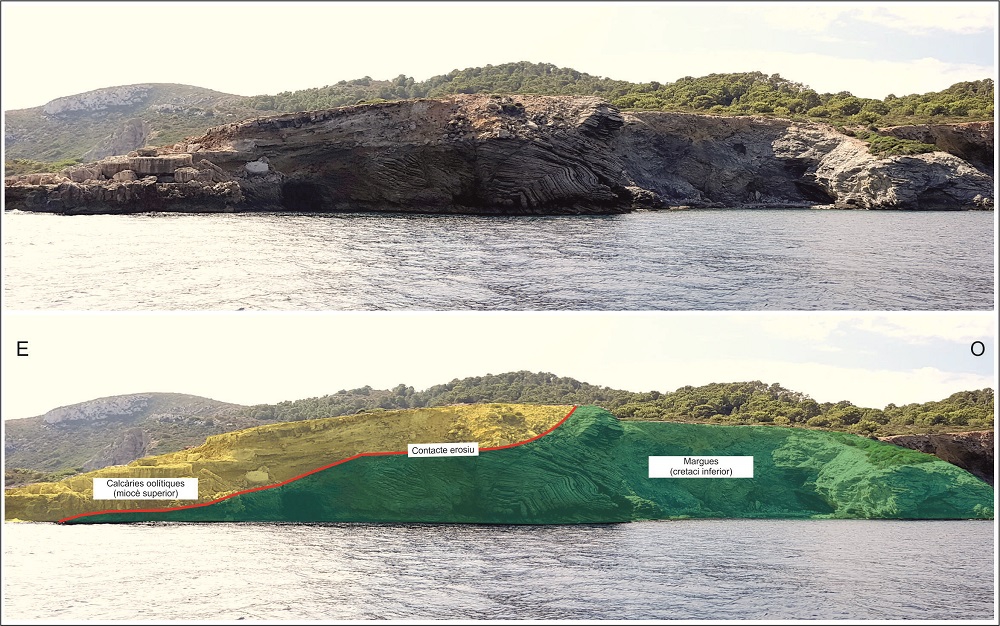
Strongly folded marls of the Lower Cretaceous on which limestones from the Upper Miocene have been deposited (point C).
Above the Cretaceous marls, and forming Sa Punta de Sa Corrent, there appears the only tectonic, eustatic or antropical processes</span></p></div>">outcrop of Upper Miocene rocks in the island of Cabrera.
It can be seen that the rocks here, of tabular appearance, are arranged horizontally. This is because they were deposited after the Alpine Orogeny, a stage of intense geological activity that began some 25 Ma ago and was the cause of the raising and deformation of the Jurassic and Cretaceous rocks that we have been seeing along the coast.
The contact between the Miocene and Cretaceous rocks marls is erosive.
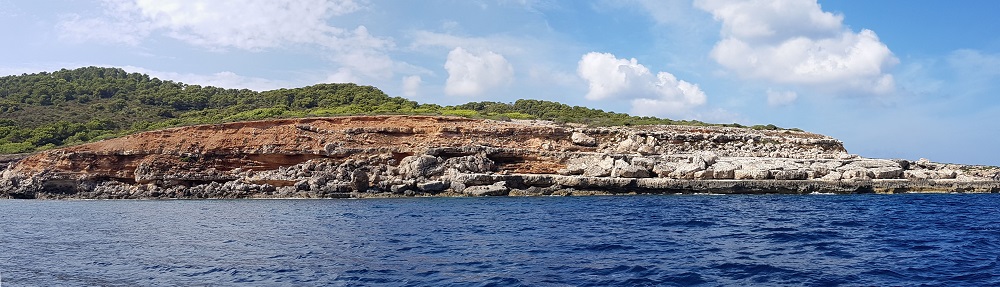
View of the limestones of the Upper Miocene from the sea (point D).
