| UTM-X | UTM-Y | ||
|---|---|---|---|
| STOP 1: THE PERMIAN OF CALA GATA | |||
| STOP 2: THE QUATERNARY OF SON BUNYOLA | |||
| STOP 3: THE MIOCENE OF BEC DE S’ÀGUILA | |||
| STOP 4: THE THRUST FAULT OF ES CAVALL |
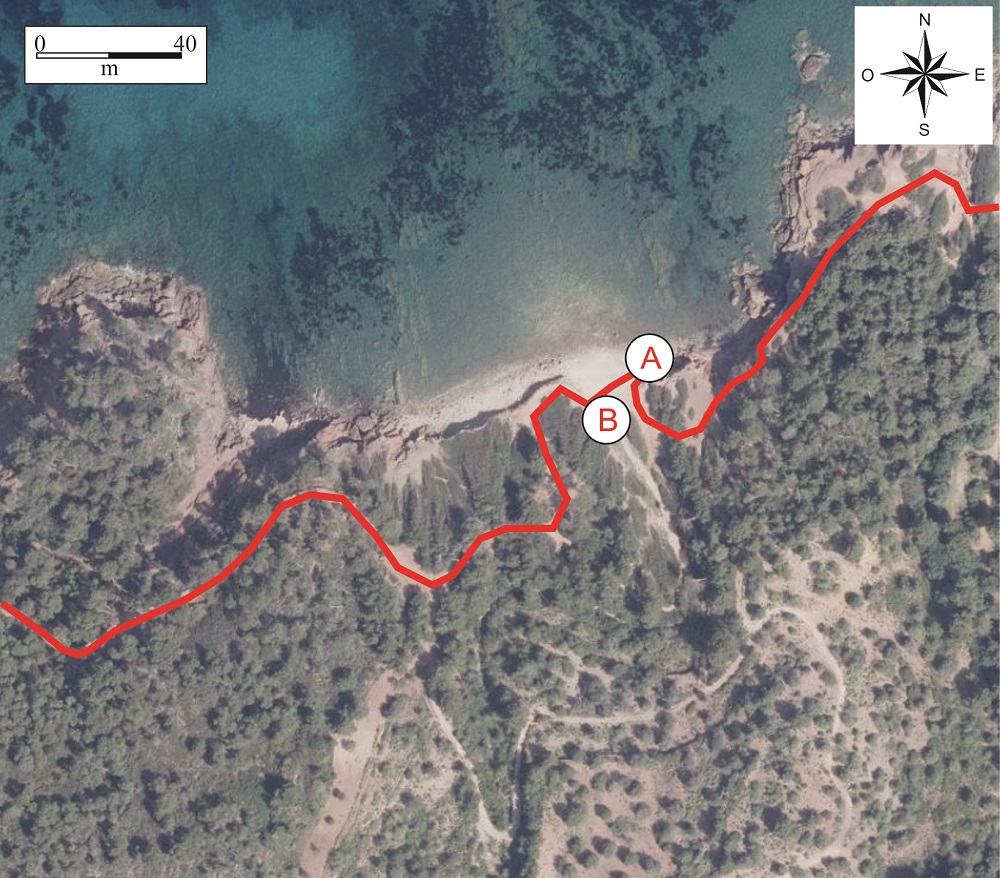
Recommended route.
In sharp contrast with the age of the rocks described above, above them there lie other types of much more modern materials, from the Quaternary (2.5 Ma-present). They are coastal deposits, formed when the coastline of the zone was similar to today’s.
In the zone there appear two types of Quaternary materials: conglomerates and calcarenites.
The conglomerates are formed by balls and gravels cemented by a silty-sandy matrix of reddish colours which correspond to ancient stream beds (alluvial deposits), most of which have disappeared. The pebbles we can observe are very rounded, which indicates that they originate from distant zones and have undergone prolonged transportation.
The abundance in the zone of this type of materials, greater than what are deposited in the present day, indicates that the rainfall was more powerful and generated much greater flows than the present-day streams.
While the Permian materials have been tilted by tectonic processes, the Quaternary materials have not undergone any deformation at all, so their arrangement is horizontal and they have produced the flat platform situated in the vicinity of Port des Canonge.
The contact between the conglomerates and the Permian substrate is of the erosive and discordant type (meaning that between strata of different materials there is no parallelism), as can be appreciated at point A.
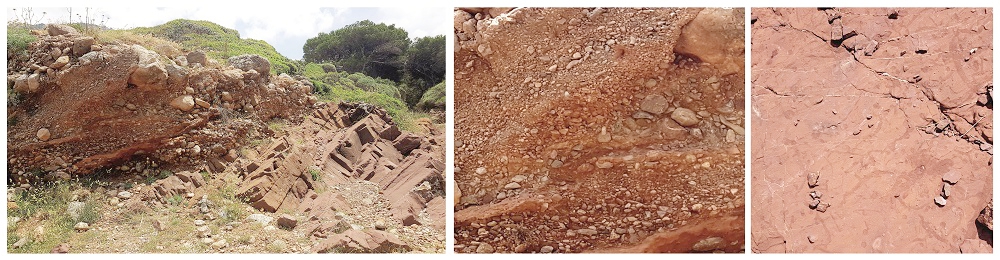
Contact between the conglomerates and the sandstones (left), detail of the conglomerates (centre) and bioturbations in the sandstones (right).
The calcarenites, popularly known here as marès, are rocks formed by carbonate-grain sands. They originate from the sand of the seabed which, in the glaciations of the Quaternary period, became subaerially exposed by the lowering of the sea level, forming dunes that subsequently fossilised.
A characteristic feature of the calcarenites is the presence of rhizocretions, a type of fossil remains that are the moulds of the roots that populated the dunes when they were formed.
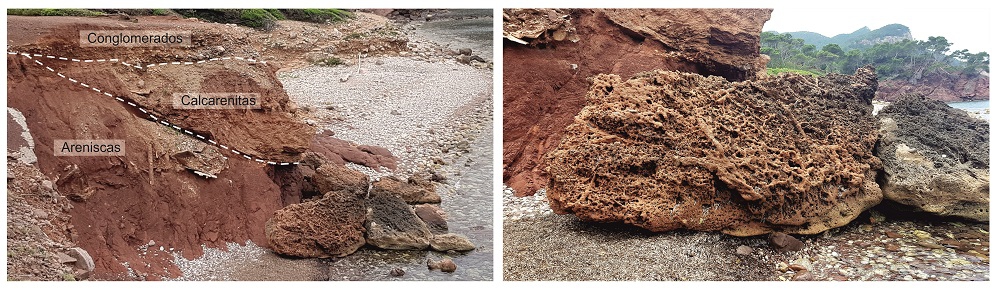
Detail of the embankment close to Son Bunyola (left) and of the abundant rhizocretions of the calcarenite (right).
Finally, it is worth inspecting in detail the surfaces of the strata of Permian sandstones that tectonic, eustatic or antropical processes</span></p></div>">outcrop in the stream bed, because they display the fossilised marks of biological activity. This type of structures are named bioturbations (see photo above right).
