Sa Foradada is interesting from the geomorphological point of view for three reasons:
- It constitutes a peninsula parallel to the coast 335 m long and 60 m wide which joins the coast by way of an arm of land 580 m long and 130 m wide.
- It displays a hole at one of its ends whose silhouette is vaguely reminiscent of the profile of the island of Mallorca.
- The texture of the peninsula is grainy while that of the arm of land is smooth.

Panoramic view of Sa Foradada from the viewpoint of Son Marroig.
The origin of its strange morphology lies in its lithology and the processes of littoral erosion.
The peninsula is formed by the conglomerates of the Lower Miocene (some 20 Ma ago) of the Sant Elm Formation, which were deposited just before the raising of the Tramuntana range, which means that they are intensely folded and fractured.
In contrast, the arm of land consists of a clearly-stratified succession of dolomites from the Middle Triassic (240 Ma) of the Muschelkalk stratigraphic unit and reflect the specific environmental conditions in which they were formed.</p><p><br></p></div>">facies submerging to the north-east.
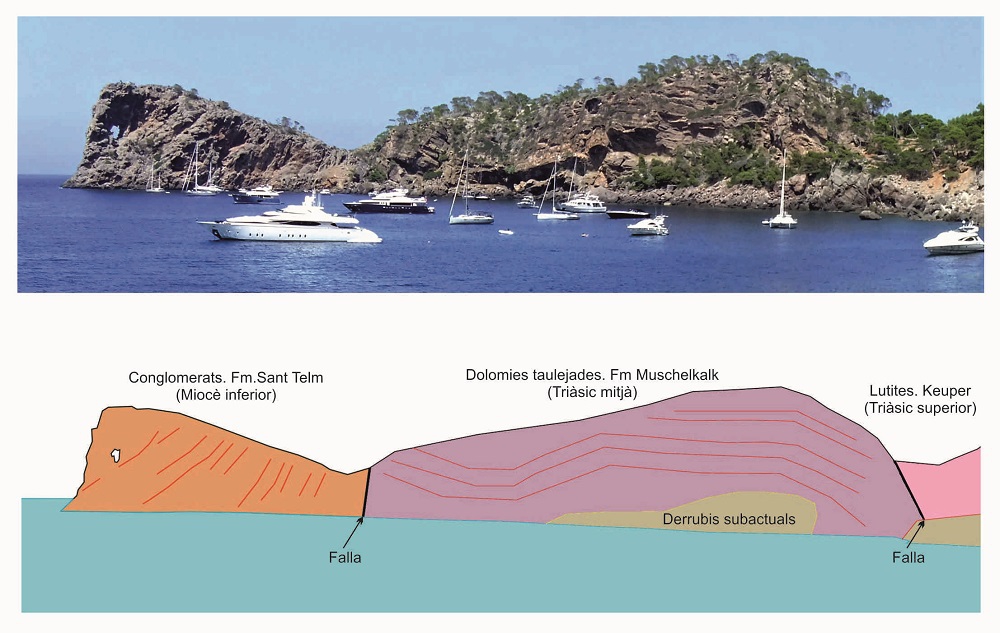
Materials of the Middle Triassic along the cape. In the background, the Lower Miocene of Sa Foradada.
The two materials are separated from each other and from the materials of the coast, which are formed by multicoloured lutites and marls of the Upper Triassic (220 Ma), by faults.
Faults constitute a zone of weakness in rocks, and therefore they are more susceptible to being altered. For this reason, in faulted zones erosion has been more intense and stream beds have been generated. This type of erosion, which affects some materials more than others, is called differential erosion.
In addition, the powerful fracturing of the Miocene conglomerates and their grainy texture has given rise to another type of erosion called alveolar erosion, which is due to the impact of particles (corrrasion) associated with the wind in coastal environments.
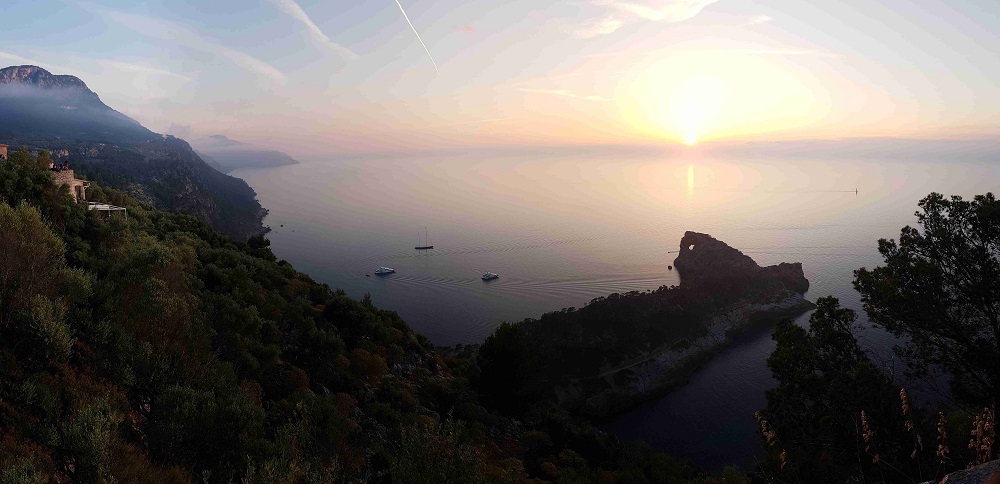
Sa Foradada at sunset, from the viewpoint of Son Marroig..
