| UTM-X | UTM-Y | ||
|---|---|---|---|
| STOP 1: THE TRIASSIC SALT LAGOONS | |||
| STOP 2: THE MIOCENE DELTA | |||
| STOP 3: THE CRETACEOUS SEABED | |||
| STOP 4: THE PENYAL DE S’ÀGUILA FAULT |
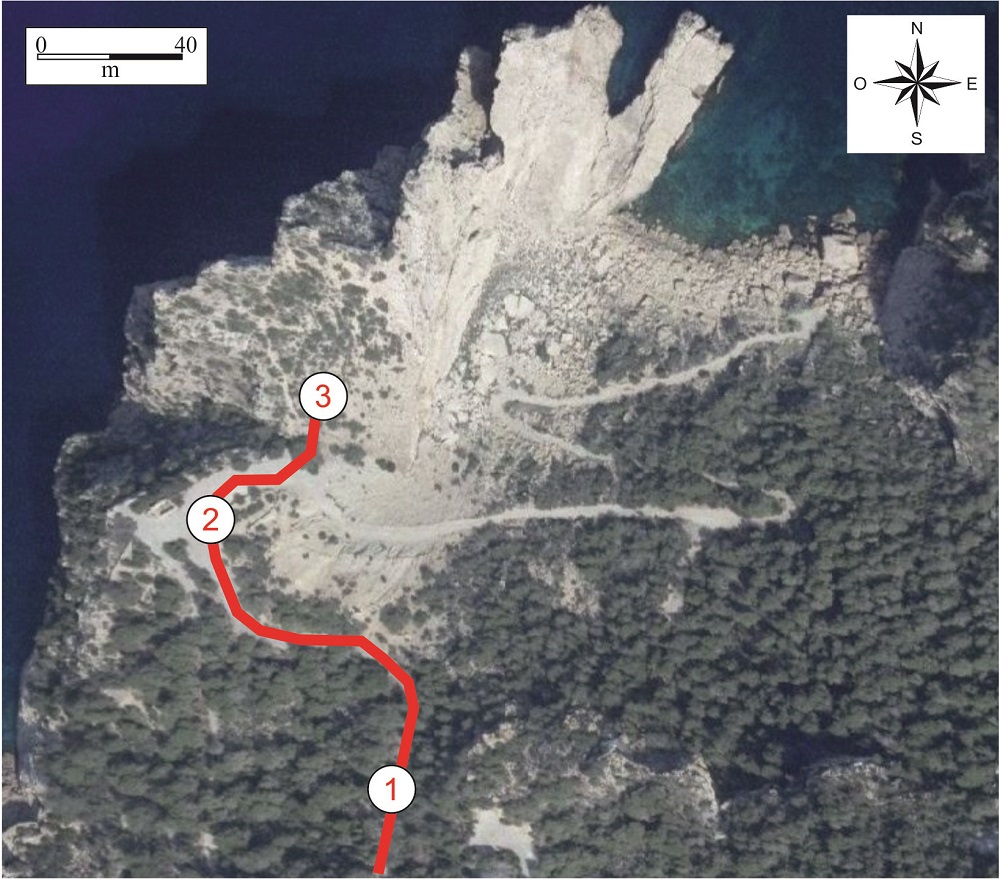
Recommended route.
The cretaceous sediments of Es Penyal de s’Àguila provide a lot of information about its own depositional environment. It is remarkable the importance of rudist reef which form the fossilferous limestones of Penyal de s’Àguila cliffs. These formations are only found in Eivissa and this place being one of the most relevant outcrops.
All these Cretaceous sediments belong to the Sedimentary rock whose main component is calcium carbonate (CaCO3). Its origin can be chemical, organic or detritic.</p><p><br></p></div>">Limestone Formation of Port Sant Miquel and can be divided into three different members (Mb), from base to top (from most modern to the oldest):
• Mb Limestones and dolomites of Cala d’en Sardina: They are constituted by dolomites of massive appearance in the lower part and by bioclastic limestones in the upper part, in which bivalves, bryozoans, echinoderms, algae and orbitolinids can be found.
The materials of this member were deposited on a shallow platform environment with clear, clean, well-oxygenated water and normal salinity, very similar to what is found in any current reef. The seafloor was abundantly populated by benthic organisms that provided a large quantity of carbonates to the environment.
• Mb Marls of Es Penyal de s’Àguila: formed by a rhythmic succession of marls and margo-calcareous soils which range from greys to ochres towards the ceiling. They are located practically at the end of the access path of Es Penyal de s’Àguila, and they have a top of a stratigraphical unit or stratigraphical sequence. </p></div>">thickness of around 14 m.
This member contains a large quantity of fossil fauna featuring infaunal echinids, brachiopods, ammonites, belemnites and orbitolinids.
The setting in which the marls were deposited corresponds to an external low-energy platform (below the level of wave action) at a moment when the sea level was higher than in the previous period. Occasionally sandy materials arrived and interspersed themselves with the marls due to the tractive currents on the seafloor.
They rest on the Sedimentary rock whose main component is calcium carbonate (CaCO3). Its origin can be chemical, organic or detritic.</p><p><br></p></div>">limestone soils of Torre des Molar by means of a clean contact with ferruginous crusts which indicate the presence of a bentonic communities tend to settle. It is indicative of long periods of little or no sedimentation, or of the exposure of a lithified stratum after an erosive period followed by an inundation.</p><p class="ql-align-justify"><br></p></div>">hardground. Laterally, the top of the marly unit is eroded and above it coarse conglomerates of the Lower Miocene are discordantly deposited.
• Mb Limestones of Torre des Molar: Located in the cliffs of Es Penyal de s’Àguila. Grey fossiliferous limestones clearly stratified into metric layers of massive appearance, the total top of a stratigraphical unit or stratigraphical sequence. </p></div>">thickness of the member being 150 m. High fossiliferous content, with notable presence of rudists. Orbitolinids, corals, ostreids and ammonites can also be found.
These materials were deposited in an environment such as the limestones and dolomites of Cala d’en Sardina, in other words, similar to a reef. The seabed was abundantly populated by bentonic organisms which supplied a large quantity of carbonates to the environment.
