| UTM-X | UTM-Y | ||
|---|---|---|---|
| STOP 1: THE TRIASSIC SALT LAGOONS | |||
| STOP 2: THE MIOCENE DELTA | |||
| STOP 3: THE CRETACEOUS SEABED | |||
| STOP 4: THE PENYAL DE S’ÀGUILA FAULT |
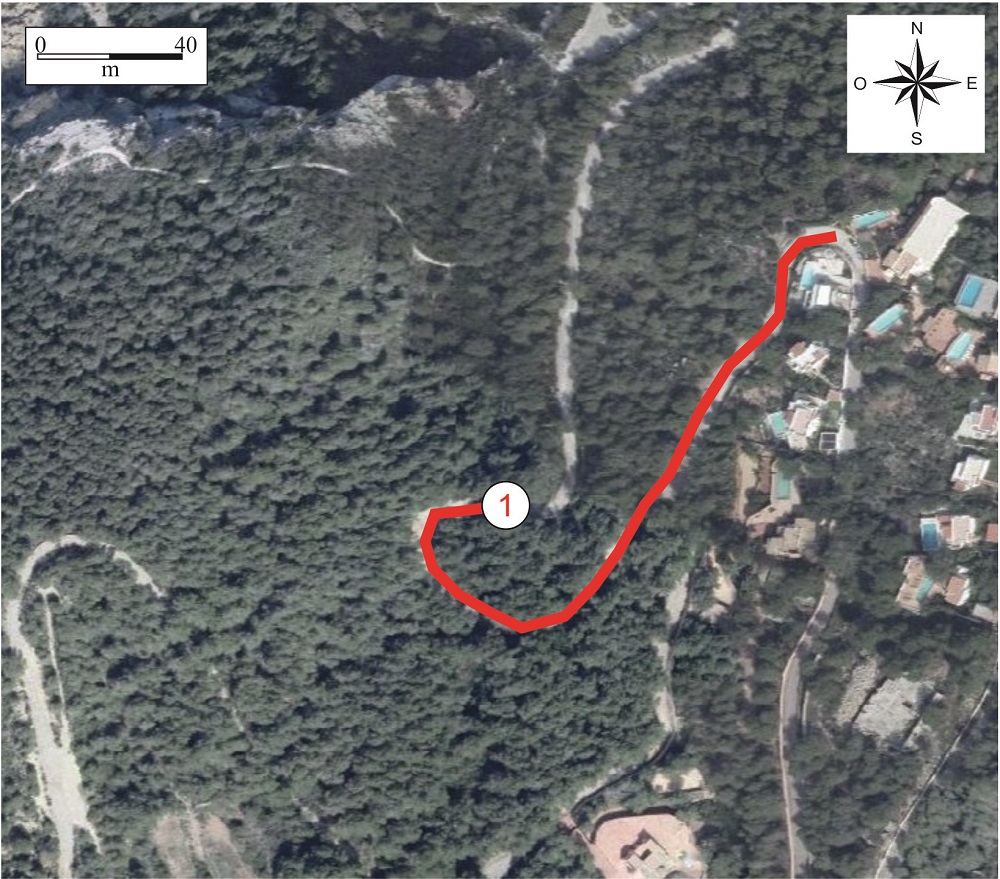
Recommended route.
During the Upper Triassic (240-230 Ma approximately) Eivissa was an area of salt lagoons that extended throughout a large part of the current Europe. These lagoons were formed from the retreat of shallow waters that had predominated during the Middle Triassic period (230-210 Ma, approximately). They filled the main sedimentary basins and created large arid lagoon plains, which evaporated often and favoured the precipitation of salts. The sediments corresponding to this geological context are formally known as Keuper stratigraphic unit and reflect the specific environmental conditions in which they were formed.</p><p><br></p></div>">facies.
From this type of environment, known as Sebkha, there are current examples such as those in the north of Africa or the Arabic peninsula. Sebkha, in origin, corresponds to a lake connected to the sea that is progressively filled with sediments. As it developes, the supply of sea water dicreases due to various causes, such as the emergence of a dune bar or coral reefs, that isolate it. When this happens, the water evaporates and a layer of salts is created, repeating the process until the lake is completely disconnected and dies.
At the beginning of the Penyal de s’Àguila road, geological proof of the aforementioned Keuper stratigraphic unit and reflect the specific environmental conditions in which they were formed.</p><p><br></p></div>">facies can be seen. These comprise multi-coloured chalks and clays (normally red). They are significantly deformed due to their plasticity.
This property later favoured, during the Alpine Orogeny, the formation of thrust planes (a surface on which a mass of rock slides overlapping another) through the Keuper stratigraphic unit and reflect the specific environmental conditions in which they were formed.</p><p><br></p></div>">facies.
In fact, the tectonic, eustatic or antropical processes</span></p></div>">outcrop mentioned here is associated with one of the most important thrusts on the island, which separates two tectonic units: The Unit of Albarca and the Unit of Llentrisca-Rei, to which the described materials belong.
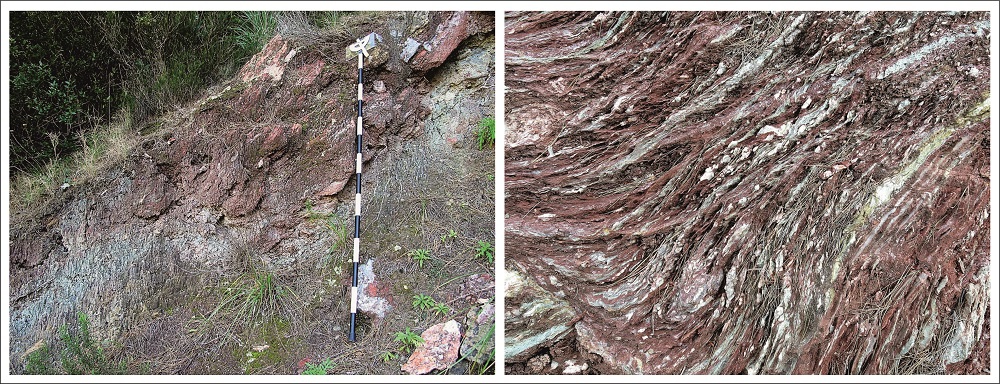
Cut in the Keuper facies materials (left) and details of the multi-coloured chalk levels (right).
Although Keuper stratigraphic unit and reflect the specific environmental conditions in which they were formed.</p><p><br></p></div>">facies are generally poor in fossil remains (apparently absent in the area), in general, they do have remarkable minerals. In this regard, in the chalk layer outcrops on the path there are even numerous bipyramidal quartz crystals, normally red or orange, and sometimes whitish.
Popularly known as Witches’ Teeth, they are better known by their mineralogy term: “Jacintos de Compostela”. The name comes from its resemblance to jacinth, a red variety of zircon that is greatly appreciated in jewellery making. Specimens tend to be very small, less than one centimetre, although they can occasionally be bigger.
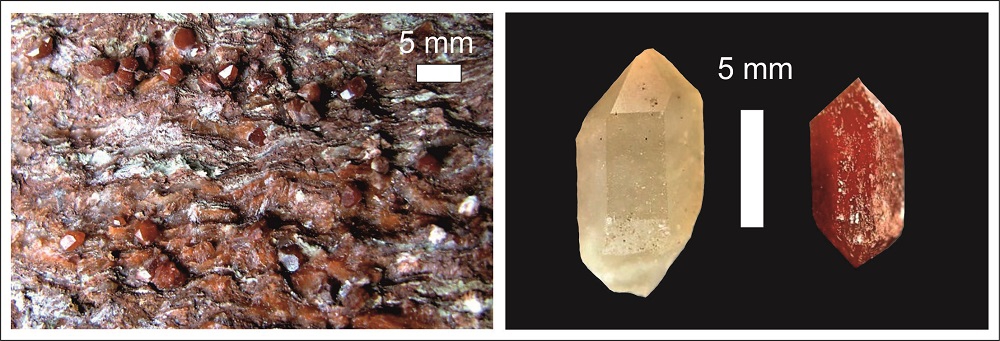
Accumulation of “Jacinths of Compostela” inside chalk (left) and two representative specimens (right).
