| UTM-X | UTM-Y | ||
|---|---|---|---|
| STOP 1: THE TRIASSIC SALT LAGOONS | |||
| STOP 2: THE MIOCENE DELTA | |||
| STOP 3: THE CRETACEOUS SEABED | |||
| STOP 4: THE PENYAL DE S’ÀGUILA FAULT |
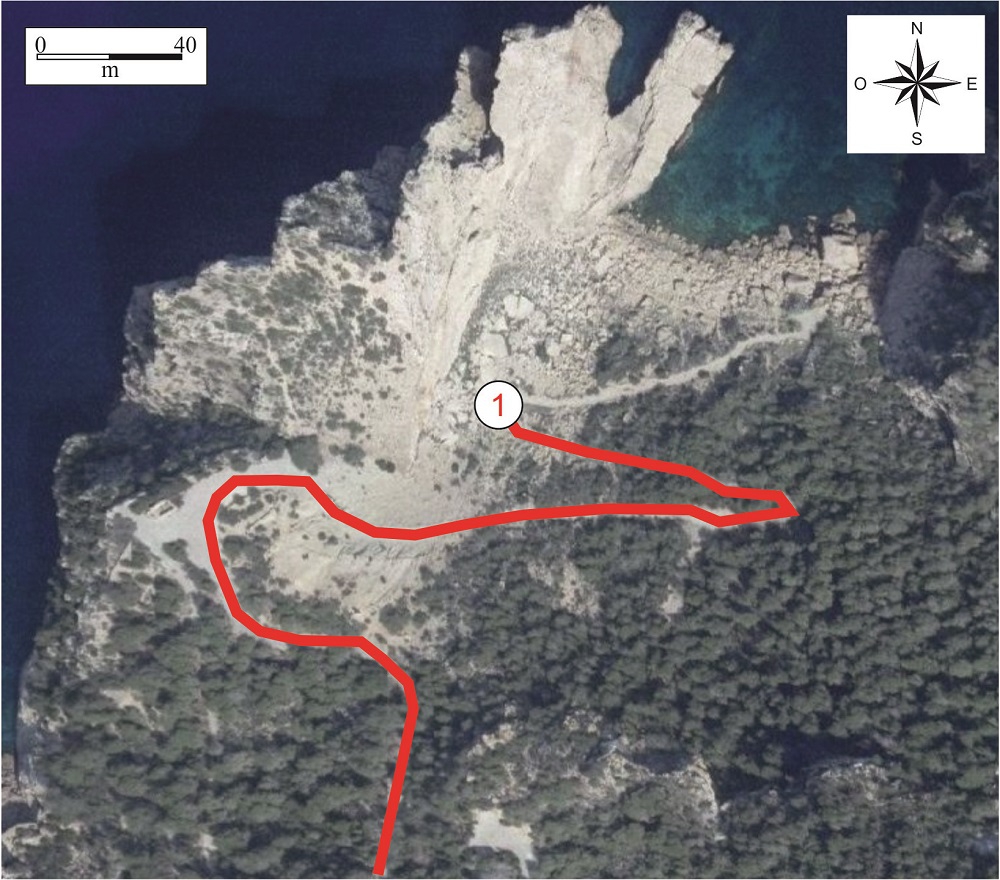
Recommended route.
At the end of the route we are on some Cretaceous materials that comprise the Sedimentary rock whose main component is calcium carbonate (CaCO3). Its origin can be chemical, organic or detritic.</p><p><br></p></div>">Limestone member of Torre des Molar that, as mentioned before, are very rich in rudist and represent shallow waters.
These, as well as all the rest of the tectonic, eustatic or antropical processes</span></p></div>">outcrop materials in the area, suffered the effects of the Alpine Orogeny, which folded the stratigraphic series and deposited them on the others through thrust faults. This stage of strong compression finished during the Middle Miocene period and was followed by a period of “relaxation”, where a series of normal faults were generated by the force of gravity.
The fault that cuts in two the Sedimentary rock whose main component is calcium carbonate (CaCO3). Its origin can be chemical, organic or detritic.</p><p><br></p></div>">limestone of Penyal de s’Àguila is from this category. Although it is not very big, this is particularly valuable from a didactic point of view for their good definition. Most of the numerous faults we can observe on the reliefs of Eivissa are in areas of difficult access, covered by soil or vegetation or formed by materials that do not allow the fracture to be clearly seen.
However, the fault of Penyal de s’Àguila affects materials that have a clean fracture enabling the formation of vertical cliffs, favouring a clear observation of this geological phenomenon.
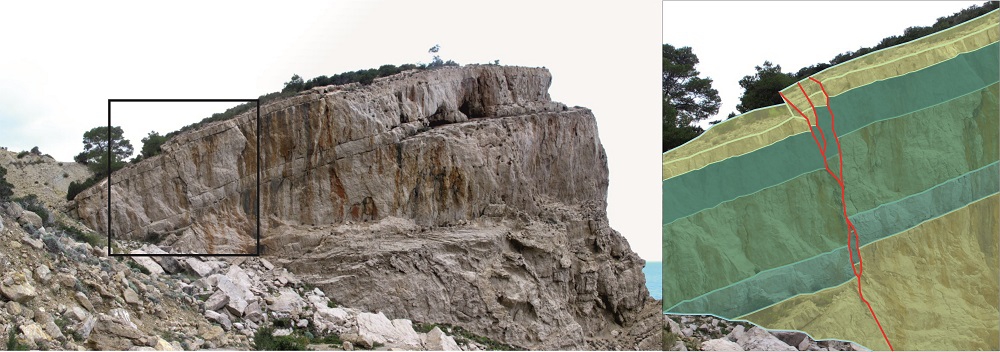
Panoramic view of the north sector of Penyal de s’Àguila and enlargement with a diagram of the fault.

Representative diagram of the formation of a normal fault.
