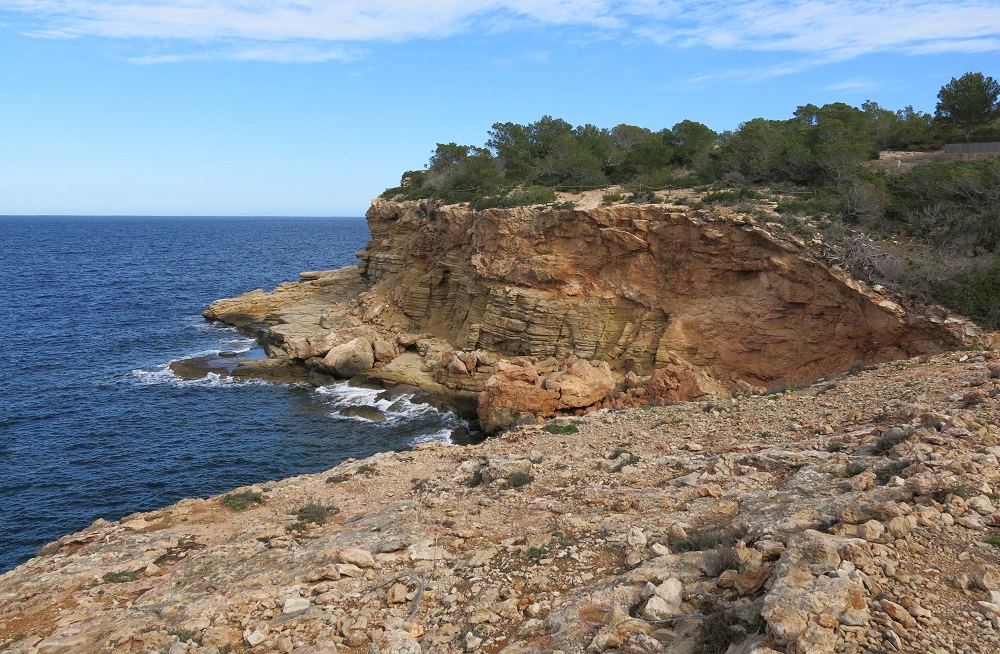
General view of Es Racó de Sa Galera from the nearby cliffs.
The cove of Es Racó de Sa Galera, comprised between the Punta de Cala Llosar and the Punta de Sa Galera, constitutes one of the best outcrops of tempestites of Middle Miocene in Eivissa island. It is formed by layered calcarenites of the Middle Miocene. The strata are horizontal and of decimetric top of a stratigraphical unit or stratigraphical sequence. </p></div>">thickness, with colours between light brown and yellow with small intercalations of marls (also of decimetric size). Due to their erosion they form “terraced” zones that correspond to the stratification surfaces.
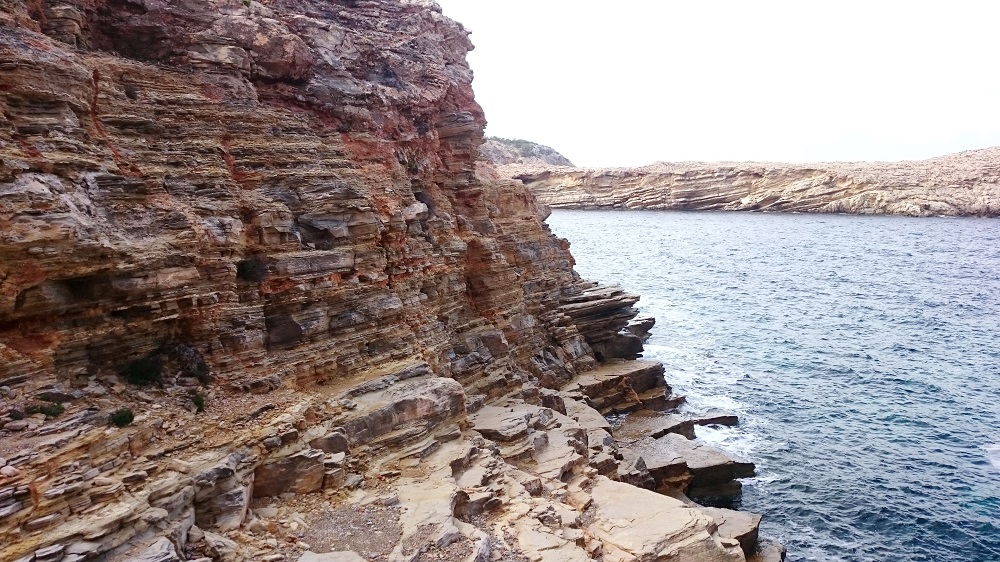
General appearance of the calcarenites and the “terraces” formed by the erosion of the strata.
Close observation of the unit makes it possible to identify a number of folded strata which are known geologically as slumps. These can be of centimetric or even metric size and correspond to small underwater collapses almost certainly produced by turbidity currents which remobilised the already accumulated sediments and deposited them again in a chaotic manner.
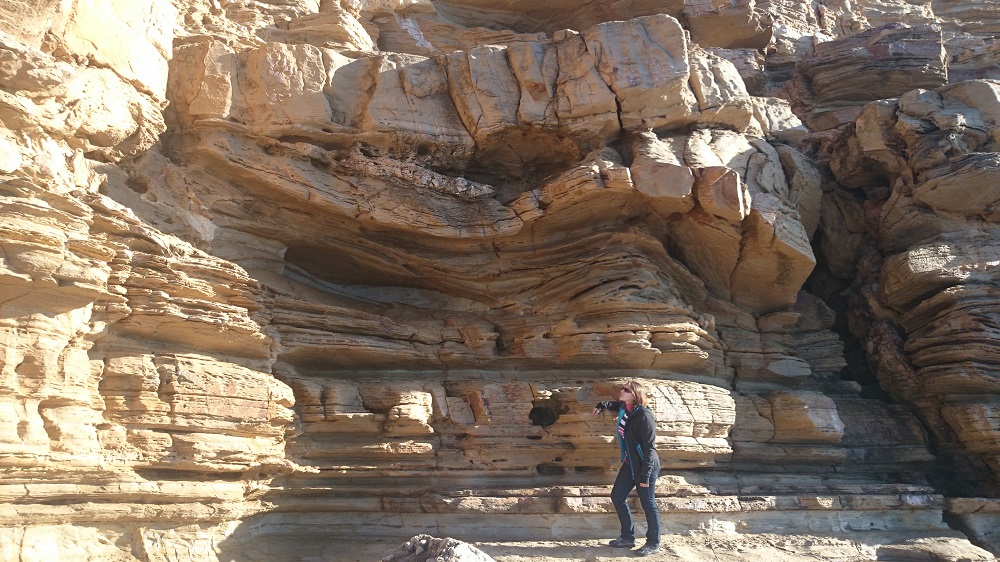
Slump of metric dimensions (above the person). To the right, a large fracture is seen cutting vertically through the strata.

Slump of centimetric dimensions (compare with the geological hammer).
It is believed that these calcarenites originated in an energetic setting, very probably associated with deltaic floods, and they can be considered to be tempestites.
It is also possible to identify a series of vertical fractures which cut through the strata, allowing rainwater to circulate through them and thus favouring their erosion. Over time, these fractures gradually individualised portions of the unit, producing unstable blocks liable to suffer rockfalls.
In the cove there are numerous detached blocks accumulated at the foot of the cliffs, particularly in the sector of the Punta de Cala Llosar.
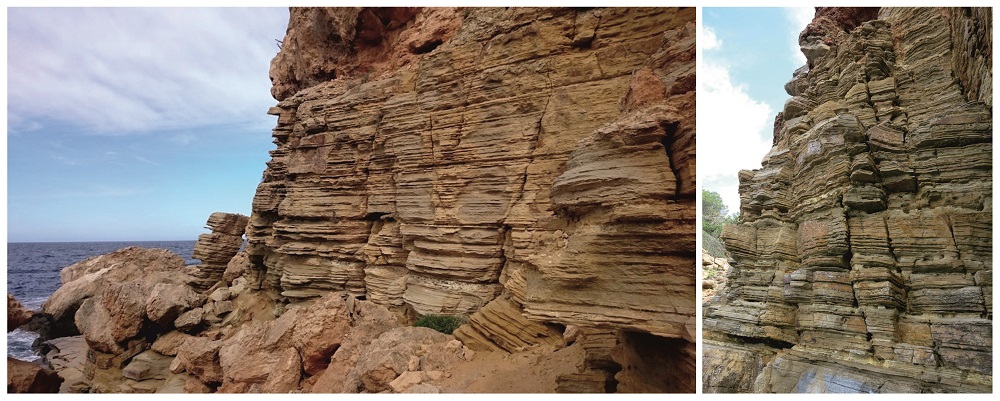
Left: accumulation of detached blocks. Right: vertical fractures which affect the calcarenites.
Another interesting aspect of the zone is that above the tempestites there are intercalations of accumulations of angular gravels in a red-coloured clay matrix, originating from the Torrent de sa Galera, and sandy deposits with very marked cross-stratification which correspond to ancient attached dunes. Both the deposits of the torrent and the fossil dunes belong to the Quaternary.
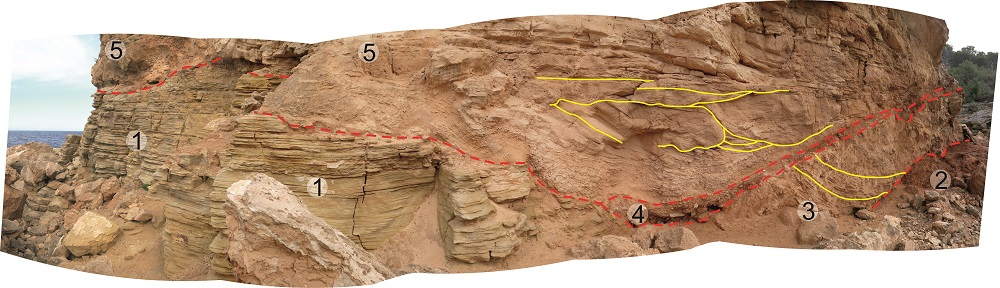
Panoramic view of the foot of the embankment of Punta de Cala Llosar, showing the different Quaternary deposits accumulated above the tempestites of the Middle Miocene. In red, the contacts between the different materials, and in yellow the cross-stratification of the fossil dunes.
Very probably the sedimentary reconstruction would be as follows:
· Once the tempestites (number 1 in the panoramic view) were exposed, the surface water began to erode them. This formed the Torrent de sa Galera, and during its active episodes it started to deposit gravels in the clay matrix (2 and 4). It is possible to find a certain overlapping of the gravels.
· Taking advantage of the inactive moments of the torrent, eolic deposits (3 and 5) were formed with marked cross-stratification (in yellow). These deposits correspond to fossil dunes composed by sands of yellowish and pink colour.
