At S’Hort de sa Cova there lies the tectonic, eustatic or antropical processes</span></p></div>">outcrop of the most ancient materials forming Mallorca, which correspond to the Carboniferous period, (359-299 Ma), although their precise age has not been established. This site has a clear affinity with the Carboniferous of Menorca.
Although it is relatively easy to reach the zone, located on the coastal cliffs, the small dimensions of the deposit and its distance from inhabited areas meant that it remained unnoticed until its publication in 1984.
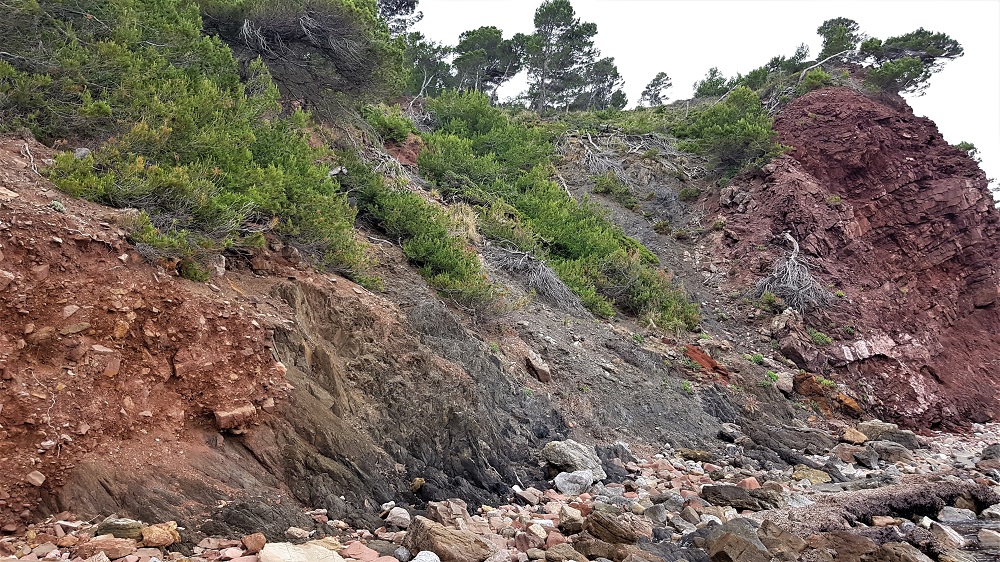
Panoramic view of the outcrop: red colluvial deposits of the Quaternary, grey metapelites of the Carboniferous and conglomerates and sandstones of the Permian.
The carboniferous tectonic, eustatic or antropical processes</span></p></div>">outcrop is covered by reddish-brown deposits from the Quaternary (2.55 Ma - present) to the north-west, contacting by means of a fault with the violet materials from the Permian (299-251 Ma) to the south-east. The latter are abundant in this part of the coast and consist fundamentally in conglomerates and sandstones of a maroon-red colour.
The Carboniferous materials, with a dark grey colour, consist in a type of metamorphic rock called sedimentary rock formed by clay.</p></div>">Pelite affected by a low degree of metamorphism.</p></div>">metapelite, which proceeds from the metamorphism of clays.
In the tectonic, eustatic or antropical processes</span></p></div>">outcrop it is possible to detect some evidence of metamorphism, such as the presence of seams of quartz and tightly-closed folds. However, this is a low-degree metamorphism because it has permitted the conservation of some fossils: these are fundamentally continental plant remains which were dragged and deposited in a marine environment. There are also a few remains of crinoids.
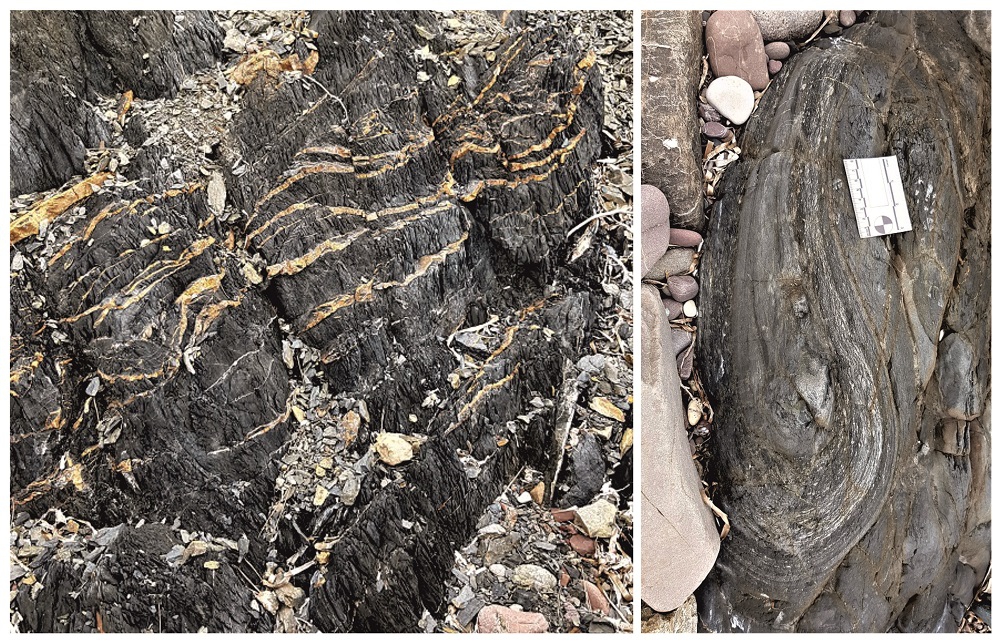
Seams of quartz (left) and fold (right) in the metapelites of the Carboniferous.
It should be noted that the folds displayed by the materials of the Carboniferous were generated during the Hercynian Orogeny and not the Alpine Orogeny which created the Serra de Tramuntana. This orogeny marked the formation of the super-continent Pangaea during the Permian and was the cause of the formation of large mountain ranges like the Appalachians or the Urals. In fact, during this period, Iberia and North America were linked, so the reliefs existing in Spain from that time are in reality the continuation of the Appalachians.
Leaving to one side the Palaeozoic site, and coinciding with the access to the coast, there is another type of materials worth highlighting: a powerful deposit of conglomerates from the Quaternary, which show that in the past the Torrent des Cable which originated the Cala de S’Hort de sa Cova had a much greater flow of water than in the present day, and also that a Sedimentary rock originated by the precipitation of calcium carbonate from supersaturated waters, especially in zones of karstic emergences.</p></div>">travertine flow formed at the exit of the spring of S’Hort de sa Cova, at the base of the conglomerates.
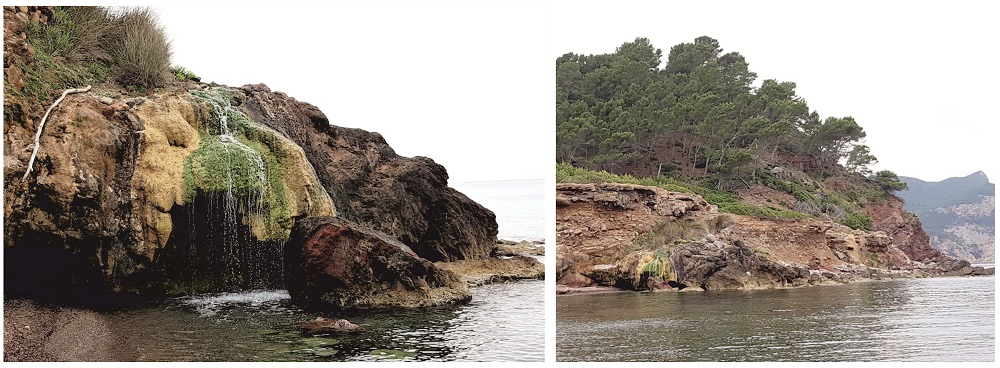
Travertine flow (left) and associated deposit of conglomerates (right).
The formation of Sedimentary rock originated by the precipitation of calcium carbonate from supersaturated waters, especially in zones of karstic emergences.</p></div>">travertine flows is a relatively fast geological process, often linked to waterfalls (where the pressure of carbon anhydride decreases drastically), so their morphology is bell-shaped. Because the flow of water, and therefore the precipitation of Sedimentary rock originated by the precipitation of calcium carbonate from supersaturated waters, especially in zones of karstic emergences.</p></div>">travertine, varies throughout the year, successive flows progressively overlap which change the relief of the waterfall itself. During its development, plant remains are often trapped and finally decompose, leaving their moulds, which give the rock a very porous appearance.
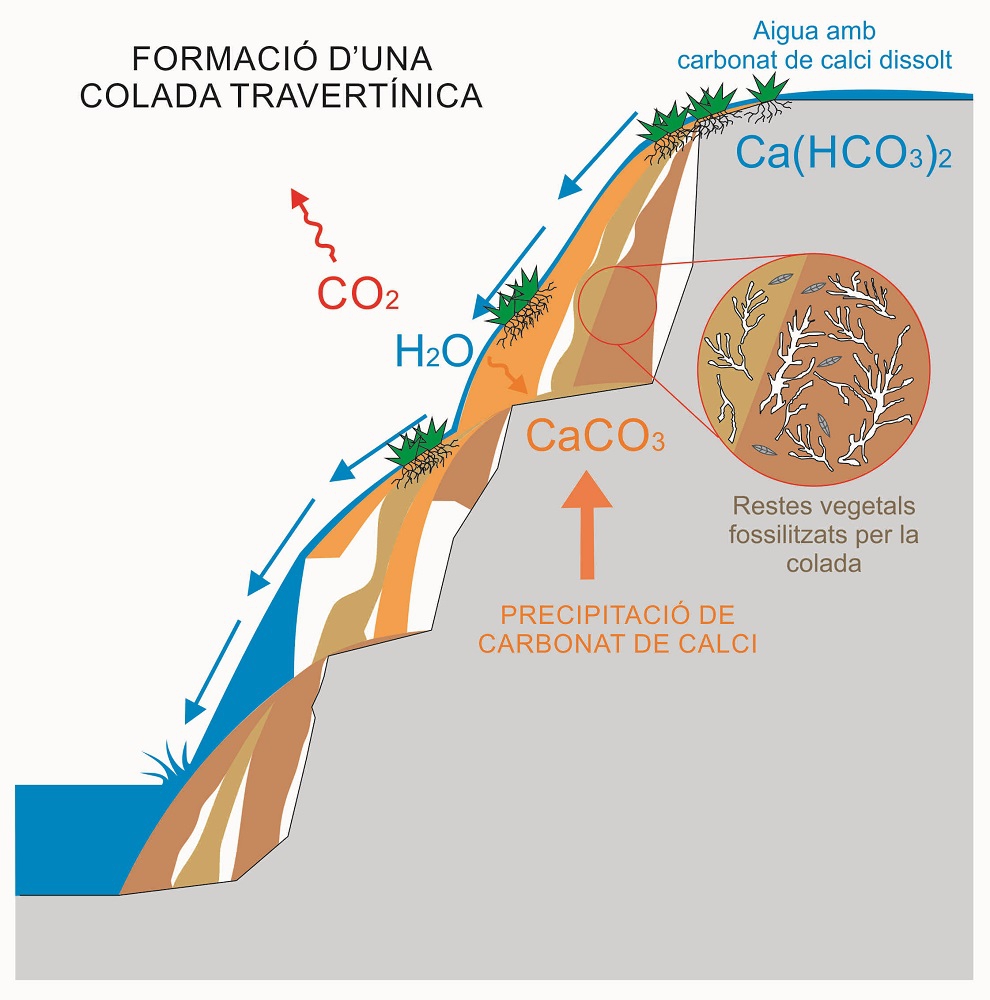
Diagram of the development of a travertine flow.
