The coast between Santa Ponça and Peguera is one of the best places for studying the Paleogene period in the Balearic Islands, with a representation of some of the oldest outcrops of Cenozoic materials in the archipelago.
The coast is formed almost entirely by reliefs from the Eocene and Oligocene, representing a series of very diverse continental levels, arranged in folded layers and forming a large fold in which the oldest materials are situated in its core.</p><p><br></p></div>">anticline. Two formations can be recognised in the zone: the Peguera Formation from the Middle and Upper Eocene and the Cala Blanca Formation from the Lower Oligocene. Both are aged at between approximately 45 and 30 Ma.
They consist of sediments associated with rivers, lakes and deltas that could have been periodically flooded by the sea (paralic environments).
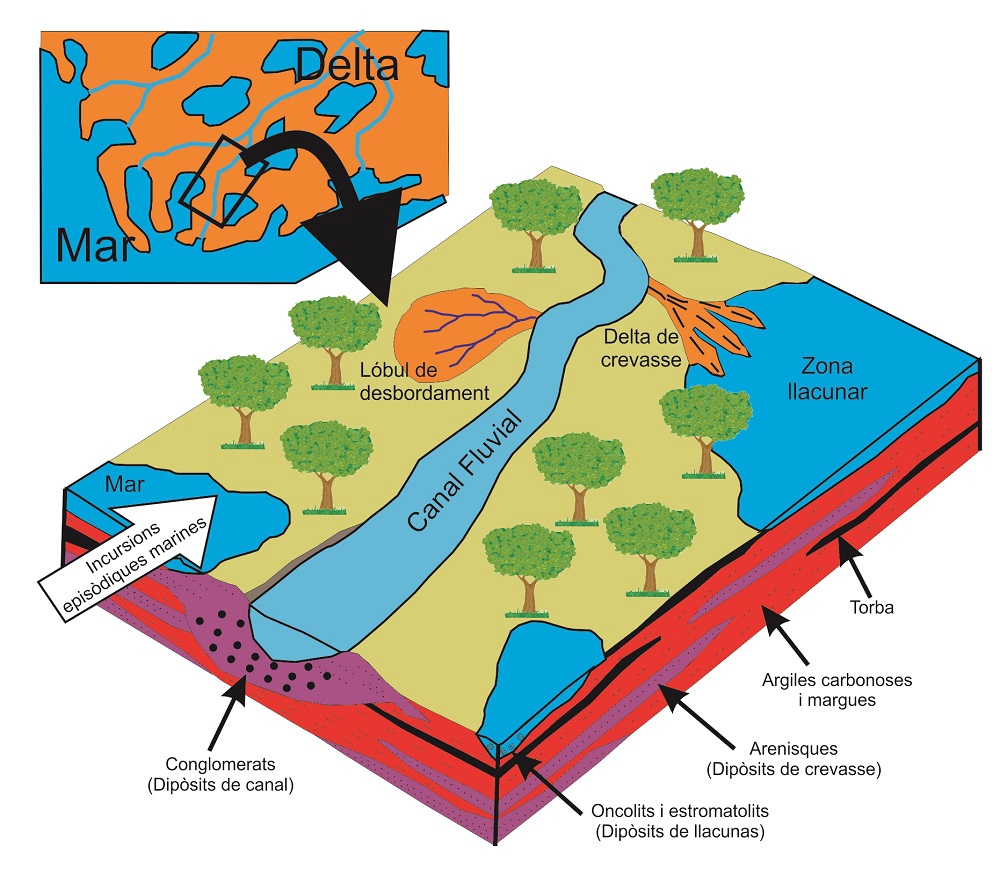
Diagram of the Paleogene sedimentary environments of the Peguera zone (Modificated from Marzo et al., 1983).
Very characteristic in the Cala Blanca Formation are rocks with spherical shapes named oncolites.
These originate from the biological activity of colonies of cyanophyceae (bacteria), which cause concentric layers of calcium carbonate to precipitate around a nucleus, which can be a mollusc shell, plant remains or a previous accumulation of cyanophyceae.
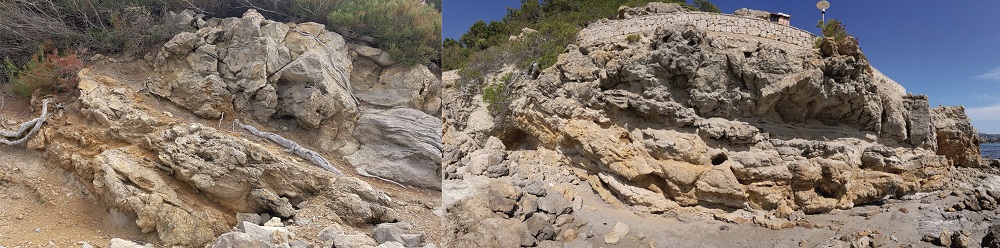
General view of the oncolites site above and below the seafront promenade.
Although oncolites tend to be small in size, occasionally some of truly extraordinary size can be seen.
In this tectonic, eustatic or antropical processes</span></p></div>">outcrop, the oncolites tend to be formed from plant remains, but in nearby outcrops in the same coastal fringe it is not unusual to see them formed by encapsulating shells of gastropods of both the freshwater and terrestrial types.
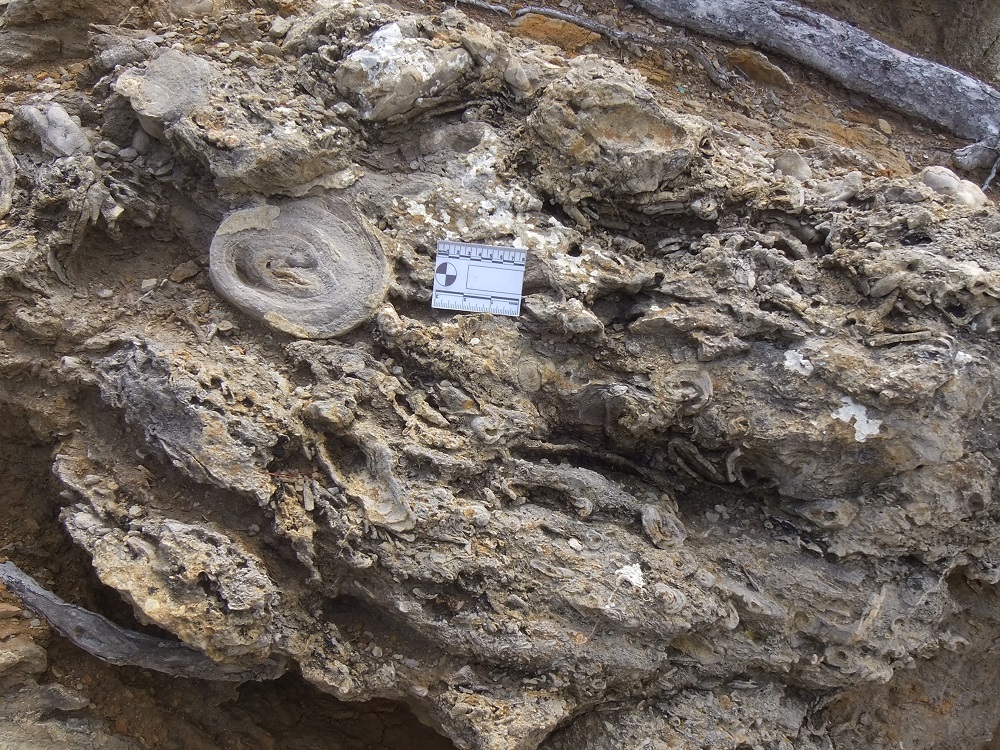
Detail of the oncolites outcrop
Apart from oncolites, the outcrops of this sector of the coast have given rise to findings of plants and remains of vertebrates. Studying them has made it possible to establish correlations with Oligocene mammal fauna in sites outside the island, which denotes the existence of an important geographical barrier between Iberia and what are today the Balearics.
The Paleogene rocks are affected by small normal faults dating from after the Alpine Orogeny and therefore relatively recent (neotectonic).
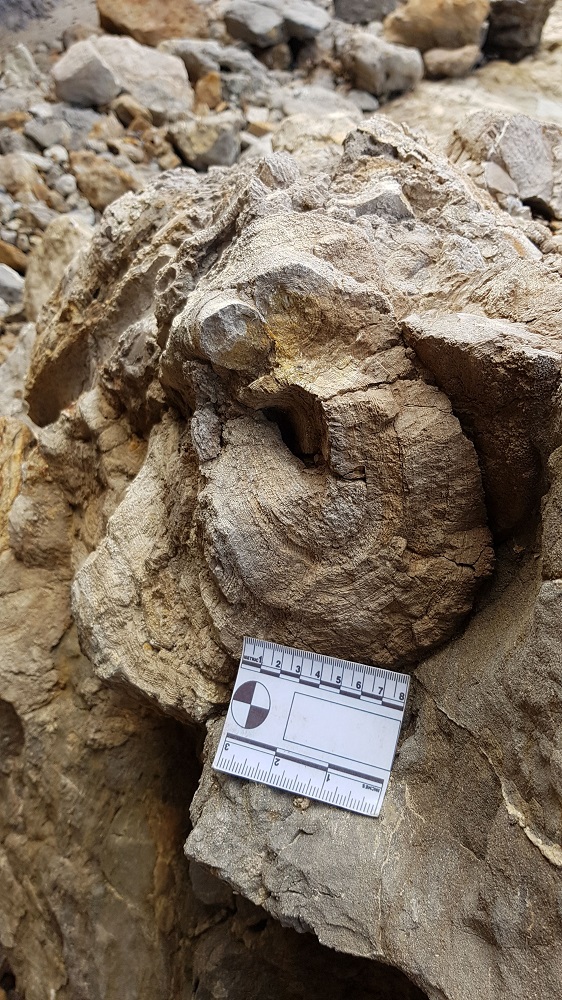
Detail of a large oncolite, displaying the concentric-lamina structure.
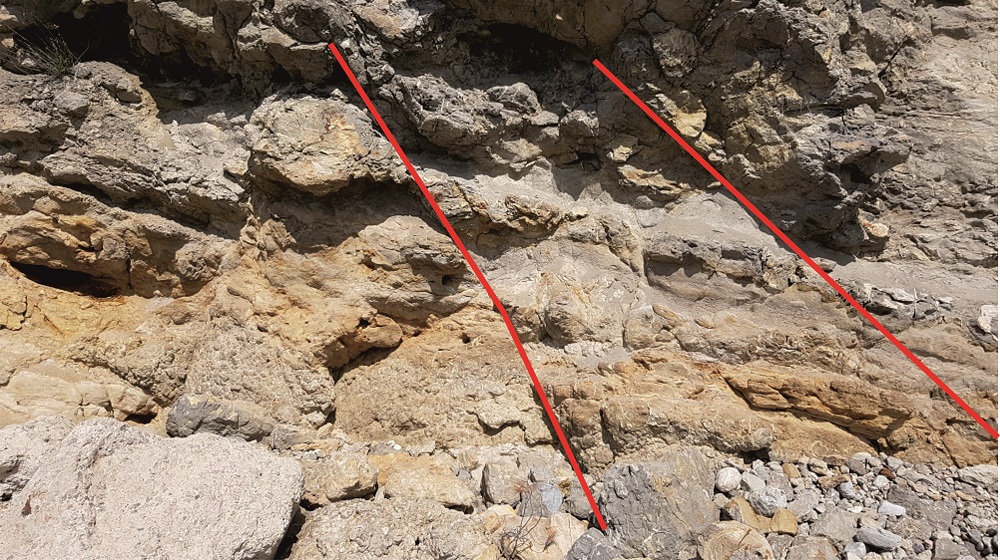
Faults traversing the sediments.
