Although a large part of the rocky massifs that compose the Tramuntana Range correspond to rocks of the Lower Jurassic (201-185 Ma), these tend to be characterised by a scarcity or absence of characteristic fossils.
Es Cosconar constitutes an exception, being one of the most important sites at the paleontological and stratigraphic level of the Lias, being notable both for the abundance of the fossils and for its extension and good exposure on the surface.
At this site, a geological formation, the Cosconar Formation, has been defined which is characterised primarily by the presence of a type of Sedimentary rock whose main component is calcium carbonate (CaCO3). Its origin can be chemical, organic or detritic.</p><p><br></p></div>">limestone rock called encrinite, composed of remains of crinoids.
Crinoids are branching echinoderms (distant relatives of starfish and sea urchins) formed by small parts that recall the pieces of a collar, called beads. When they die, the beads usually disintegrate and often form accumulations on the seabed, thus originating the encrinites.
Associated with them in these deposits there appears the other principal fossil of the site: the belemnite.
Relatives of the present-day squids, the belemnites are one of the most characteristic fossils of the Mesozoic. Although their soft parts are very rarely preserved, the apex (face) of their bullet-shaped calcareous shell is frequently preserved, being capable of forming accumulations as do the crinoids. The proportion of an isotope of oxygen (oxygen-18) in the shells is indicative of the temperature of the marine environment in which they lived.
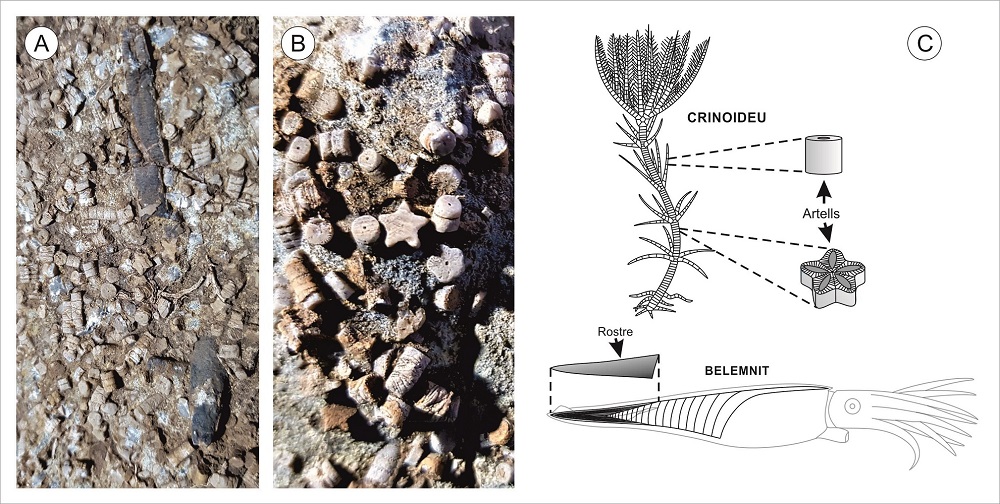
A) Faces of belemnites among beads of crinoids, B) Details of the beads of crinoids that form encrinite. C) Diagram of a crinoid and a belemnite, showing the parts that generally fossilise.
In a not so important way, and in the upper levels of the Cosconar Formation, mainly formed by margo-limestones, there are also ammonites and brachiopods.
Thanks to the abundance of fossils in the site, it has been possible to conduct numerous finely-detailed biostratigraphic studies of the evolution of both the environment and the fauna of this stage of the Lower Jurassic.
In the Es Cosconar area there is also an tectonic, eustatic or antropical processes</span></p></div>">outcrop of rocks of the Lower Miocene, from some 20 Ma ago, which correspond to the Sant Elm Formation, composed of littoral marine deposits prior to the Alpine Orogeny. They appear in the base of the scarp where the houses of Es Cosconar lie under a fault
<div class="ql-editor"><p class="ql-align-justify">Inverse fault in which the stratification plane.</p><p><br></p></div>">dip of the fault plane is at a low angle (generally less than 45<sup> o</sup>). It tends to refer to large-scale (regional) structures.</p><p><br></p></div>">thrust fault whose base consists of rocks of the Upper Triassic.As the Miocene materials are more prone to erosion, this has formed a shelter that has been exploited to construct the buildings. This unequal erosion is called differential erosion.
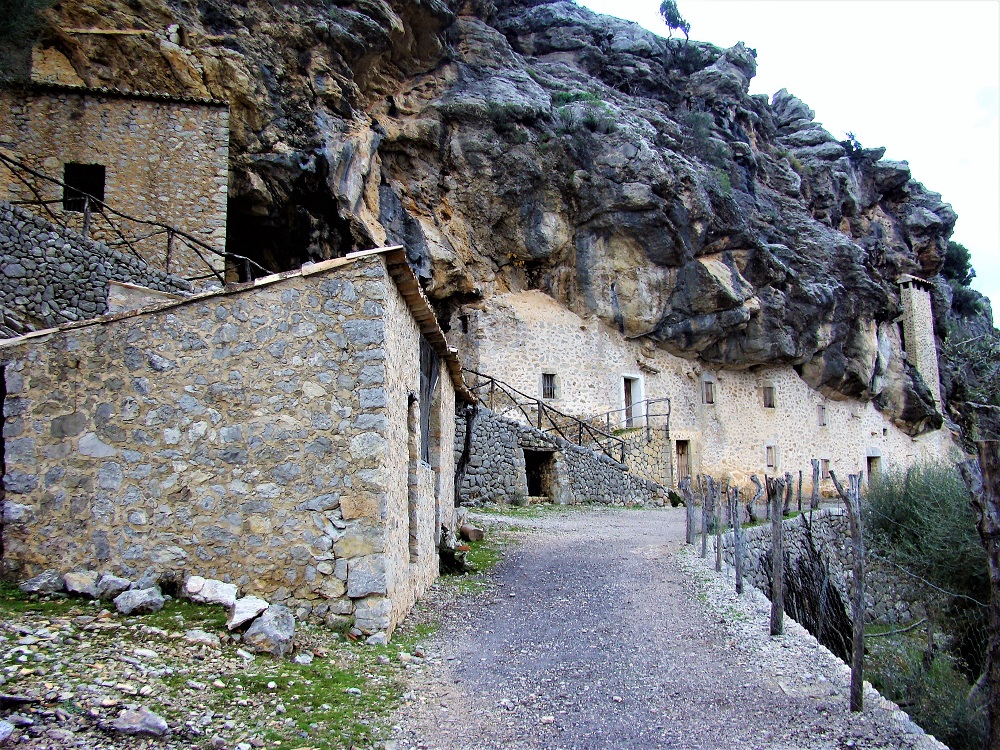
Houses of Es Cosconar, built taking advantage of the cavity left by the differential erosion of materials of the Lower Miocene in contrast with the much harder materials of the Upper Triassic (the rocks of the upper part).
