As is well known, the Albufera (lagoon) of Mallorca is the largest wetland in the Balearic Islands, with one of the most important ecosystems of the entire archipelago. It was named a Natural Park in the year 1988.
To know its geological origin it is necessary to go back to the Alpine Orogeny, which took place between approximately 25 and 15 Ma, approximately. This process structured the island into a series of elevated zones (horst) and depressions (graben). The horsts corresponded to the mountains while the grabens are basins that have been filled in and now constitute plains.
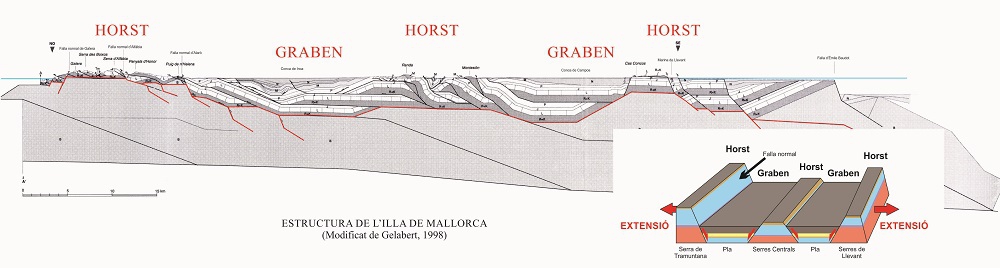
One of the graben is the Sa Pobla basin that, during the upper Miocene (11,6-5,3 Ma), had a shallow seabeds where coral reef proliferated. These disappeared a little less than 6 Ma ago were buried by marine and coastal sediments.
In the Quaternary (2.5 Ma - present), large dune systems and beaches were formed which eventually silted up the original basin, finally leaving the present-day dune barrier which separates the lagoon from the Alcúdia Bay.
The most common rock generated by these sediments is calcarenite, calcareous sand-sized clasts.</p><p><br></p></div>">sandstone, that is a very porous and permeable rock. The income of water is double, on the one hand the karstic aquifers from the Tramunana Range irrigate s’Albufera with fresh water and, on the other, the great permeability of the rock allows the arrival of salt water from the sea. The zone where both types of water intersect is called fresh water-salt water interface and changes according the season and anthropic activity (pumping).
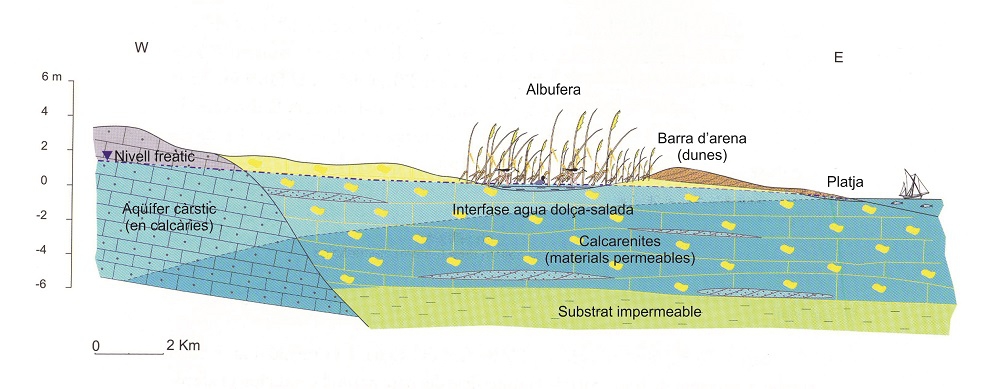
Hydrogeological diagram of the zone of S’Albufera, showing the distribution of the materials and how the water adapts to them. Modified from Mateos Ruiz and González Casasnovas (2009).
In historical times, between the 17th and 19th centuries, some engineering works were carried out which dried out a part of the original wetland, reducing it to approximately half its size.
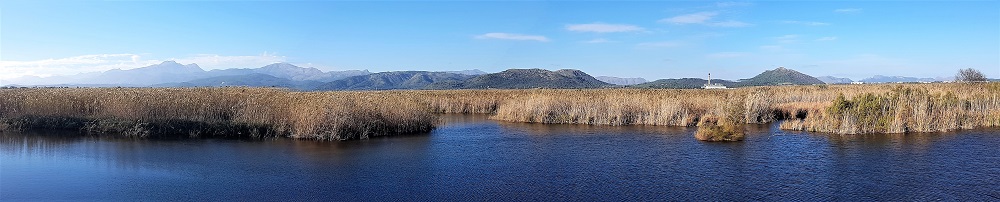
Overview of the Albufera of Majorca with the Serra de Tramuntana in the background.
Finally comment that the oldest buildings that we can observe in the Albufera area (tool sheds) are built with blocks of Pleistocene coquina (2,6 Ma), probably from a nearby quarry.
Almost all the fossils correspond to the current common cockle that already live on the coast of Majorca in the Pleistocene.
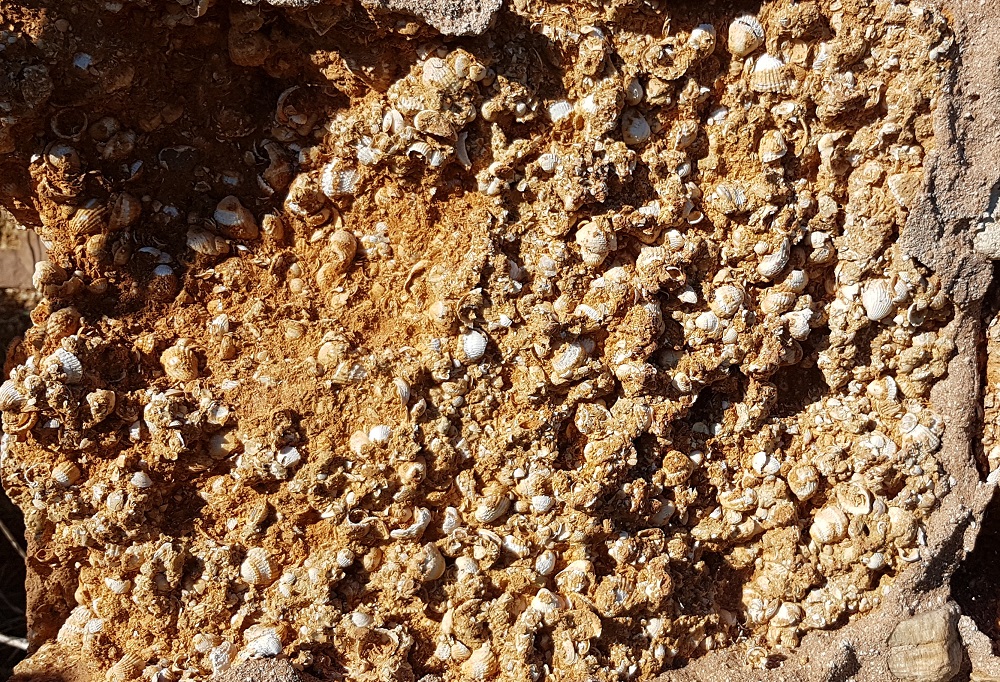
Rock blocks used in the old buildings of s’Albufera.
