The north part of Formentera is mainly formed by two depressed lagoons called Estany Pudent and Estany des Peix. The latter seems to have been originated by a karstic collapse favoured by a system of normal faults. The origin of its nearby lagoon, S’Estany Pudent, was probably the same. This makes them a place of unique interest.
The faults on the island are due to tectonic activity after the Alpine Orogeny, which is the predominant orogeny in the Balearic Islands. As a result, the materials in the area are normally affected by karstic processes that generate cavities and aquifers and which progressively cause the area to sink.
When this area is small, it is called a subsidence doline).</p><p><br></p></div>">doline, while large ones are referred to as poljes. The size of the Formentera lagoons suggests that these could be poljes, although to date there is a lack of studies providing further information on this matter.
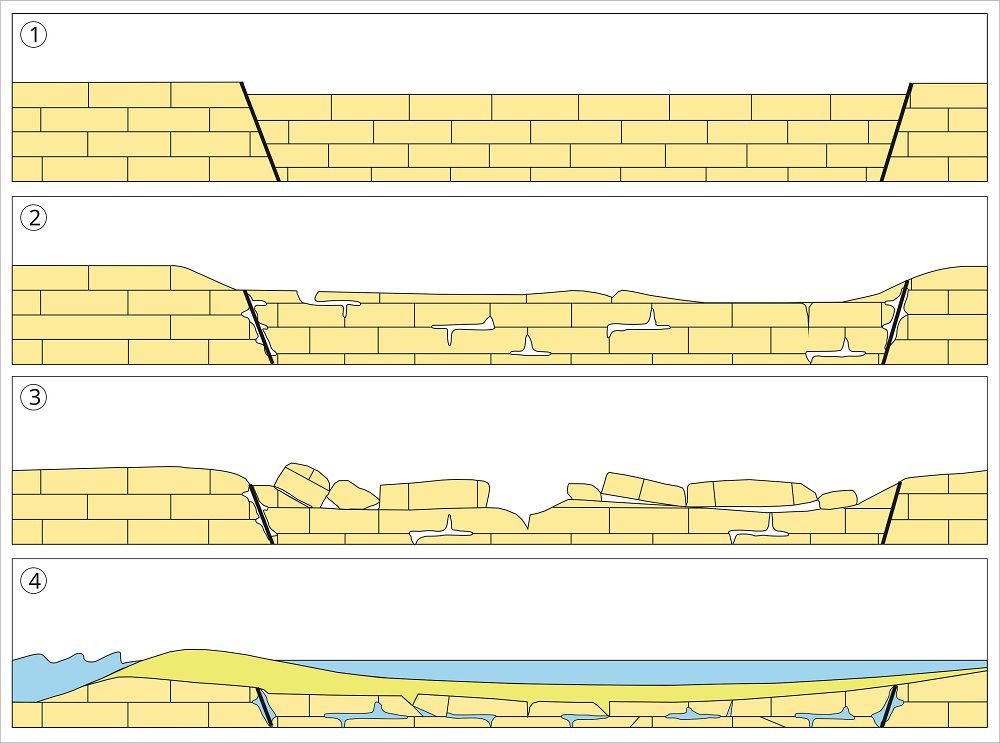
Hypothetical diagram of the formation of Estany des Peix.
In any case, once the land that is currently occupied by the lake collapsed, this had suffered both erosive and sedimentary processes.
During the Pleistocene period, and to date, the dunes and beaches deposited on this area have filled in the previously created basin. The oldest are fossilized and are formed by sand-sized clasts.</p><p><br></p></div>">sandstone, while the more recent dunes and beaches continue to be active and are not consolidated.
Both the fossilized sediments of the beaches and dunes and the current ones form the barrier that separates the lake from the sea except for a point in the north, where the marine currents have permitted a large quantity of fish to pass, hence its name [Fish Lake].
