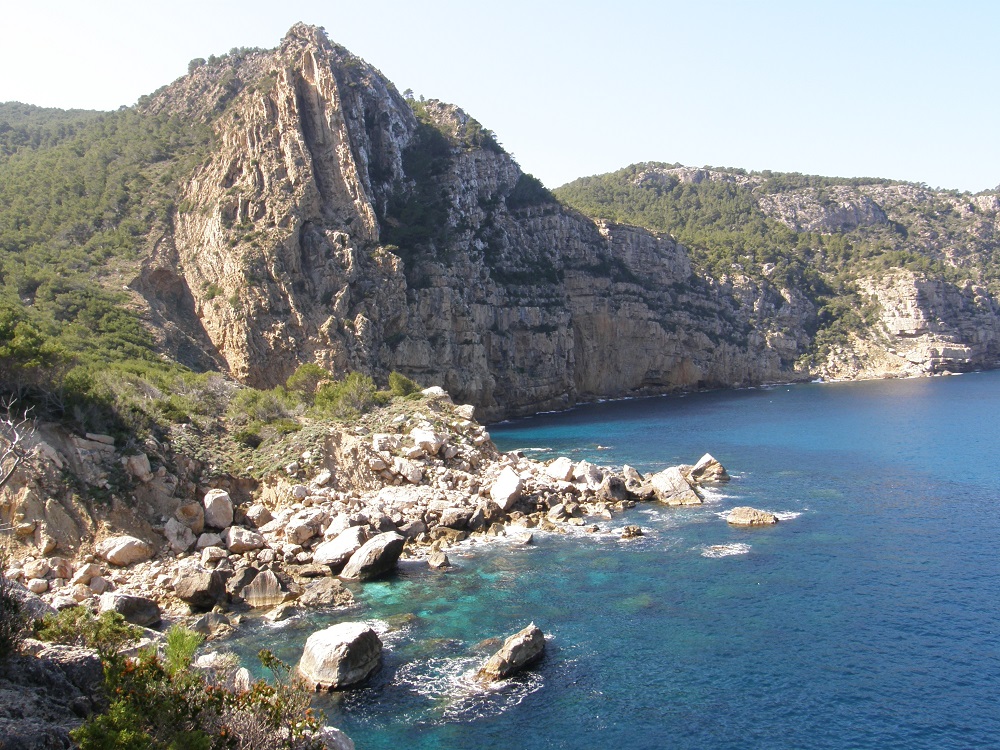
Synclinal fold of Cala d’Albarca.
The synclinal fold of Cala d’Albarca is a good example of the tectonic forces that raised the Balearic Islands during the Alpine Orogeny.
Folds are mainly caused by compressive tectonic forces which cause the earth’s crust to compress and thicken. Folds of many sizes and configurations can be found, from microscopic structures to very smooth undulations or even sharply-marked Z-shaped formations.
Isolated folds exist, but the most common phenomenon is a series of interlinked undulations.
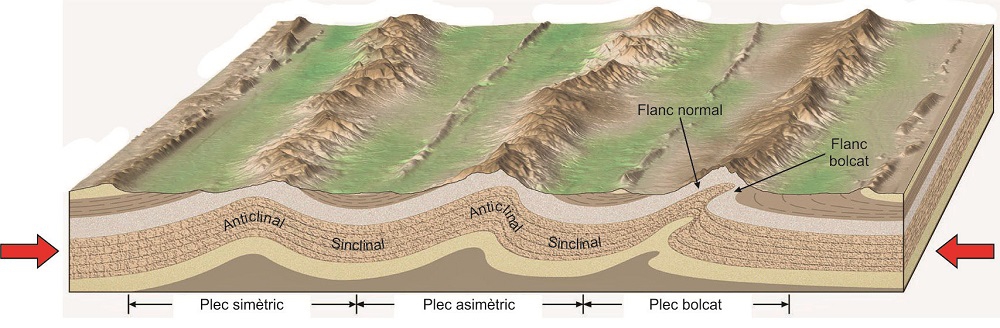
Modification of a diagram by Tarbuck E. J. & Lutgens F. K., 2005 representing a series of folds originated by the tectonic forces (represented by the red arrows).
The simplest classification, according to the form of the fold and the age of the materials contained in its nucleus, is the following:
• Fold of convex shape.</p></div>">Antiform: A-shaped fold
• Synform: U-shaped fold
• fold in which the oldest materials are situated in its core.</p><p><br></p></div>">Anticline: the nucleus of the fold contains the most ancient materials.
• Syncline: the nucleus of the fold contains the most modern materials.
Folds can also be symmetric (with both limbs equal) or asymmetric (when the limbs are different). At the same time, asymmetric folds can be overturned (when one of the limbs is inclined beyond the vertical) or recumbent (when the fold rests on one of the limbs).
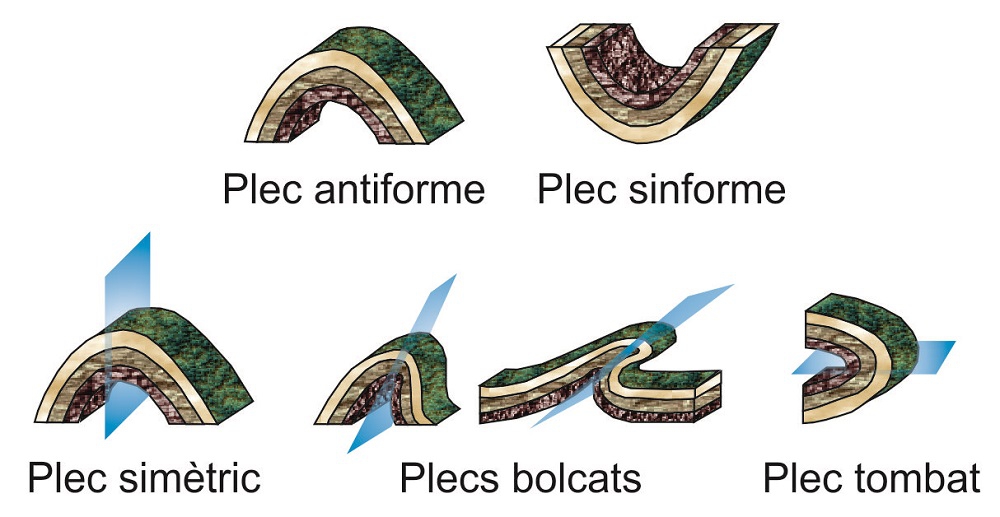
Classification of the basic types of folds according to their form and inclination.
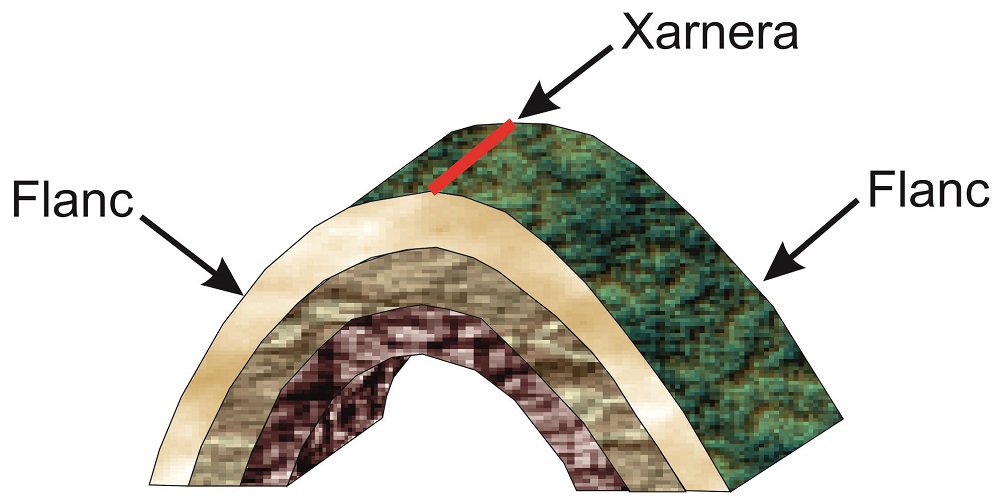
Diagram representing the different parts of a fold.
The fold of Cala d’Albarca is of the recumbent synform synclinal type. It is large in scale and consists of fossiliferous limestones of the Lower Cretaceous approximately 125 million years old.
Due to the force to which it was subjected, and because the deformed materials were not sufficiently ductile, inflection faults were formed in the zone of the hinge.
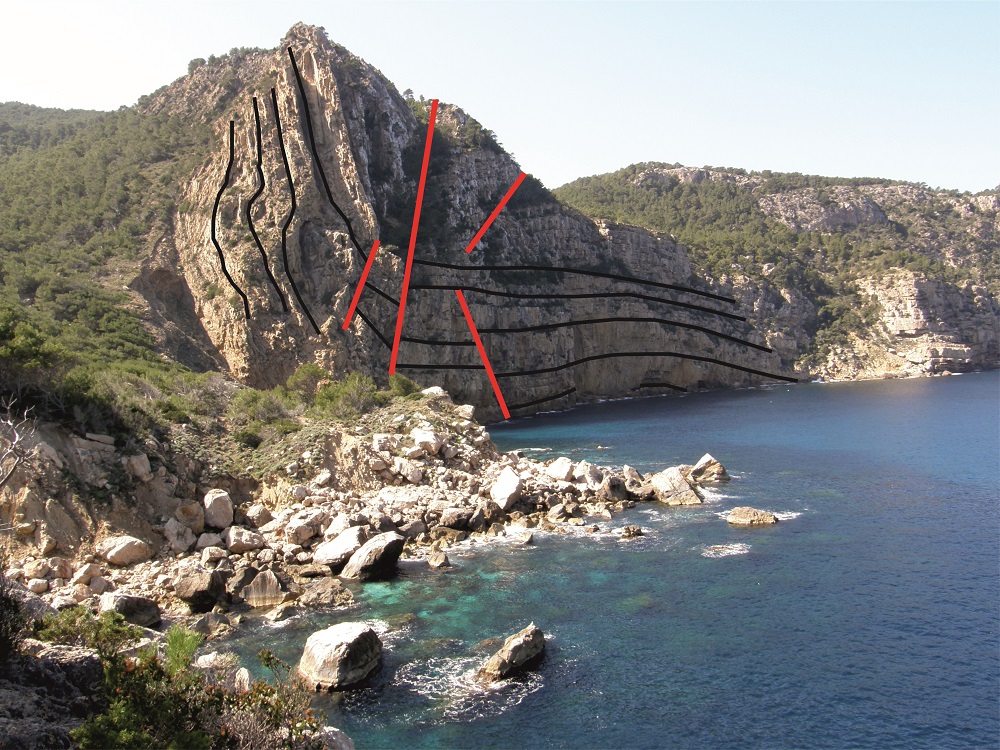
Synclinal fold of Albarca, marking some of the strata and the inflection faults.
