The Pla de Corona (the Corona plain) takes its name precisely from its extensive flat orography, surrounded by hills. Geologically speaking this structure receives the name of polje.
A polje is a large karstic depression of kilometric dimensions which presents an irregular perimeter and a flat bottom, normally covered with silts and clays originated from the erosion of its surrounding reliefs which, due to the oxidation of the containing iron, produce very reddish tonalities (terra rossa).
This depression is caused by the collapse of subterranean cavities, sometimes, helped by the action of faults.
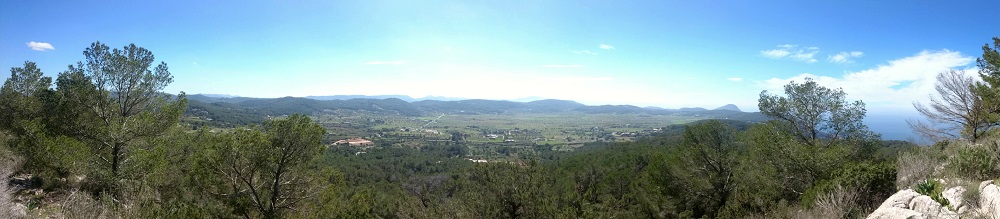
Polje of Santa Agnès de Corona.
In the case of the polje of Santa Agnès, this karstic depression was favoured by a series of faults which present NW-SE and NE-SW orientations, which caused the collapse of blocks. Later, the groundwater took advantage of the planes of weakness to gradually dissolve the rocky substrate and thus favour the karstic processes.
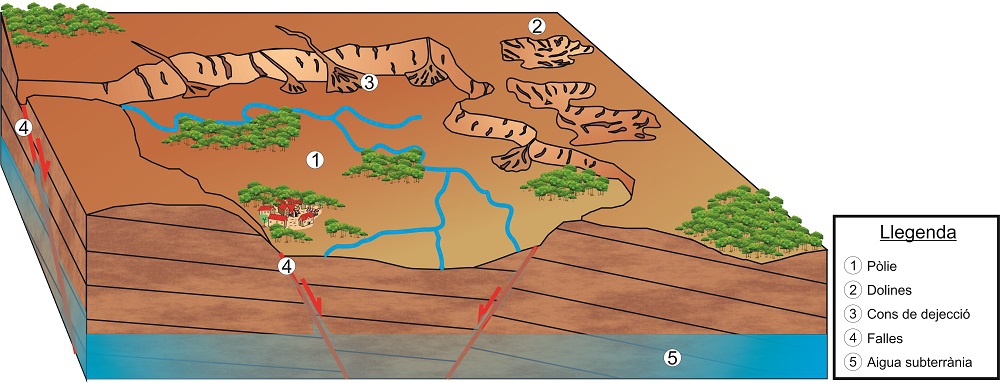
Diagram representing the formation of a polje.
This depressed geomorphology has meant that nowadays the Pla de Corona behaves like an endorheic basin, that is, like an accumulation plain of the waters and sediments proceeding from the torrents of the hills surrounding the polje which have no outlet to the sea. The surface waters are absorbed by the ponors.
The poljes of Santa Agnès de Corona and Sant Mateu d’Albarca are the two most important examples of this type of karstic modelling, although in aerial photographs it is possible to observe other smaller poljes and dolines.
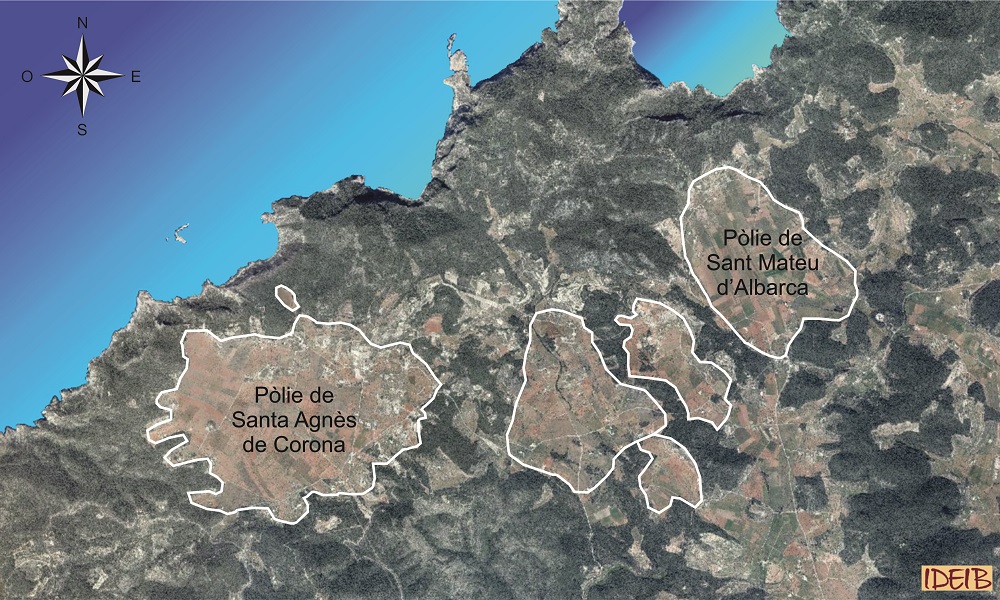
Aerial photograph delimiting the two principal poljes and the secondary dolines and poljes.
