Located close to Port des Canonge, the cape of Bec de s’Àguila is undoubtedly one of the most important geological sites of Mallorca. It is an extensive sedimentary sequence from the Lower to Middle Miocene (with 23-16 Ma, approximately) which presents a very special sedimentary structure: a progressive stratigraphic series or successions.</p><p><br></p></div>">discordance.
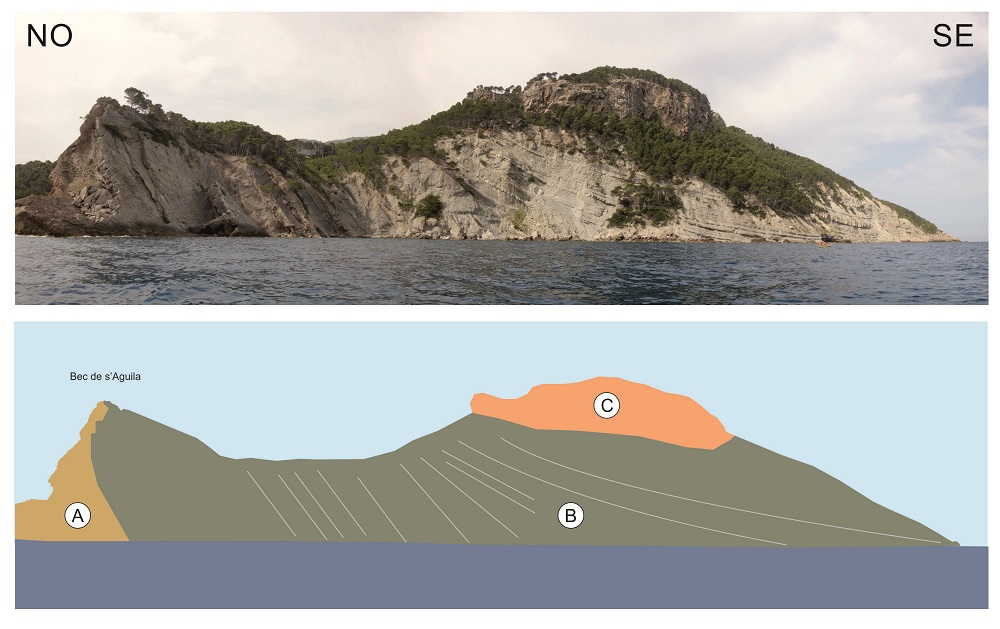
View of Bec de s’Àguila from the sea. A) Sant Elm Formation, B) Banyalbufar Formacion, C) Lower Jurassic.
From the sea, as showed above, we can observe three types of materials:
- Almost vertical rocky layers which constitute the tectonic, eustatic or antropical processes</span></p></div>">outcrop of the Bec de s’Àguila, formed by rocks with a grainy texture and ochre and yellowish colours.
- Clay materials of light grey colour, with thin intercalations of tabular-shaped whitish rocky layers, which form the rest of the coastline.
- A cavernous rocky promontory located in the upper part of the coastal cliff, formed by rocks of orange-grey colour.
The tectonic, eustatic or antropical processes</span></p></div>">outcrop of the Bec de s’Àguila corresponds to the Sant Elm Formation of the Lower Miocene, which represents shallow seawater.
It is mainly composed of rocks formed by cemented sands and is remarkable for presenting accumulations of remains of thousands of oysters in its base.
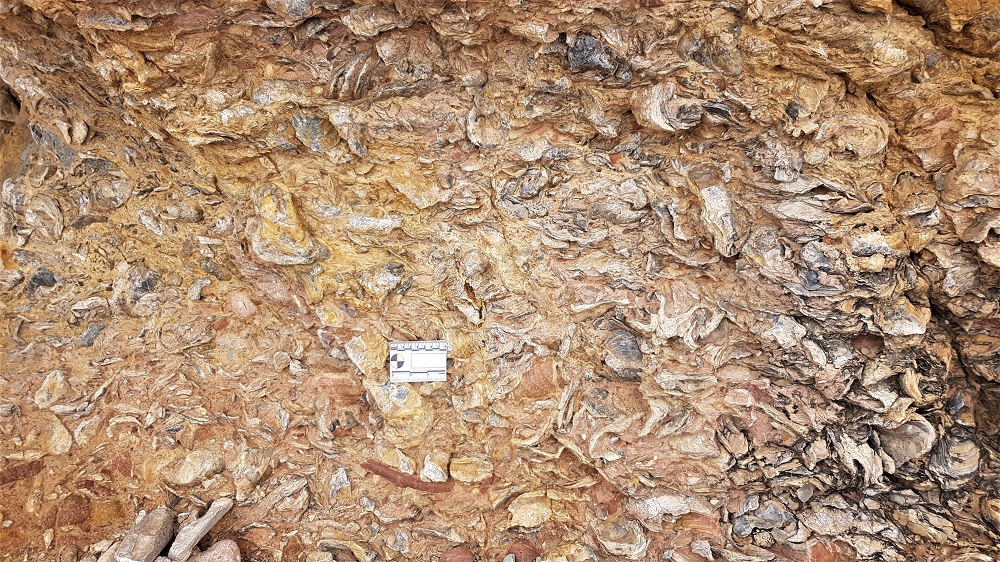
Accumulation of oysters in the Bec de s’Àguila.
In contrast, the rest of the coastal cliffs are formed by soft grey-coloured rocks called marls, which present intercalations of hard, whitish, grainy-textured tabular layers which correspond to sandstones too. It is a type of deposit formed by successive rockfalls of materials in submarine slopes called turbidites, usually caused by tectonic activity.
The deposition of the turbidites occurred in a subsidence basin. Although the strata deposited horizontally, the progressive sinking of the supporting substrate gradually changed their angle (phases 1 to 5 in the diagram).
As the oldest levels have been exposed to deformation longer than the later ones, the result is a stratigraphic series whose lower levels are more inclined than the higher ones. This particular type of stratigraphic sequence is called progressive stratigraphic series or successions.</p><p><br></p></div>">discordance.
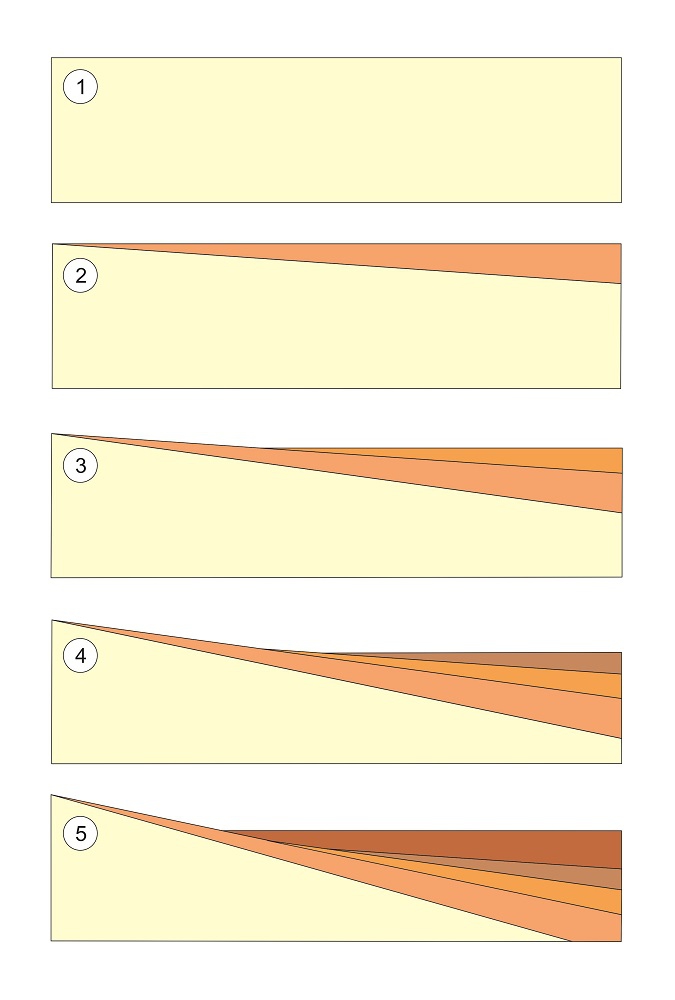
Genetic diagram of a progressive discordance.
The sedimentation of the turbidites took place during the Lower-Middle Miocene and the stratigraphic complex is named Banyalbufar Formation.
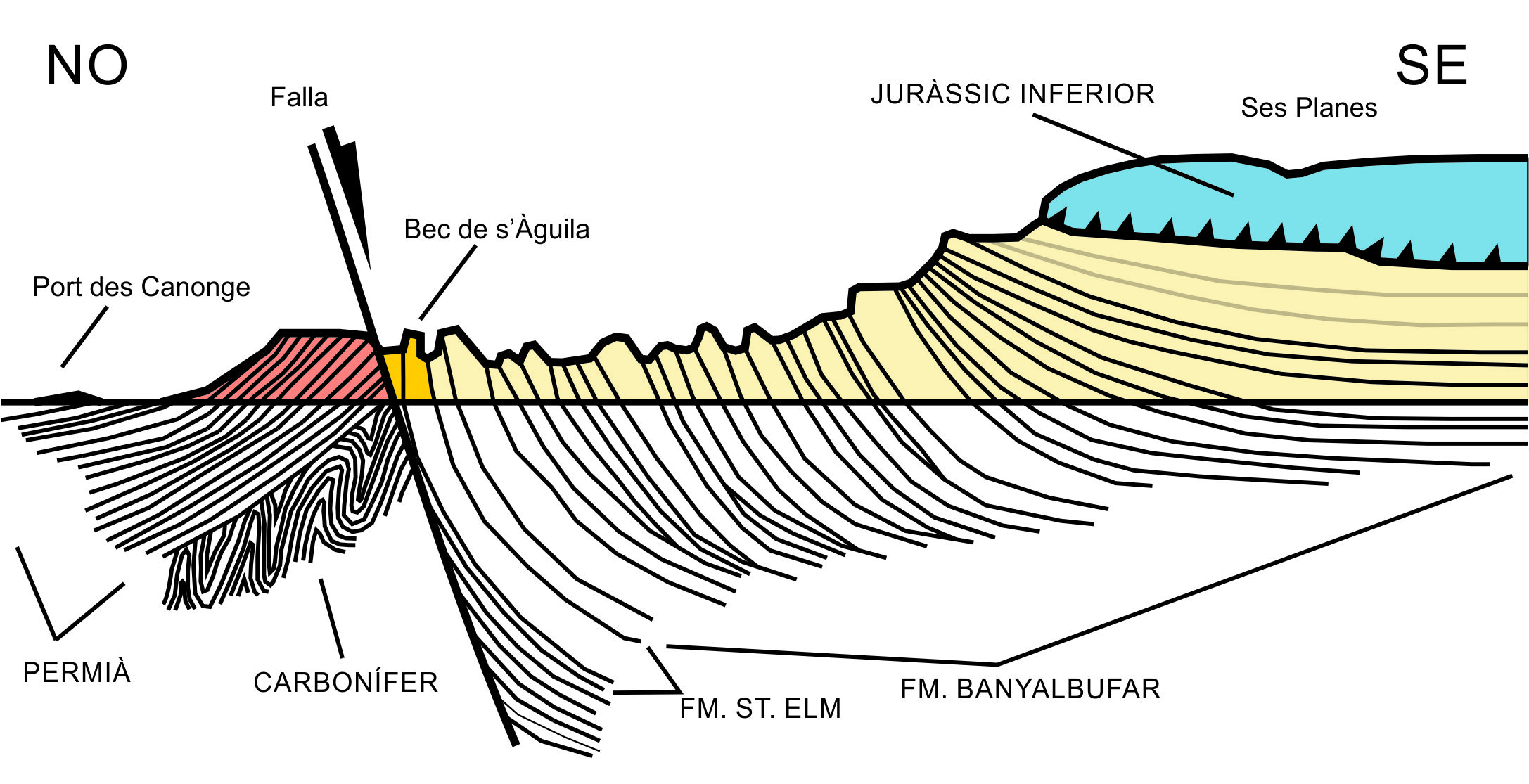
Geological profile of the Bec de s’Aguila area. Modified from Rodríguez-Perea (1984).
As a consequence of the Alpine Orogeny, the sediments of the Banyalbufar Formation have been thrusted by older rocks from the Lower Jurassic: limestones, dolomites and breccias, whose alteration due to phenomena of dissolution and corrasion (erosion by rock fragments) has given the rocks a cavernous appearance.
Due to the different resistant behaviour of the coastal materials (sandstones and marls), marine erosion has sculpted the present-day coastline: while the harder sandstones have given rise to outcrops (Bec de s’Àguila), the marls have generated a straight coastline. This type of process is named differential erosion.
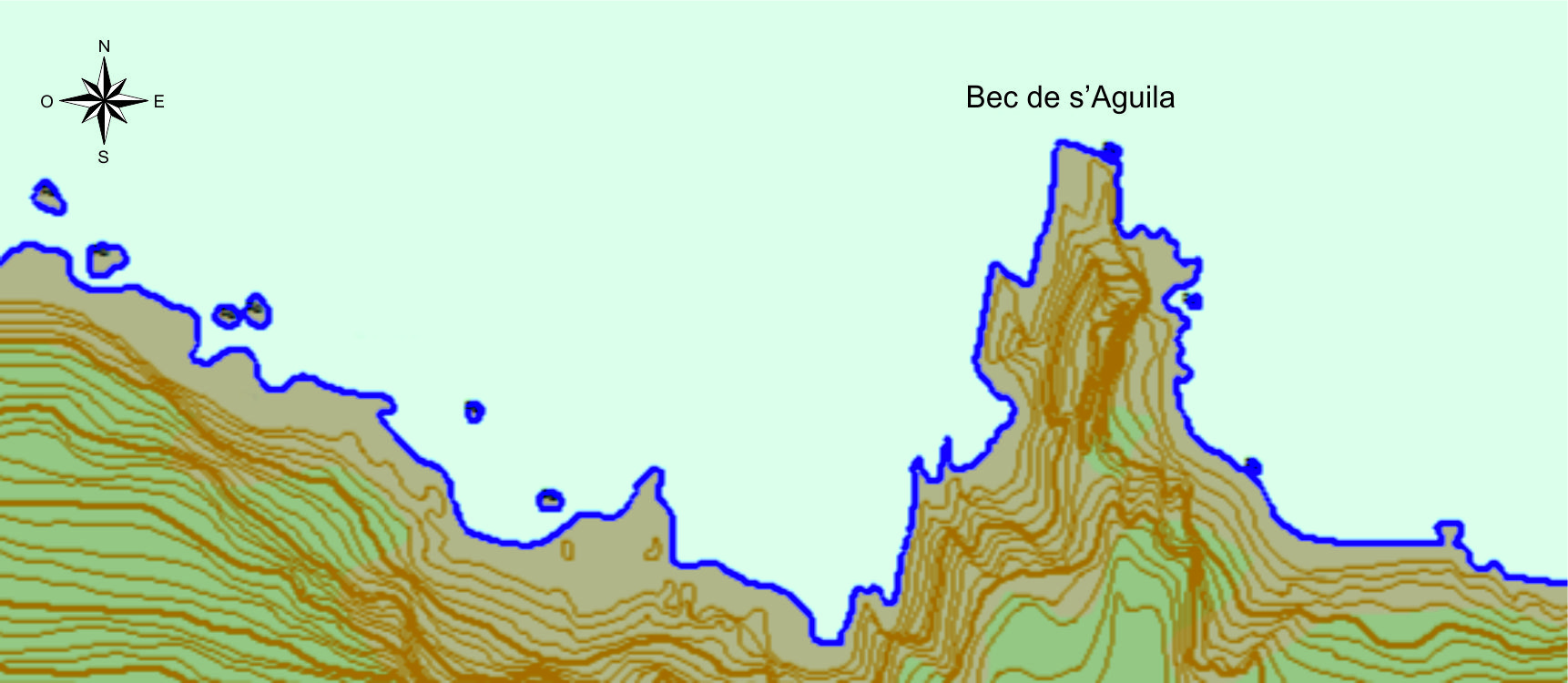
Surroundings of the coast in the Bec de s’Àguila area.
