The element that probably gives the site its greatest point of interest (although there are others), is a 1.5-metre thick layer that demarcates the limit between the two upper geological units known in the Migjorn region of Menorca. In the south of the island, three units have been identified; the lowest, and least important in terms of extent, is a unit made up essentially of conglomerates sedimented during the lower and/or middle Miocene (around 15 million years ago). The middle was deposited in the lower Tortonian (now in the upper Miocene, some 11 million years ago), where we see different types of rocks, primarily marès. The upper unit is attributed to the upper Tortonian – Messinian (also in the upper Miocene, but sedimented around 7 million years ago) and is made up of both limestones (living rock) and marès.
Therefore, the Site of Geological Interest can be divided into two main units (although the upper clearly dominates) and the transition between them has been identified. This passage from one unit to another is recorded in the rocks at the site by a layer crammed with small fossils known as ‘Heterostegina’. These are fossils of benthic foraminifera (which inhabited marine sediments) and were present in the sea around 34 million years ago. Foraminifera are organisms that are characterised by a segregated calcium carbonate shell in which the animal lives that has one or more interconnected chambers and that fossilises relatively easily, which is why it is considered the most important group of marine microfossils as so many of them are found in the sediments.
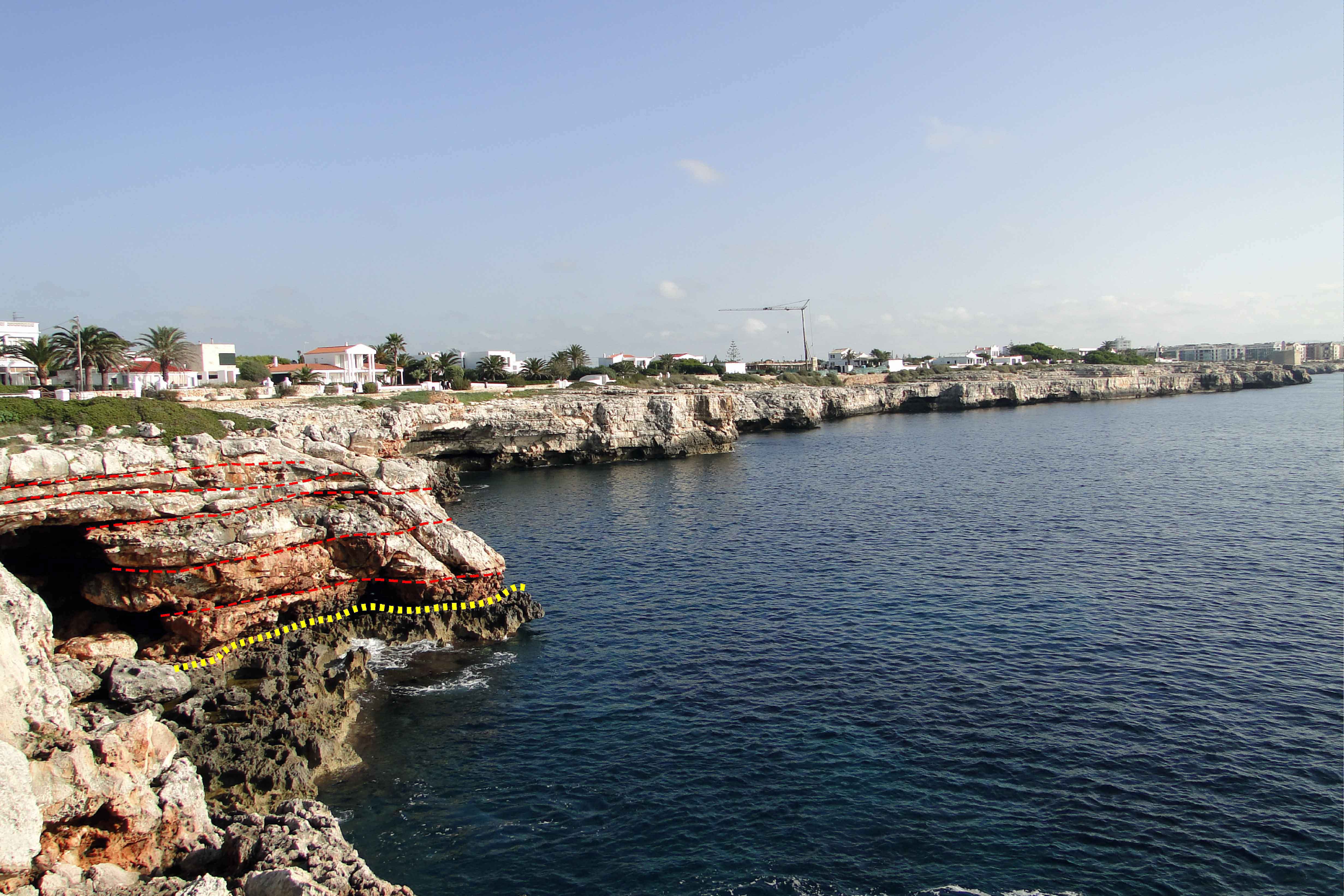
General view of the site from the Punta de na Mari headland and contact (in yellow) between the two main units (middle and upper) of the Menorcan Miocene in the foreground. The red shows the main levels of strata identified at this point.
The layer of Heterostegina has been found at other sites throughout Menorca, although we should mention that in the area around S’Algar this layer, which marks the limit between units, has been substituted by a phosphate crust. The presence of these layers marks a change in the type of sedimentation in the Migjorn region of Menorca, which implies the start of the development of a sedimentary atmosphere dominated by reefs. This change is associated with an ecological change that, possibly linked to a rise in temperature, may mean a decrease in nutrients, an essential factor that enabled the development of the reef complex as it needed these to grow an atmosphere of clear and sunny water.
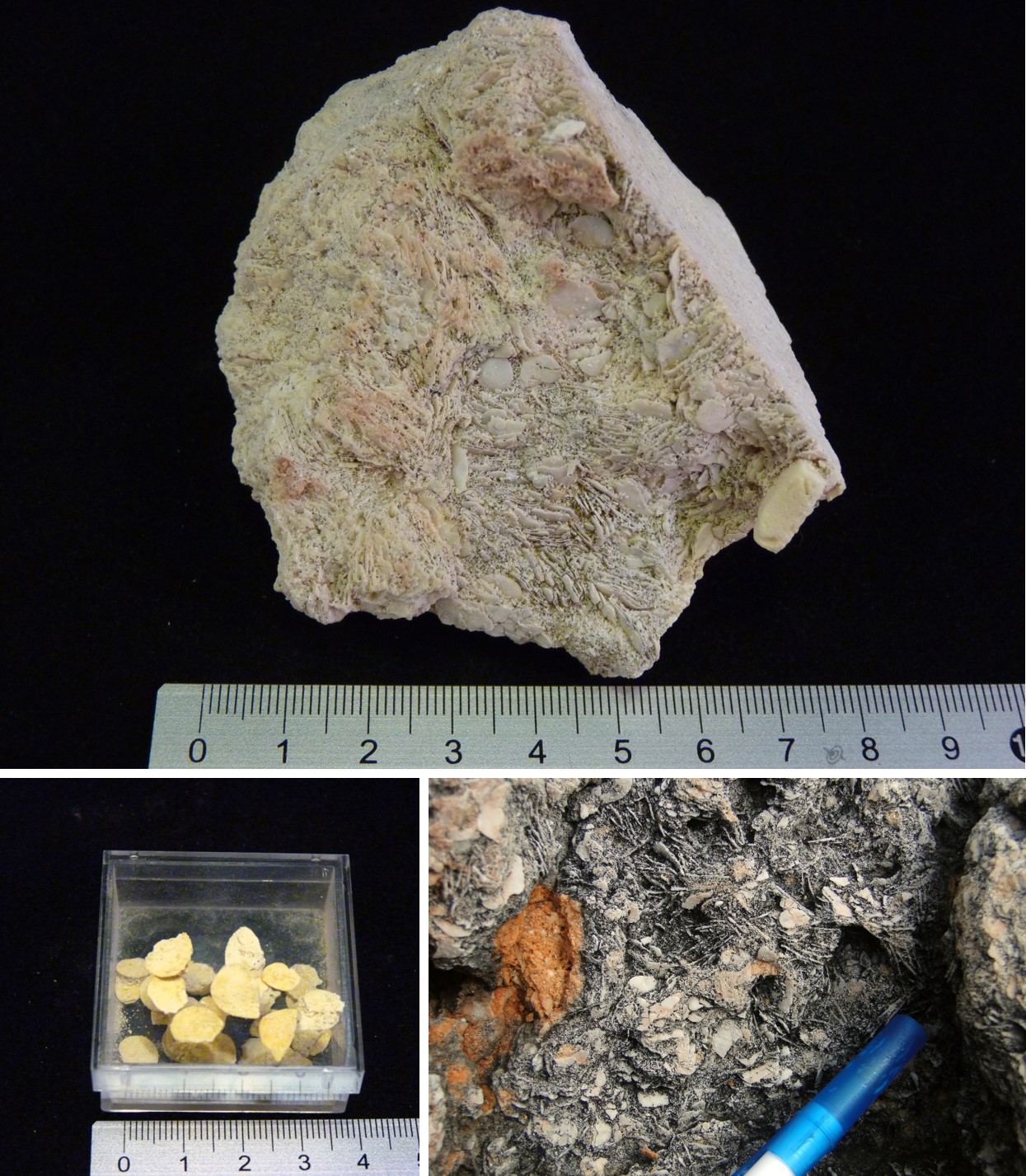
Rock formed essentially of fragments of Heterostegina (top) and fossils of this foraminifera (bottom left) (both of which are samples gathered at the Site of Geological Interest and deposited at the Menorca Geology Centre) and appearance of the rock in the field
This layer is accompanied by abundant, often broken fossils of Clypeaster sp., sea urchins from the irregular group, and whose shell, unlike the sea urchins we often find along our coastline, can be divided into two symmetrical parts. They are large, with a bell-shaped, somewhat raised back usually with thick margins. Fossils of clams (pectinids) and the teeth of an ancestor fish to today’s sea bream have also been identified.
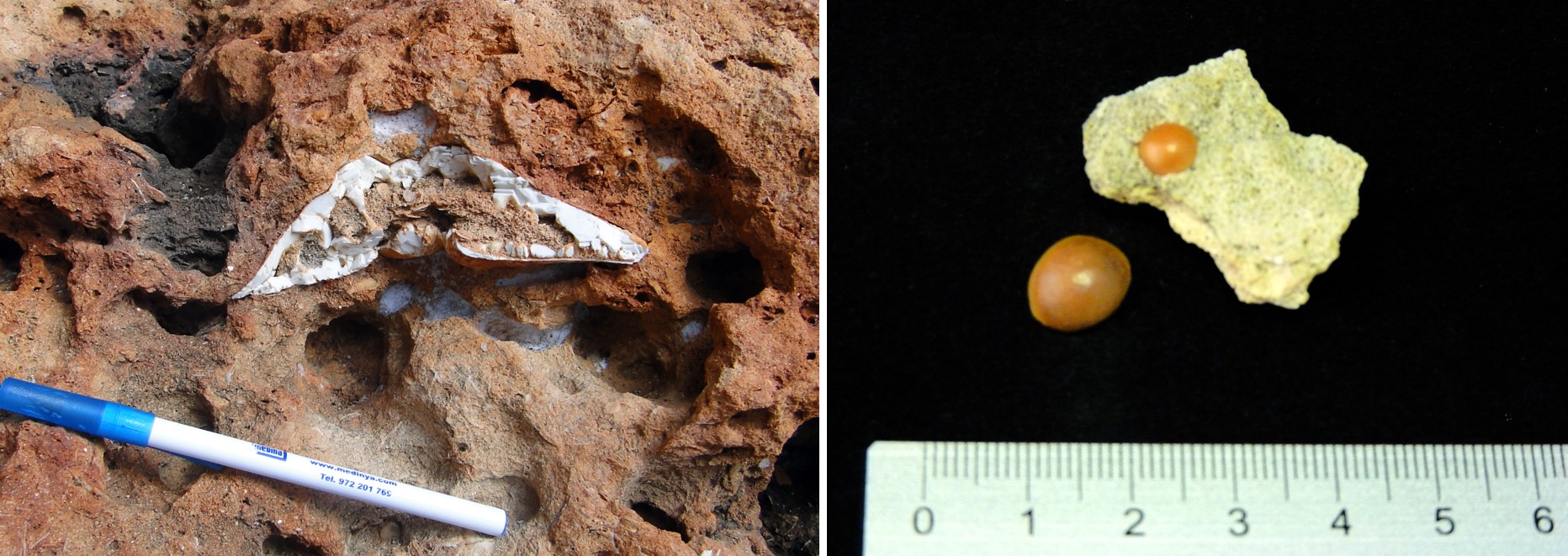
Close-up of a fossil of a Clypeaster sp. at the Na Mari headland and the fossilised teeth of some fish related to sea bream (Menorca Geology Centre).
As you can see from this photograph, the rocks often show red colouring linked to the erosion of the contacts between both units. The colour is provided by a red or orangeish clay called ‘terra rossa’ or residual clay. This clay is the residual material that is left when underground waters dissolve the Sedimentary rock whose main component is calcium carbonate (CaCO3). Its origin can be chemical, organic or detritic.</p><p><br></p></div>">limestone that makes up the area (karstification).
The rocks that comprise the upper levels (and which are therefore sedimented later) are formed primarily from fragments of red algae fossils (rhodoliths) that alternate with fine sediments containing fossils of pectinids, bryozoa and broken sea urchins. At some levels, the red algae show branched and tree-like morphologies. These rocks have been interpreted as sediments deposited in the open sea in the lower part of the photic zone, and therefore sedimented as far as the depth to which sunlight penetrates.
Finally, we should point out that the site has produced paleontology finds of land vertebrates.
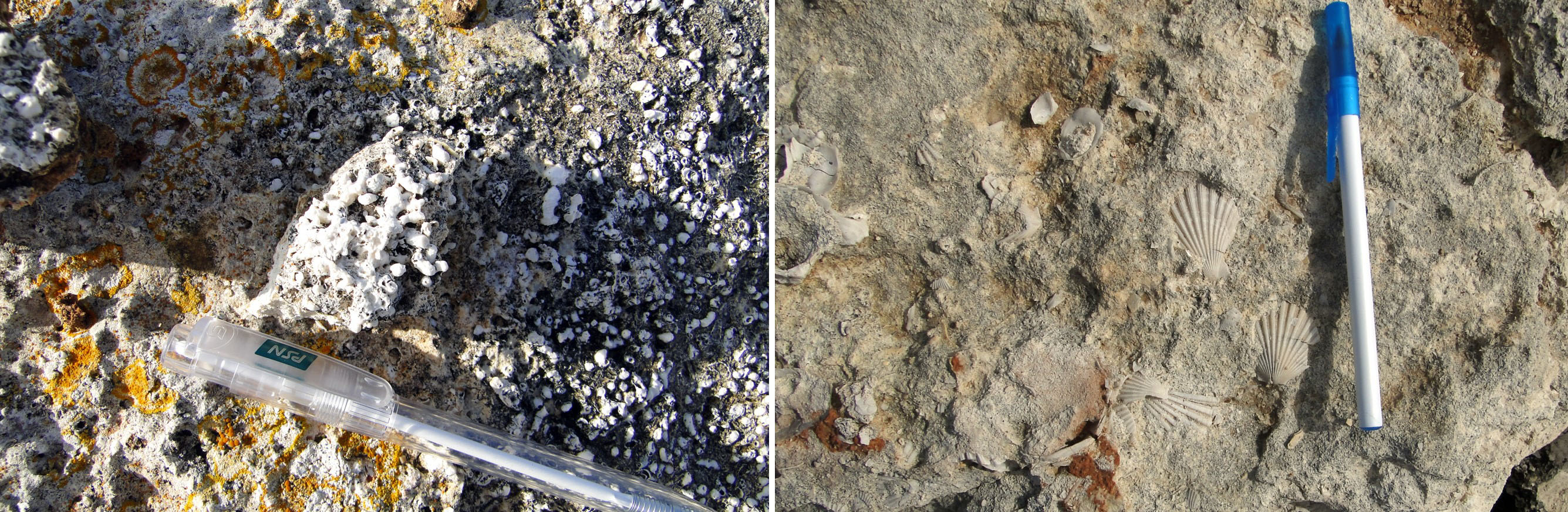
Close-up of fossils of branched red algae with a tree-like morphology in a rock comprising primarily fragments of these algae and; fossils of pectinids.
