Despite its apparent homogeneous appearance, the Migjorn region of Menorca contains three different geological units. The oldest is made up primarily of conglomerates, was sedimented around 15 million years ago and can be easily identified at Cala Morell cove. The middle was deposited later, some 11 million years ago, and dominates most of this region of the island. It is made up primarily of marès, although we do see other rocks, and it was sedimented in a flat and inclined area towards the sea depths, at different depths, where numerous and varied life forms proliferated. At the top, the most recent unit was deposited around 7 million years ago in a reef environment. It is made up of marès and limestones (hard rock) with coral and levels of Sedimentary rock whose main component is calcium carbonate (CaCO3). Its origin can be chemical, organic or detritic.</p><p><br></p></div>">limestone algae (rhodoliths), that, when calcium carbonate enters their tissue, can fossilise.
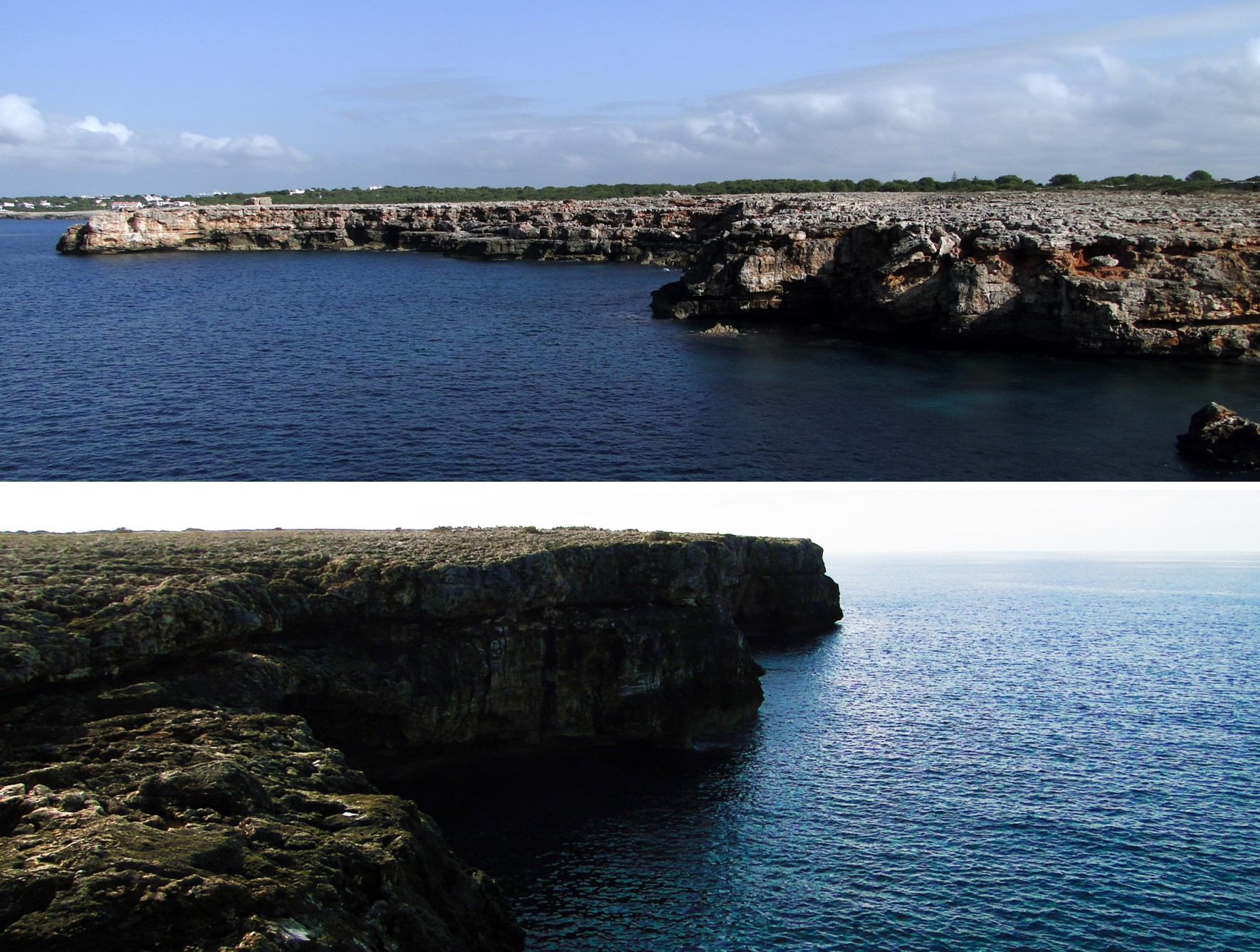
General views of the Site of Geological Interest at Cala en Bastó cove (top) and Cap Negre (bottom).
The Site of Geological Interest is associated with different outcrops from the last upper unit sedimented after the development of the reefs. Reefs are marine ecosystems of calm tropical, and therefore warm, waters made up of a community of living marine beings such as corals and Sedimentary rock whose main component is calcium carbonate (CaCO3). Its origin can be chemical, organic or detritic.</p><p><br></p></div>">limestone algae. These organisms with a calcareous skeleton grow on top of other dead ones, creating a very resistant Sedimentary rock whose main component is calcium carbonate (CaCO3). Its origin can be chemical, organic or detritic.</p><p><br></p></div>">limestone rock, which is known in Menorca as living rock (we should point out that living rock can also be formed in other ways). The layout created by the reefs, with organisms growing on top of older ones, ends up with a morphology of uneven rocky mounds, often without a well-defined sedimentary structure.
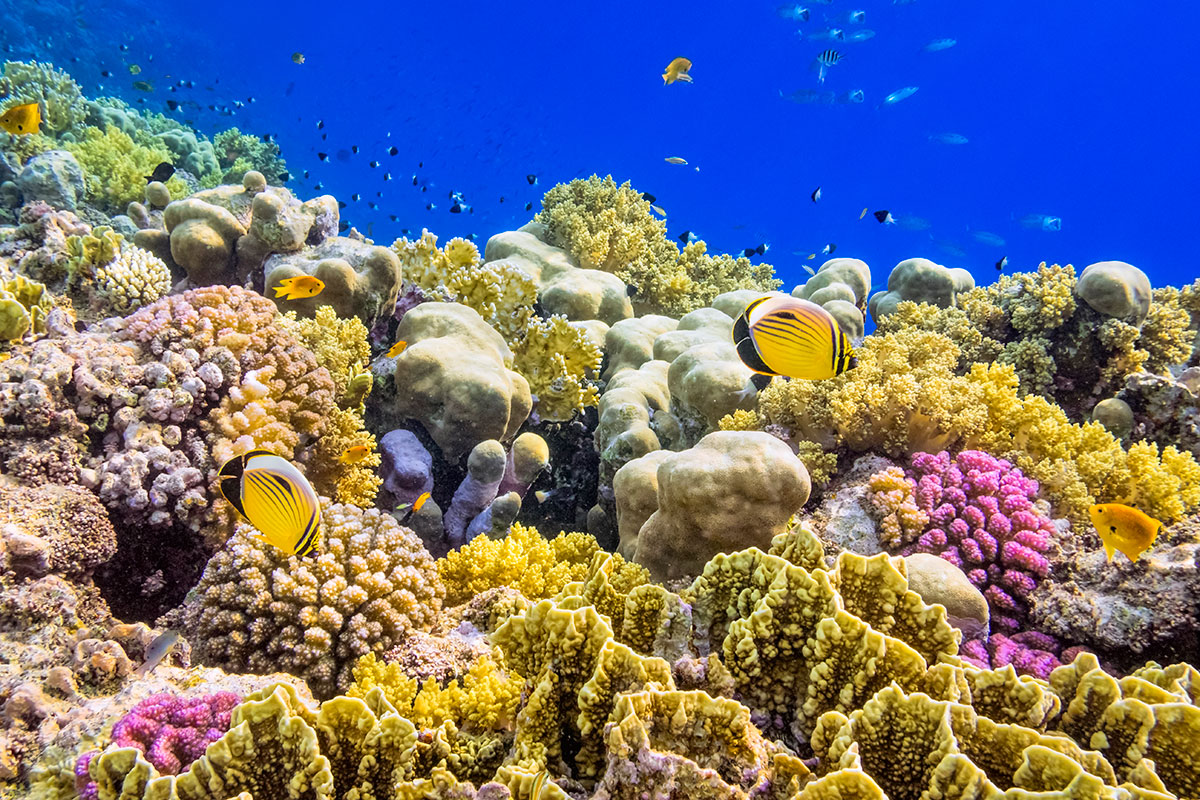
In reefs, each individual is joined to the constructions of its neighbours. Through their growth, they segregate calcium carbonate, which acts as cement to anchor them to the constructions of underlying dead individuals. This way, the reef extends vertically and horizontally. Most of the reefs are made up of skeletons of corals, organisms that live in colonies of numerous individuals. Despite this, other living beings are identified, such as limestone algae and clams (www.newscientist.com).
Consequently, the reefs build a solid construction that stands proud of the surrounding marine formations, and although it is rigid enough to resist the waves, the continuous action of the waves, together with the erosive activity of living organisms, can break off fragments, frequently the size of sand, which are deposited extensively at its base. This way, it should be considered that the reef structure is not limited solely to a mound crammed with calcareous skeleton organisms, but that the sediments derived from its destruction, which are deposited around it, making up its flanks or taluses, are also part of the structure.
Different geological formations, associated with reef construction, have been identified between Cala Blanca cove and Cap d’Artrutx headland. These vary depending on the presence of certain fossils, and the appearance of the sediment that makes up the rock, which changes depending on where it is deposited.
The area south of Cala Blanca up to Cala en Bastó is dominated by marès, which is associated with reef taluses, in other words, with the sediment that broke off from the heart of the reef due to the effect of erosion, together with the new ones that formed at these points. It should be pointed out that other life forms also proliferate in this sediment, which is deposited at the bottom of the reefs. Consequently, at the Punta d’Aigua Dolça headland there is an abundance of Sedimentary rock whose main component is calcium carbonate (CaCO3). Its origin can be chemical, organic or detritic.</p><p><br></p></div>">limestone algae (rhodoliths) and in the levels immediately above these rocks we find clams of between 5 and 10 cm. At Cala en Bastó, we have also found oysters, bryozoa, and other organisms. Here, above the sandy-looking rock, you can see another more compact Sedimentary rock whose main component is calcium carbonate (CaCO3). Its origin can be chemical, organic or detritic.</p><p><br></p></div>">limestone rock, containing coral from the reef itself. On the route from this cove to Cap d’Artrutx, you will see materials from the heart of the reef (with abundant coral), together with levels of its own erosion.
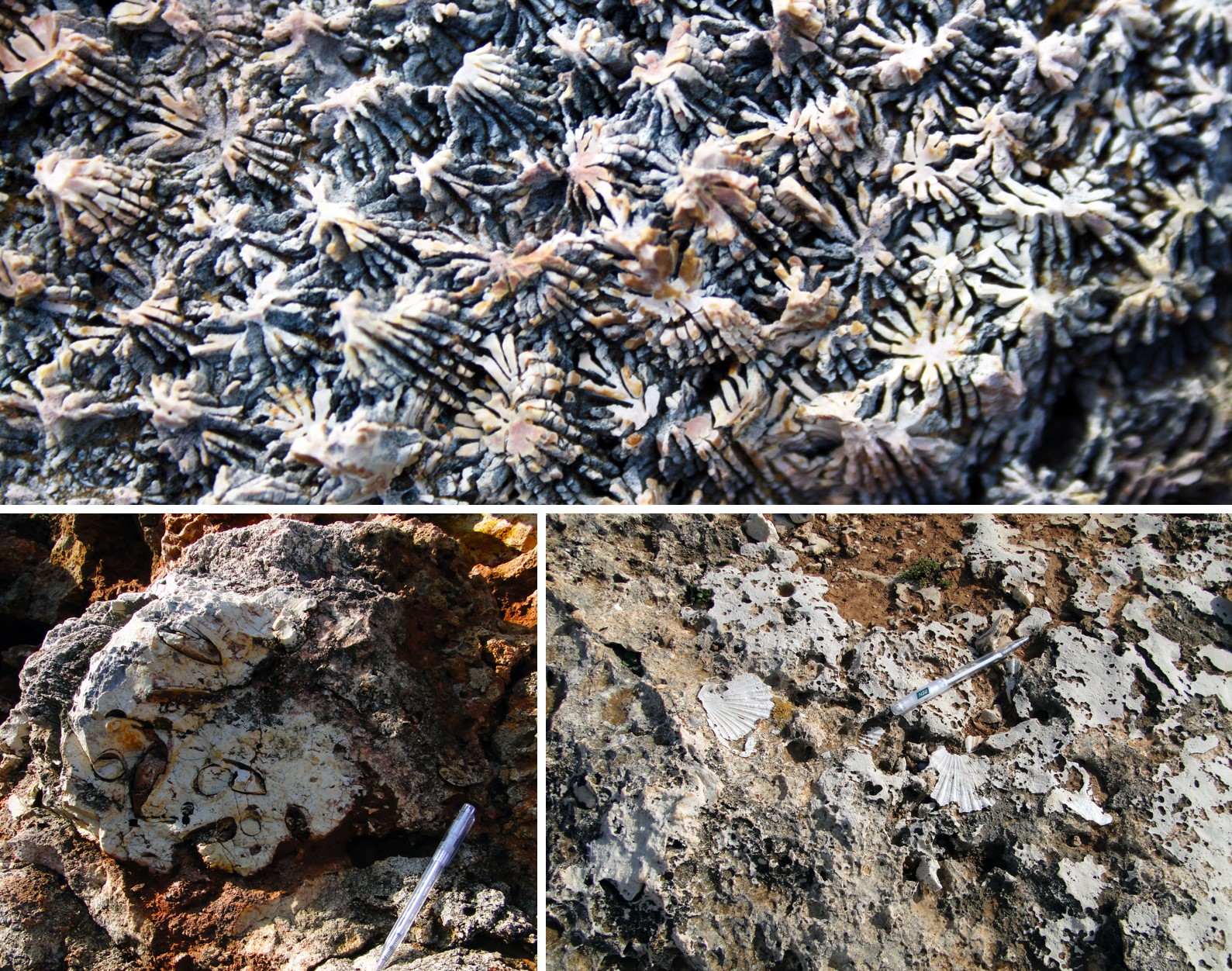
Fossils of coral colonies (top) and fossilised clams (bottom). To the right, you can see lithophaga (date mussels), that can perforate the rock and in this case they have perforated fossil coral. On the left, these are pectinids, characterised by a lower valve, bigger than the upper one, which is almost flat, and the undulations that fan out from the vertex of each valve, creating a fan-shaped image.
Red sediment is frequently detected in the area made from the residual product of the dissolving of Sedimentary rock whose main component is calcium carbonate (CaCO3). Its origin can be chemical, organic or detritic.</p><p><br></p></div>">limestone rocks. This sediment has produced fossils of vertebrates and especially invertebrates, such as land snails (Testacella sp, Oxychilus lentiformis (Kobelt, 1882), Rumina decollata (Linnaeus, 1758), Chondrula (Mastus) gymnesica (Quintana, 2006), Trochoidea frater (Dohrn and Heynemann, 1862), Testacella (Testacella) scutulum G.B (Sowerby, 1820) and Xerocrassa nyeli (Mittre, 1842).
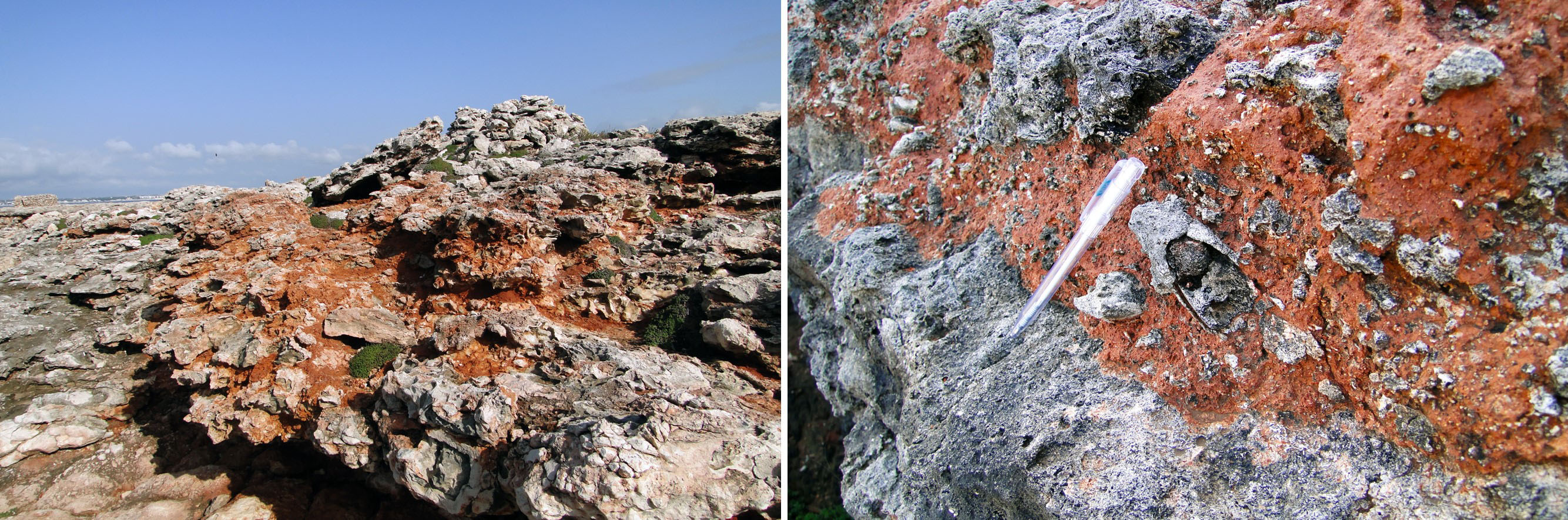
Red sediments of continental origin where fossils have been identified at the Na Freda headland at Cala en Bastó cove.
